









































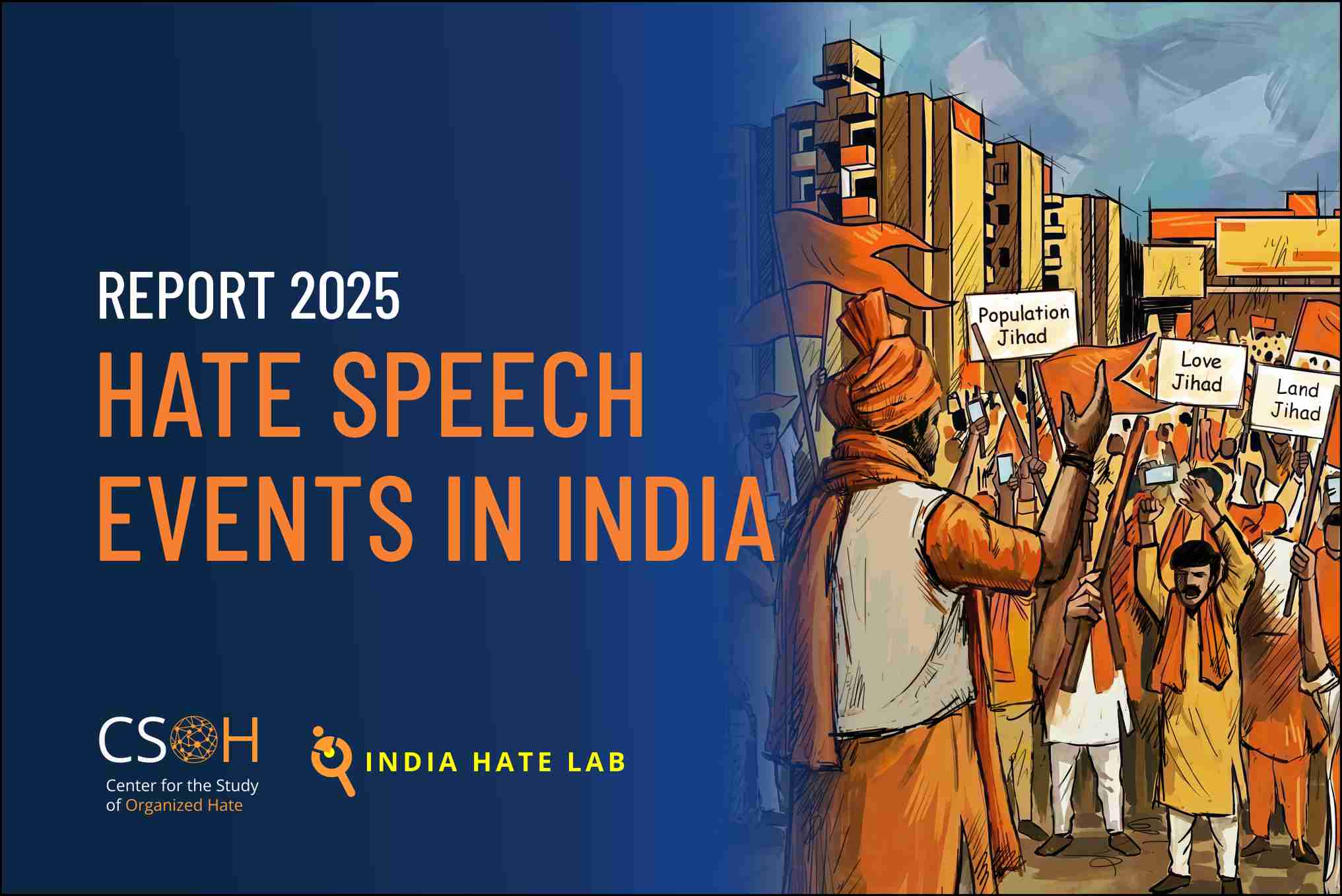
India Hate Lab has reported a sharp rise in hate speech against religious minorities in India, documenting 1,318 in person hate speech events across the country in 2025. The findings show a 13 percent increase compared to 2024 and an alarming 97 percent rise since 2023, pointing to what the group describes as a new and dangerous normalisation of public hate.
According to the report, Muslims remained the most targeted community. Hate speech against Muslims rose by nearly 12 percent compared to the previous year. Anti Christian hate increased even faster, jumping by almost 41 percent in 2025. Together, speeches targeting Muslims and Christians dominated the hate landscape throughout the year.
The highest number of hate speech events were recorded in Uttar Pradesh, Maharashtra, Madhya Pradesh, Uttarakhand and Delhi. These five regions alone accounted for nearly two thirds of all incidents documented nationwide. India Hate Lab noted that almost 88 percent of all hate speech events took place in states governed by the BJP, either directly or through coalition governments, marking a significant rise from 2024.
“This year reflects a deeply troubling shift where hate speech is no longer occasional or campaign driven but has become a constant feature of political and social life,” the report said. It added that inflammatory rhetoric has moved from the margins to the centre of public discourse.
The report said 2025 marked a disturbing phase in which public expression of hate against minorities appeared increasingly permissible. Hate speech events were recorded at political rallies, religious processions, protest marches and nationalist gatherings across 21 states, one Union Territory and the National Capital Territory of Delhi. On average, four such events took place every day.
India Hate Lab linked the sustained rise in hate speech to the broader Hindu nationalist project led by the ruling BJP and its allied organisations. “What we are seeing is a top down sanction for communal hostility, where narratives promoted by national leaders are echoed and amplified at the grassroots level,” the report stated. It said state elections, including those in Delhi and Bihar, played a key role in intensifying this rhetoric.
The content of the speeches, the report said, repeatedly portrayed Muslims and Christians as outsiders, anti national elements or demographic threats. Conspiracy theories such as love jihad, population jihad, halal jihad and spit jihad were frequently used to fuel fear and suspicion. Nearly half of all recorded speeches in 2025 referred to such conspiracies.
“This kind of language is not harmless talk,” the report warned. “It prepares the ground for policy decisions, legal measures and social actions that target minority communities.”
India Hate Lab also flagged the growing severity of rhetoric. Nearly one fourth of the speeches contained direct calls for violence, while many others urged social and economic boycotts or the destruction of places of worship. Mosques and churches were repeatedly targeted, with sites such as the Gyanvapi Mosque and Shahi Idgah Mosque mentioned frequently.
The report named organisations like the Vishwa Hindu Parishad and Bajrang Dal as the most frequent organisers of hate speech events, along with several other Hindu nationalist groups. It also noted the role of religious figures, including monks and priests, who were involved in a rising number of incidents, lending religious legitimacy to anti minority narratives.
Social media platforms played a central role in spreading this hate. Videos from 1,278 of the 1,318 events were first shared or live streamed online. Facebook emerged as the main platform, followed by YouTube, Instagram and X. “Social media has become the backbone of hate mobilisation,” the report said, adding that platforms have failed to enforce their own policies against hate speech.
India Hate Lab warned that the continued spread of such rhetoric has made Muslims and Christians increasingly vulnerable to harassment, discrimination and violence. “Hate speech has been absorbed into the machinery of politics,” the report said. “It is now being used to polarise society, consolidate majoritarian support and justify exclusionary policies.”