Amjad Siwan
The protest demanding the restoration of the Aligarh Muslim University Students’ Union has entered its 17th day, with the movement showing no signs of slowing down. What began as a demand for student representation has now developed into a wider campus mobilisation, with students from almost all major departments joining the boycott of classes and turning up at the protest site at Duck Point.
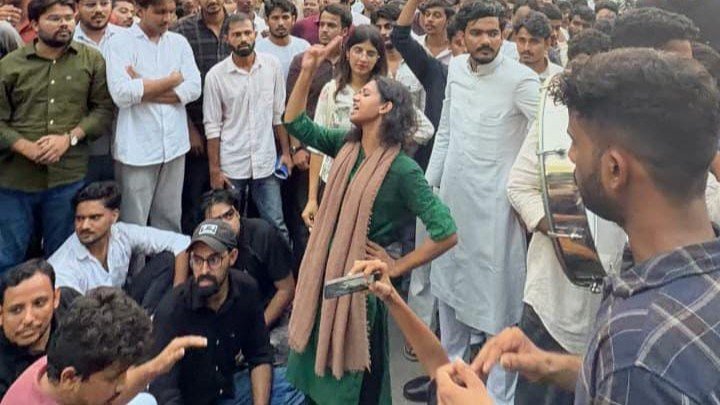
By the time of reporting, approximately 2,000 students were gathered at Duck Point, according to an on-ground estimate by protesters. The gathering included students from different departments and residential halls, while slogans demanding student representation and accountability from the university administration continued throughout the day.
At the centre of the movement are now two major demands: the holding of AMUSU elections and the resignation of the AMU Proctor; third is the revocation of the illegal suspension.
Election Demand: Students Want AMUSU Restored
The first and central demand of the protesters is the restoration of the Aligarh Muslim University Students’ Union and the immediate initiation of the election process.
AMUSU elections have not been held since 2018-19. Students are now demanding the appointment of a Chief Election Officer and the announcement of a definite election date.
Protesting students are also referring to the recommendations of the Lyngdoh Committee and directions concerning student union elections while arguing that students should have an elected body representing their interests.
For the protesters, the issue is not simply about conducting an election. They argue that the prolonged absence of an elected students’ union has created a gap in formal student representation and has left students without an elected platform through which they can collectively raise academic, administrative and welfare-related concerns.
Why Students Are Demanding the Proctor’s Resignation
The second major demand emerging from the movement is the resignation of the AMU Proctor.
Students supporting the demand have cited several incidents and alleged instances of what they describe as high-handedness and excessive use of disciplinary authority.
Women students have particularly raised allegations concerning an earlier incident involving students of Abdullah Hall. According to protesting students, the manner in which female students were allegedly treated by the Proctorial administration was inappropriate and disrespectful. The issue subsequently received attention in national media, and students have maintained that no satisfactory action followed from their perspective.

Male students have separately raised allegations concerning the treatment of Yasir Fahad when he went to sit at the protest site. Students allege that he was not treated appropriately and that there was a physical confrontation involving members of the Proctorial team.
The protesters have also questioned several suspensions and disciplinary actions against students, describing some of them as unjustified or arbitrary. Some students further allege that the Proctorial office has used phone calls, summons and official communications in a manner that creates pressure or intimidation, including in cases involving women students.
These allegations have been made by protesting students and are presented here as their claims; they have not been independently established as facts.
Yasir Fahad Completes 17 Days of Hunger Strike
At the heart of the ongoing protest is Yasir Fahad, whose indefinite hunger strike has now entered its 17th day.
His prolonged fast has increasingly become a major focus of the movement. Students have repeatedly expressed concern over his deteriorating health and have demanded an immediate resolution to the issues that led to the protest.
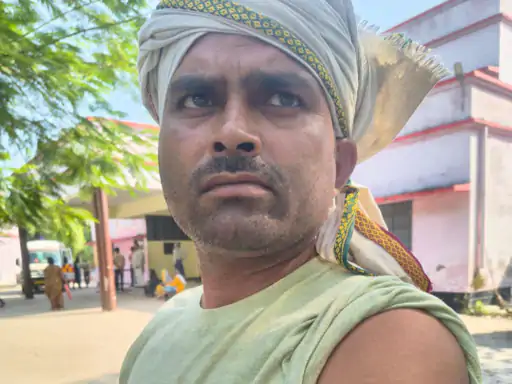
Late on the night of October 6 and into October 7, the situation at Duck Point became particularly tense after a medical team and members of the Proctorial administration reached the protest site in connection with Yasir’s health.
According to protesters, there was an attempt to persuade Yasir to go to hospital for treatment. Yasir, however, wanted medical assistance to be provided at the protest site. Students subsequently formed a human chain around him, remaining at the location and insisting that his condition be monitored without disrupting the protest.
The late-night developments further energised the gathering, with students staying at Duck Point and continuing slogans.
Women Students Join the Mobilisation
The movement has also witnessed visible participation from women students.
Students from Abdullah Hall, Indira Gandhi Hall and Begum Sultan Jahan Hall, among other residential halls, have participated in mobilisation and raised slogans in support of the protest.
Late-night slogans from the women’s hostels added another dimension to the movement, particularly to the demand for accountability from the Proctorial administration.
The participation of women students has also become significant because one of the major reasons cited by protesters for demanding the Proctor’s resignation relates to the alleged treatment of female students.
Class Boycott Spreads Across Departments
The protest has now moved beyond a gathering at Duck Point. Students from almost all major departments have reportedly joined the class boycott, signalling a wider campus response.
Students of the Urdu Department also boycotted classes and joined the movement. Students from law and other departments have similarly been visible at the protest site.
The growing participation has transformed the agitation into a campus-wide mobilisation, with classrooms, departments, hostels and the central protest site all becoming part of the movement.
JNU Students’ Union Extends Support
The movement has also received support from outside AMU.
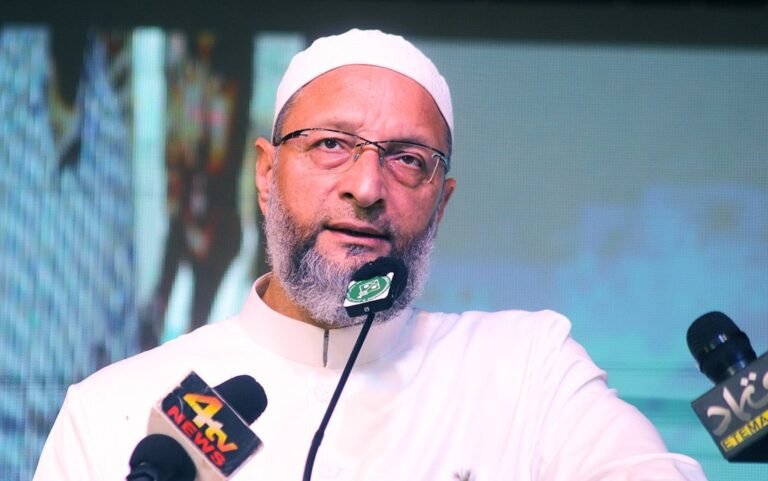
Danish Ali, Joint Secretary of the Jawaharlal Nehru University Students’ Union (JNUSU), addressed students at Duck Point and expressed solidarity with the ongoing movement.
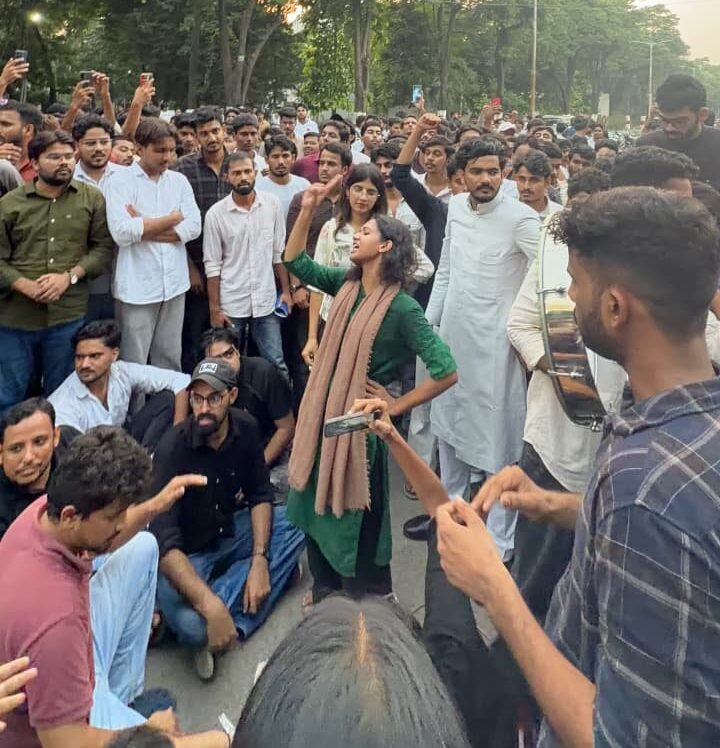
A JNUSU delegation also attempted to meet the AMU Vice-Chancellor, although, according to reports from the protest, the delegation did not get a meeting.
The involvement of JNU students has added a wider student-union dimension to the AMU movement, particularly because the restoration of an elected students’ union remains its central demand.
Legal Battle Intensifies
Alongside the street-level mobilisation, the dispute has also entered a legal and administrative phase.
On October 6, 2026, advocate and former AMU student Syed Kaif Hasan sent a Legal Notice-cum-Representation to the AMU Vice-Chancellor. The notice, sent at around 4:05 PM, also involved the Registrar and Dean, Students’ Welfare.
The notice raised issues concerning alleged defamatory remarks attributed to the Vice-Chancellor’s office, the implementation of the Lyngdoh Committee recommendations and the need for immediate redressal of Yasir Fahad’s hunger strike.
The legal action followed a controversy over remarks attributed to the university administration regarding an earlier incident involving Kaif Hasan.
According to a report in Hindustan, DSW Prof. Athar Ali Ansari referred during discussions with a student delegation to the Vice-Chancellor being hurt by an incident involving juice-spitting and the burning of an AMU notice. The DSW later clarified that he had not taken anyone’s name and had only conveyed what he said was stated by the Vice-Chancellor during the interaction.
Kaif Hasan’s notice has sought clarification and redressal while also raising the election issue and the demands associated with Yasir Fahad’s hunger strike.
A Movement Now Defined by Two Demands
After 17 days, the AMU protest has grown considerably from its initial stage.
The protest site at Duck Point is witnessing a large student presence, classes are being boycotted across departments, women students are mobilising in hostels, external student organisations are expressing solidarity, and the legal dimension of the dispute is becoming increasingly prominent.
Yet, despite the expanding nature of the movement, protesters insist that its central message is straightforward.
First: restore the AMU Students’ Union and announce the election process.
Second: the AMU Proctor must resign.
With Yasir Fahad continuing his hunger strike and thousands of students reportedly gathering at Duck Point, the immediate question now is whether the AMU administration will initiate a dialogue capable of addressing these two major demands—or whether the campus mobilisation will continue to intensify.
Amzad Ali, popularly known as Amjad Siwan, is a student activist at Aligarh Muslim University and a third-year law student. He has also been placed under suspension by the University administration, which he maintains is unlawful and unjustified. Despite submitting documentary and other evidence in support of his case, his suspension has not been revoked to date.