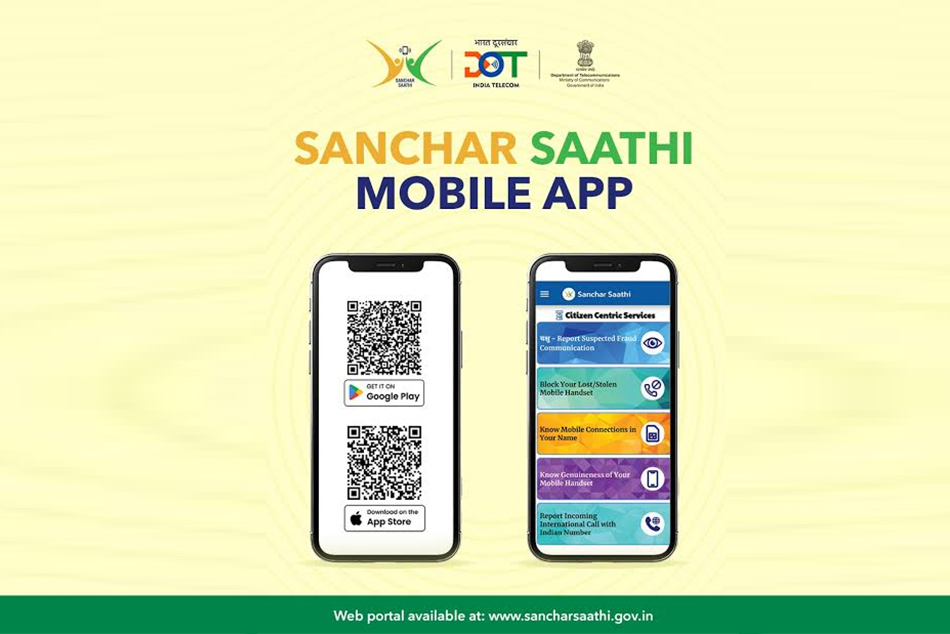
A major political controversy has broken out after the central government directed all mobile phone manufacturers to pre-install the Sanchar Saathi app on every device made or imported in India. The government says this move is meant to protect people from cyber fraud and help track lost phones. But the Opposition has accused the Centre of creating a tool for state surveillance, demanding that the order be immediately withdrawn.
Sanchar Saathi is a “digital safety platform” created by the government. Through its app and website, people can report suspected fraud calls, spam messages, phishing links, device-cloning attempts and other harmful communication. The platform also includes a feature called Chakshu, which allows users to alert authorities about cyber fraud. The government says this reporting helps prevent misuse of telecom resources for crimes.
The Department of Telecommunications, under Communications Minister Jyotiraditya Scindia, has told phone companies that Sanchar Saathi must be clearly visible and accessible when a new phone is first switched on. Manufacturers have been given 90 days from November 28 to comply. Phones already produced must receive the app through a software update, and the government says action will be taken if companies fail to follow the direction.
Opposition leaders have sharply criticised the order. Congress leader KC Venugopal said, “This move is beyond unconstitutional. Big Brother cannot watch us. The Right to Privacy is part of the Right to Life under Article 21.” He argued that a government app that cannot be removed is a “dystopian tool to monitor every Indian”, adding that it could track “every movement, interaction and decision of each citizen.” He demanded that the government roll back the directive immediately.
Shiv Sena (UBT) MP Priyanka Chaturvedi also attacked the move, calling it “another Big Boss surveillance moment.” She said, “Such shady ways to get into individual phones will be protested and opposed. If the IT Ministry thinks it can build surveillance systems instead of strong grievance-redressal systems, it should be ready for a pushback.”

A Reuters report said the decision may lead to friction between the government and major phone makers, especially Apple, which has opposed similar directives earlier citing privacy risks. Industry sources told Reuters that the government issued the order without consulting manufacturers. Apple, Samsung and Xiaomi did not respond to Reuters’ questions, nor did the Communications Ministry.
The Sanchar Saathi website says the platform has been used to block over forty lakh stolen phones and helped recover more than twenty-six lakh devices. The app has crossed one crore downloads on Android and nearly ten lakh on iOS.
Privacy experts are worried that mandatory pre-installation removes the need for user consent, which is central to data-protection laws. They point out that similar decisions in countries like Russia and China have been used to expand state control over digital communication.
The move also comes soon after the Centre privately directed messaging platforms like WhatsApp, Telegram and Signal to introduce SIM-binding within 90 days. This means users will have to stay continuously linked to the same SIM card, and web sessions will automatically log out every six hours. If the SIM is removed, the messaging apps will stop working.
The government argues that these steps are needed to tackle cyber threats, including scams involving duplicate or spoofed IMEI numbers. It recently announced that Sanchar Saathi had helped recover more than fifty thousand lost phones in October alone, with total recovery across the country now crossing seven lakh devices.

According to the latest Telecom Survey 2025, about 85.5 percent of Indian households have at least one smartphone, making the new directive one of the most significant technology interventions in recent years.