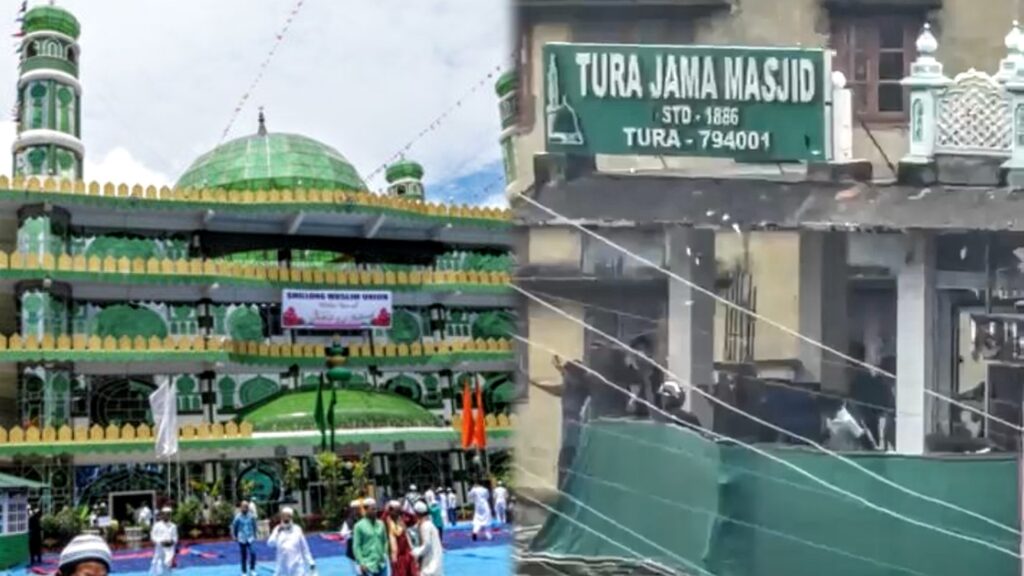
Before sunrise on March 10, several Muslim families in parts of Meghalaya’s West Garo Hills quietly packed their belongings and left.
Some crossed the border into neighbouring Assam. Others sought refuge in nearby villages.
Fear is dominant after episodes of violence which erupted following the nomination period for elections to the Garo Hills Autonomous District Council (GHADC).
“Muslims here have fled towards the Assam side. Women and children have left the area entirely,” a resident told The Observer Post, requesting anonymity.
On March 10, two Muslim men were found dead in the aftermath of bloodshed occurring in West Garo Hills following tensions over the participation of non-tribal candidates in the Garo Hills Autonomous District Council (GHADC) elections.
The deceased were identified as Khairul Islam and Ashraful Islam, both residents of the West Garo Hills region. Their bodies were recovered after the violence subsided on March 11, and later sent for post-mortem examination.
According to autopsy findings, one victim died after being attacked with a sharp weapon, while the other sustained fatal gunshot injuries from a country-made pistol.
Following unrest, authorities imposed curfew restrictions, suspended mobile internet services for 48 hours, and later deployed army columns to conduct flag marches in affected areas.
“With the presence of the armed forces, we are a little relieved now,” a resident from West Garo Hills, who spoke to The Observer Post, shared on condition of anonymity.
“But the atmosphere in many neighbourhoods remains tense. Several families who fled their homes have yet to return,” he added.
The GHADC elections, originally scheduled for April 10, 2026, to elect 29 members of the council, have now been deferred until further notice.
Background of the violence
The violence began on March 9, the first day of the GHADC election nomination window.
Locals say tensions escalated when a former MLA and member of the district council, described as Esmatur Momineen, arrived at the Tura district magistrate’s office to file nomination papers.
His move agitated the other tribal contestant members, who began confronting him and later beat him up badly, inflicting multiple injuries on his face.
‘Tu yaha kyu aya hai? Tera yaha kya kaam hai? Hum non-tribals ko election me nahi khada hone denge, (Why have you come here? What business do you have here? We will not allow non-tribals to stand for election.)’” he was told.
Location: Chibinang, West Garo Hills, Meghalaya
This is not Gaza; this is Meghalaya.
Garo community members torched shops and homes of Bengali-origin Muslim vendors in Garo Hills after rumors spread of Muslim candidates filing nominations for GHADC elections. pic.twitter.com/POFnxS6PLx
— The Muslim (@TheMuslim786) March 14, 2026
He insisted that the law allowed him to contest, but the scene began heating up, and several groups of tribal Garo men began mobilising across nearby areas.
The respondent we spoke to also alleged that militant or pressure groups may have played a role in the violence that unfolded late on the night of March 9 and continued into March 10.
According to him, individuals linked to the Garo National Liberation Army (GNLA) and activists associated with the Federation of Khasi-Jaintia and Garo People (FKJGP) were present during the unrest.
The GNLA has previously demanded the creation of a separate Garoland state within Meghalaya, according to multiple reports.
Authorities, however, have not officially confirmed these allegations.
Reports suggest that organisations advocating stronger protection for tribal communities have historically mobilised against what they describe as the influence of “outsiders,” often referring to Muslims of alleged Bengali origin. Such groups have periodically attempted to bar non-tribals from participating in, or even voting in, local elections.
Muslim Properties Reportedly Targeted
According to reports, homes belonging specifically to members of the Muslim community were vandalised and set on fire during the violence.
Shops and properties owned by non-tribal Muslims in the Chibinang and Tura market areas were also targeted. More than 30 shops were reportedly vandalised or burned, according to media reports.
A mosque was also set ablaze, and the mosque’s imam was allegedly assaulted during the attack.
However, the respondent claimed that a nearby temple remained untouched.
He believes the attackers deliberately avoided damaging the temple.
“They knew burning a temple could have consequences since there is a Hindu-majoritarian government at the Centre,” he said.
“There is no one to listen to the plight of Muslims here.”
Hate Slogans
Several videos circulating on social media appeared to show a Garo community leader calling Muslims in West Garo Hills “illegal immigrants from Bangladesh.”
In the footage, the speaker is heard shouting slogans such as:
“This is not your land; ‘Allahu Akbar’ will not work here.”
Meanwhile, there are growing calls within certain groups for leadership similar to that of neighbouring Assam, invoking claims of infiltration and demographic change allegedly caused by Muslim communities.
Such narratives have increasingly surfaced across several border states in recent years, particularly amid heightened political rhetoric around migration and citizenship.
Dispute Surrounding Elections
Earlier this year, the Garo Hills Autonomous District Council (GHADC) issued a notification requiring candidates to produce a Scheduled Tribe (ST) certificate while filing nomination papers. The move effectively barred non-tribal candidates from contesting the election.
However, the Meghalaya High Court later struck down the notification, ruling that it bypassed the required legislative procedure and therefore could not stand in law.
What Does the Constitution Say About Non-Tribals Contesting Elections in Meghalaya?
The question surrounding whether non-tribal candidates can contest elections in Meghalaya’s tribal areas is shaped by two key constitutional frameworks: Articles 330–332 of the Indian Constitution and the Sixth Schedule, which governs tribal autonomous regions in Northeast India.
Under Article 332, seats in state legislative assemblies may be reserved for Scheduled Castes (SCs) and Scheduled Tribes (STs) to ensure representation for historically marginalized communities. When a constituency is designated as ST-reserved, only candidates belonging to recognised Scheduled Tribes in that state are legally eligible to contest the election.
In Meghalaya, the vast majority of Assembly constituencies — including those in West Garo Hills — are reserved for Scheduled Tribes. Consequently, non-tribal candidates cannot contest Assembly elections from these seats.
However, the situation becomes more complex in the case of Autonomous District Councils (ADCs) created under the Sixth Schedule.
These councils were designed to grant tribal communities a degree of self-governance over land, customary laws and local administration in parts of Assam, Meghalaya, Mizoram and Tripura.
In Meghalaya, the GHADC is one such body.
Unlike Assembly elections, eligibility rules for district council polls are established through regulations framed under the Sixth Schedule and state legislation — an arrangement that has repeatedly triggered legal and political disputes over whether non-tribal candidates should be allowed to contest.
Muslims in Meghalaya
Even though Meghalaya is commonly considered to be a mainly tribal Christian state, its population makeup is more nuanced.
According to the 2011 Census, Muslims constitute approximately 4.4 per cent of the state’s population.
Most of them are Bengali Muslims whose families either migrated to the region during the colonial period or during the Partition.
Another less well-known group of Khasi Muslims- tribal groups that converted to Islam several generations ago and still adhere to matrilineal practices and local cultural customs.
For many people in Meghalaya, identity is not fixed but convoluted.
However, at times, ethnic tension has put Muslim communities in a particularly difficult situation.
History of tribal-non-tribal tensions
Warfare between the tribal and non-tribal communities in Meghalaya is not unfamiliar.
Migration, land ownership, and indigenous identity issues have since become causes of occasional unrest since the state was formed in the early 1970s.
Tribal communities were given greater control over local governance, land use, and customary law through autonomous district councils, such as the GHADC, under the Sixth Schedule.
While the framework was intended to safeguard indigenous rights, disputes over political participation and demographic change have continued to fuel tensions across the region.