Sayima Dar
Bollywood star Ajay Devgn’s upcoming Kashmir-based action film Chauhaan, releasing in October 2027, has sparked huge nationwide outrage as its first promotional teaser appears to mock pellet victims of the valley and turn human rights violations as well as the tragedy of hundreds of families into a spectacle, a punchline, a slogan and a marketing hook.
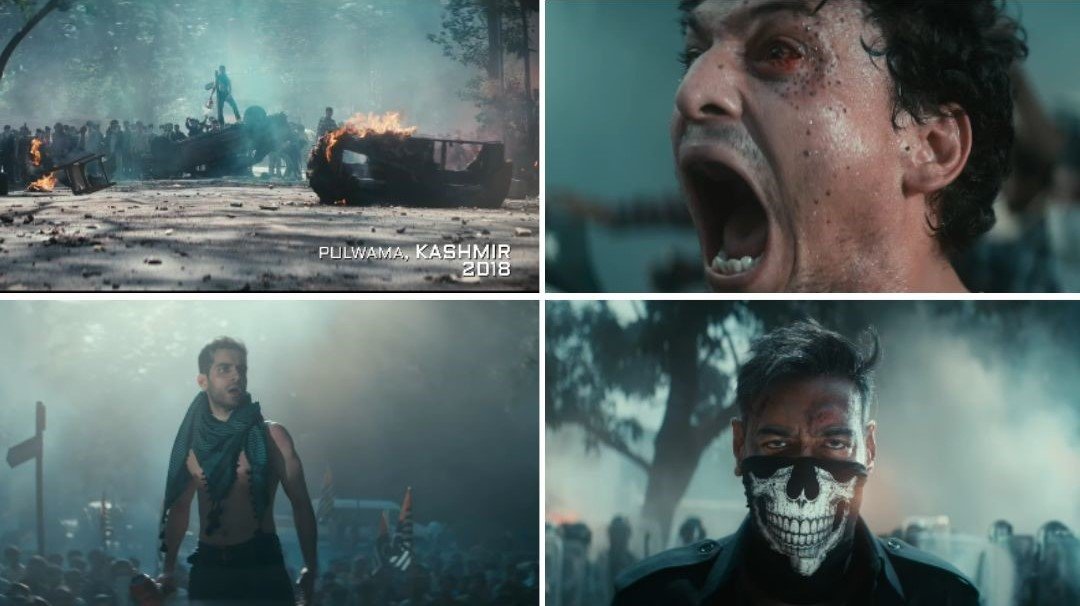
The film, directed by Neeraj Yadav and produced by Jio Studios and Colour Yellow Productions, is a mass-action story set against the backdrop of unrest and stone-pelting incidents in the Pulwama district of Kashmir. The film depicts escalating street protests where pellet guns (shotguns that fire cartridges filled with hundreds of small, jagged lead pellets), water cannons, and tear gas are used to curb the street protesters.
The outrage, especially from political leaders, social activists, and youth of Kashmir, ignited following the film’s recently released 144-second teaser that shows a pellet-victim man during protests, and Devgn’s voiceover describes it as “limited damage” and as “temporary solutions” to curb the Kashmir’s “stone-pelleters”. The critics claimed that the film is not just insensitive but disrespectful to the valley, which has already suffered the most painful reported mass-blinding episodes in recent memory.
Pertinently, the pellet guns were initially introduced in Kashmir under the Congress-led United Progressive Alliance (UPA) central government and the National Conference (NC) government during the peak unrest year in August 2010, which was primarily triggered after the Machil fake encounter of local young men from Nadihal village of Baramulla district, who had been lured and killed by Army’s 4 Rajputana Rifles in a forest and the subsequent killing of a 17-year-old student, Tufail Mattoo.
According to data available on Wikipedia, over 10,000 to 20,000, including infants and minors, are estimated to have been hit by pellet guns in Kashmir since 2010. The overwhelming majority of these total injuries and eye injuries that resulted in total eye vision loss occurred during a concentrated window between July 2016 and 2019.
Following the film teaser launch, the youth of Kashmir expressed their anger and pain on social media platforms, accusing the current Bollywood factions of racing to villainise the valley and its people and presenting serious subjects as cruelly packaged entertainment just for hefty profits.
The youth highlighted the plight of pellet victims’ lives and recalled the youngest pellet victim named Hiba Nisar, who was only 18 months old when she was hit in the eye while playing inside her home in 2018, while the protests were taking place outside on the streets. They also highlighted teenager female pellet victim named Insha Mushta, who was 14 when she lost her eyesight entirely after security forces shot pellets while peering out her window. Her face was pockmarked with more than a hundred pellet wounds; some hit her eyes, some pierced close to her brain. Her nasal, frontal, and maxillary bones were also broken.
National Conference spokesperson Imran Nabi Dar described the teaser as “trash” and wrote the upcoming film had put “Goblean propaganda to shame”. “This trash of a compilation is a propaganda that has put Goblean propaganda to shame. It is full of content that can incite violence in Kashmir. Mocking children and young people who lost their eyesight, some even their lives, and opening up old scars of their families is nothing short of a spiteful agenda against Kashmiris,” Dar posted on X.
Kashmirs argue that there was a time when Bollywood used to shoot movies like Kashmir Ki Kali, Jab Jab Phool Khile, and Betaab, showing the picturesque Mughal Gardens, local traditional beauty and lush valleys to define the quintessential Indian romance. However, the new era filmmakers have spun the agenda now and have made Kashmir’s grief and trauma an endless content mine. Kashmir’s misery is now cultivated for ideological convenience.

Kashmir’s pain, fear, funerals, and wounds are all repackaged for heavy profits by filmmakers and stars who will never have to live with any consequences and whose privileged children have never touched the grass, while Kashmiris who are trying to heal and move on are forced to live with the past trauma by portraying them as villains and twisting their stories with lies and propaganda without empathy.
Kashmiri student activist Sahil Parray flagged concern over Kashmiris being shown in a negative light and as villains just to sell movie tickets. “You clowns really thought vilifying Kashmiris and laughing at pellet victims would sell tickets?
How much more hatred are you gonna spread? Shame on you.
P.S We DGAF about these propaganda movies,” he wrote on X.
Another part of the teaser, Kashmiris found more offensive was the line where Ajay Devgn is seen saying, “Pathano se khedo Chauhaan aa rahe hai” ( Tell the Pathans, Chauhaan is coming), giving a communal and casteist tone as if the valley is inhabited by a single enemy identity waiting for a heroic arrival. Kashmir has a diverse culture and traditions, among them, Pathans (also known as Pashtuns) make up a very small minority in the valley, accounting for less than one per cent of the total population.
The community historically lived separately in hilly parts away from mainstream Kashmiri society to strictly preserve their distinct tribal bloodlines, language, and ancestral codes of honour. Delivering dialogue that sounds like code messages to establish a feeling and ideas for viewers as if only Pathans live in Kashmir, is exactly the kind of shallow, outsider framing that has damaged the way Kashmir is represented in popular culture for years.
Local social activists and political leaders argued that any film featuring Kashmir should be responsible and begin with listening and understanding that the valley is not a prop and content treasure, but a place with memory, for resilience, and daily life beyond conflict, unlike Chauhaan, which seems to have chosen the easy route to provoke, inflame, simplify, sell and make money.
Kashmiri social activist Wajahat Farooq Bhat also expressed his anger on social media and asserted that cinema should stop reducing Kashmir to a perpetual battlefield and its people to props in stories of violence.
While tagging the lead actor, Ajay Devgn Bhat wrote, “As a Kashmiri, I say this with conviction: enough is enough. For decades, we buried our loved ones, lived through bomb blasts, gunfire, curfews, fear, and uncertainty. There was nothing glamorous, heroic, or entertaining about that reality. It destroyed families, stole childhoods, and held an entire generation hostage. So please stop glorifying violence through fictional “alpha male” heroes and endless gunfights. That is not our story.”
Kashmirs expressed that their anger and outrage are not about censorship but about dignity and refusing to let trauma be turned into a marketing and money machine. It’s the assertion that a people’s suffering and eye vision loss at a very young age are not “limited damage” but an endless pain and trauma of Hibba and Insha, like pellet victims who are going to never see this world again with their eyes. And it is also about setting boundaries between a cinema business and the cultural values, as well as their sufferings that should be understood, not exploited for personal gains.

The film teaser has been in a public debate since its release, which has forced people to dig out and reopen horror files of pellet atrocities, which were never heard of and discussed at the national level with accountability. However, despite making the victims’ pain their business, Chauhaan film makers and Ajay Devgn have prompted long-buried incidents back into pubic veiw. The film, instead, indirectly exposed the moral failure of treating Kashmiris.
While expressing outrage, the other part of Indian critics claimed that it is not only Chauhaan or Kashmir, but Bollywood has now found an easy way to make money and appease the government. They alleged that in recent years, filmmakers have weaponised cinema for political appeasement, resulting in the spread of Islamophobia and casteism, and Chauhaan appears to be walking directly into that same old trap, only more offensively than before.
“Bollywood’s new genre seems to state-sanctioned slaughter dressed as ‘entertainment.’ Copy-pasting Israeli propaganda tactics, but make it desi because nothing sells tickets like dehumanising Kashmiris for the 100th time. Art imitates apartheid, and you are all clapping. Disgusting”, wrote one critic on X
Several times, critics and rights groups argued that such movies exploit complex historical and social issues to advance a polarising, majoritarian narrative, and such moves often get government approval and are granted tax-free status under the GST system, reducing ticket prices by roughly six to nine per cent.
The views expressed in this article are the author’s own and do not necessarily reflect the policy of the platform.