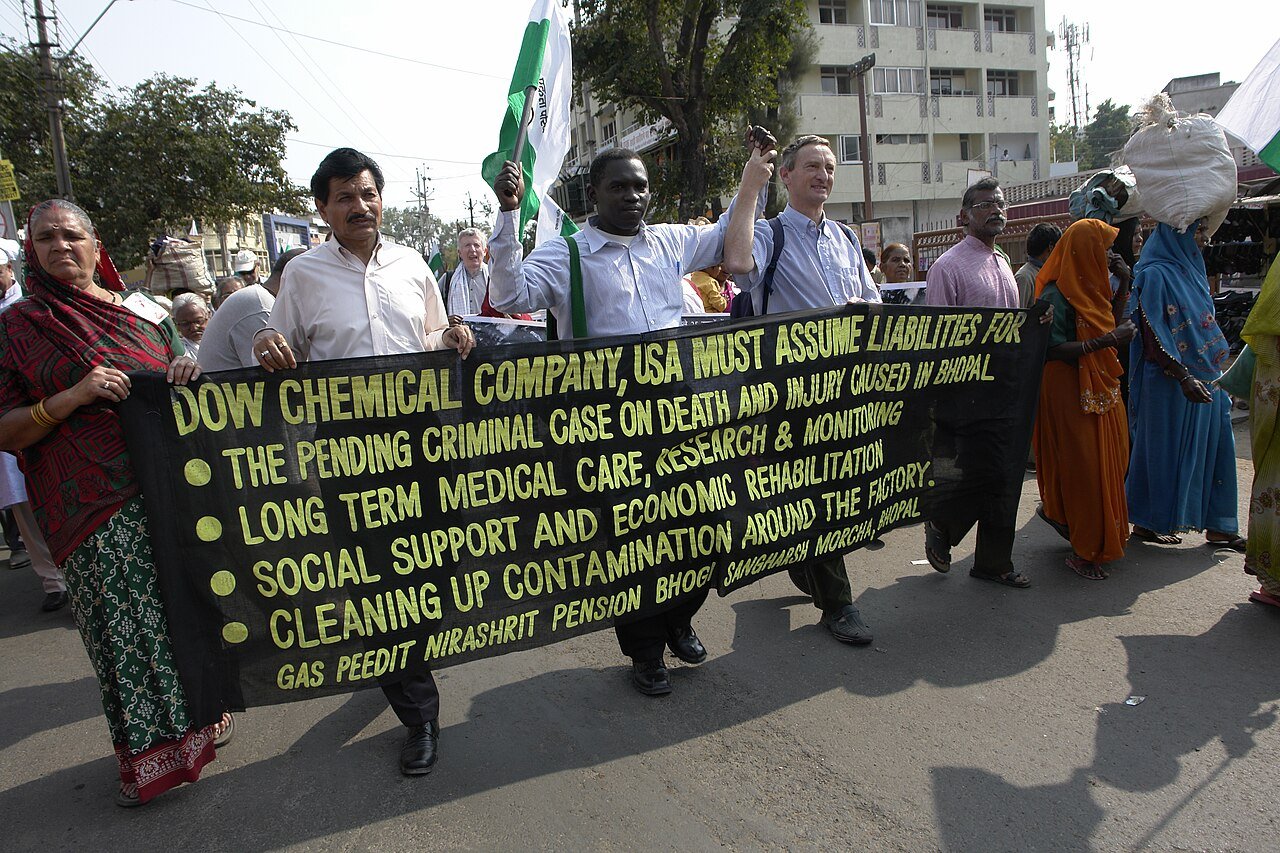
Four organisations representing survivors of the 1984 Bhopal gas tragedy have alleged that thousands of residents living around the abandoned Union Carbide factory are receiving sewage-contaminated drinking water, raising concerns over public health and accusing authorities of failing to comply with Supreme Court directions issued years ago.
At a press conference in Bhopal on Friday, the groups released a report claiming that nearly 70% of drinking water samples collected from affected localities tested positive for faecal coliform bacteria, indicating contamination with human waste.The Bhopal Municipal Corporation (BMC), however, rejected the allegations, saying regular testing has found no contamination in the city’s piped water supply.
Survivors’ Groups Claim Widespread Contamination
According to Nawab Khan, president of the Bhopal Gas Peedit Mahila Purush Sangharsh Morcha, 63 water samples were collected from taps across 30 communities between July 2 and July 22.
“We tested 63 water samples from taps in 30 communities this month and the presence of faecal coliform was confirmed in 43 samples. There is clear evidence that drinking water supplied to 19 out of 30 communities is contaminated with faeces,” Khan said.
He further claimed that around 90% of samples from water supplied through the Upper Lake source and 25% of samples supplied from the Kolar Dam were found contaminated, while samples supplied from the Narmada River did not show contamination.
Activists Warn of Health Crisis
Rashida Bee, president of the Bhopal Gas Peedit Mahila Stationery Karmchari Sangh, said residents in neighbourhoods surrounding the abandoned Union Carbide factory were suffering from waterborne illnesses.
“Residents in the communities next to the abandoned Union Carbide factory are suffering from a host of waterborne diseases from drinking faeces-contaminated water. Entire families are complaining of diarrhoea and vomiting and private clinics are reporting too many cases of typhoid,” she said.
The organisations warned that the situation could resemble the Bhagirathpura tragedy in Indore, where sewage-contaminated drinking water reportedly caused more than 35 deaths last year.
Supreme Court Orders Yet to Be Implemented, Say Survivors
The activists recalled that in 2004, the Supreme Court directed authorities to provide piped drinking water after groundwater near the Union Carbide site was found contaminated with toxic chemicals and heavy metals.Balkrishna Namdeo, president of the Bhopal Gas Peedit Nirashrit Pensionbhogi Sangharsh Morcha, said the Supreme Court again intervened in 2018 after complaints of faecal contamination in piped water.
“In August 2018, the Supreme Court directed the Bhopal Municipal Corporation to lay sewage lines and ensure proper drainage in the area. The corporation had promised to complete the work within three months, but even after eight years, no meaningful action has been taken,” he alleged.

Social activist Rachna Dhingra demanded accountability from officials and called for independent monitoring of drinking water quality.
“People should not have to die as they did in Bhagirathpura for officials to be punished. We demand time-bound implementation of the sewage and drainage plan and an independent system to monitor drinking water quality,” she said.
BMC Denies Allegations
Responding to the allegations, the Bhopal Municipal Corporation said treated piped water is being supplied to all 42 colonies inhabited by gas tragedy-affected families and denied that groundwater from tube wells is being used.
“In the 42 residential areas housing families affected by the Bhopal Gas Tragedy, treated water is being supplied through pipelines. Regular testing of water supplied across the city has not revealed any impurity or contamination,” the civic body said in a statement.
The BMC added that whenever complaints of contaminated water are received, immediate corrective measures are taken and safe drinking water is supplied through tankers until the issue is resolved.