



















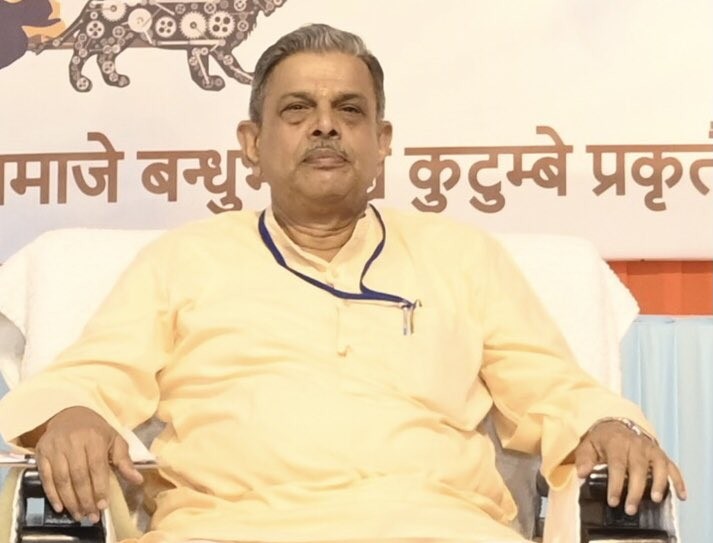
A delegation of the Communist Party of China on Tuesday visited the Rashtriya Swayamsevak Sangh headquarters in New Delhi and held an hour-long meeting with RSS general secretary Dattatreya Hosabale, triggering a political controversy amid tensions over China’s claim on the Shaksgam Valley in Jammu and Kashmir.
The meeting took place at Keshav Kunj, the RSS headquarters, a day after the same Chinese delegation met senior BJP leaders as part of efforts to improve inter-party communication. The visit to the RSS, which is the ideological parent of the BJP, was seen as a rare and significant outreach.
Sources in the RSS said the meeting was held at the request of the Chinese side and described it as a courtesy interaction. “They requested a meeting and we agreed. It was a courtesy meeting without any fixed agenda,” a senior RSS leader said, adding that RSS chief Mohan Bhagwat was not present due to prior commitments. Another leader said the discussion focused on the RSS organisational structure and its functioning, and took place in an informal setting over tea.
The RSS had last year not invited Chinese diplomats to a lecture series addressed by Mohan Bhagwat during the organisation’s centenary celebrations, a move that was linked by many to strained India-China relations following recent military and diplomatic tensions.
The Chinese delegation was led by Sun Haiyan, Vice Minister of the International Department of the Communist Party of China. On Monday, the delegation visited the BJP headquarters in New Delhi, marking the first such interaction between the BJP and the CPC in six years. BJP leaders said the meeting reflected a gradual improvement in ties after the 2020 Galwan clashes.
Confirming the BJP meeting, BJP foreign affairs department head Vijay Chauthaiwale said on social media, “A delegation of the Communist Party of China under the leadership of Ms Sun Haiyan visited the BJP head office. A BJP delegation headed by general secretary Arun Singh discussed ways to advance inter-party communication. Chinese Ambassador to India Xu Feihong was also present.”
The Congress strongly criticised both the BJP and the RSS for engaging with the Chinese delegation. Congress media department chairman Pawan Khera accused the BJP of hypocrisy and double standards. “Those who used to talk about showing a red eye to China have now rolled out the red carpet for it,” he said.
Questioning the RSS meeting, Khera added, “Non state actors should not be allowed to influence state politics. The red eye claims have now turned into red salute.” He also asked whether the BJP raised sensitive issues such as China’s claim over Indian territory and its support to Pakistan during Operation Sindoor.
The BJP rejected the Congress allegations and said it had acted transparently. BJP spokesperson Tuhin Sinha said, “We are holding meetings openly in view of improving relations. We do not sign secret agreements that we cannot explain later.”
The Congress also pointed out what it called contradictions in the BJP’s China policy. “On one hand people are told not to buy Chinese goods, and on the other hand Chinese companies are given contracts in Jammu and Kashmir,” Khera said.
This is the first formal interaction between senior CPC leaders and the RSS leadership in more than a decade, though both sides have interacted in the past. In earlier exchanges, RSS leaders have noted that while both organisations are cadre-based, the CPC functions through state power, whereas the RSS works directly with society.
The visit comes at a time when India-China relations have shown signs of thawing after a bilateral meeting between Prime Minister Narendra Modi and Chinese President Xi Jinping in October 2024, the first such engagement since the Galwan clash.