Qurat Ul Ain
When I was a teenager, my father used to emphasise, as he still does with increased urgency, that if I need to understand my purpose in life, what it means to be human and why I was sent to this earth, I need to read Iqbal.
Years later, when I left my hometown and came to university, I realised this advice had not been given to me alone. It had been passed down across generations, across borders, to many of my peers. Perhaps it travelled so widely because every generation of young South Asian Muslims finds itself, sooner or later, asking the questions Iqbal asked, and few have answered them as unflinchingly as he did.
Poetry is believed to stem from passion. It often acts as a purgation for the poet and the reader. But when it comes to reading Iqbal, or rather understanding the poetry, as aimed by the poet himself, that catharsis is not that easy to achieve. This is not because Iqbal is difficult to understand or the underlying concepts and references that he uses are obscure, of course not. It is because the inward window his poetry opens is very uncomfortable to look through.
Beyond the romantic recitation of “khudi ko kar buland itna …” before every speech, something in the poetry and philosophy of Muhammad Iqbal makes people pause in guilt. This guilt is not only about failing ourselves or forgetting the purpose of life, but also about failing generations, before and after us. And it is this guilt that makes Iqbal more necessary now than ever: a generation fluent in the language of burnout and anxiety has rarely been asked what its restlessness is for.
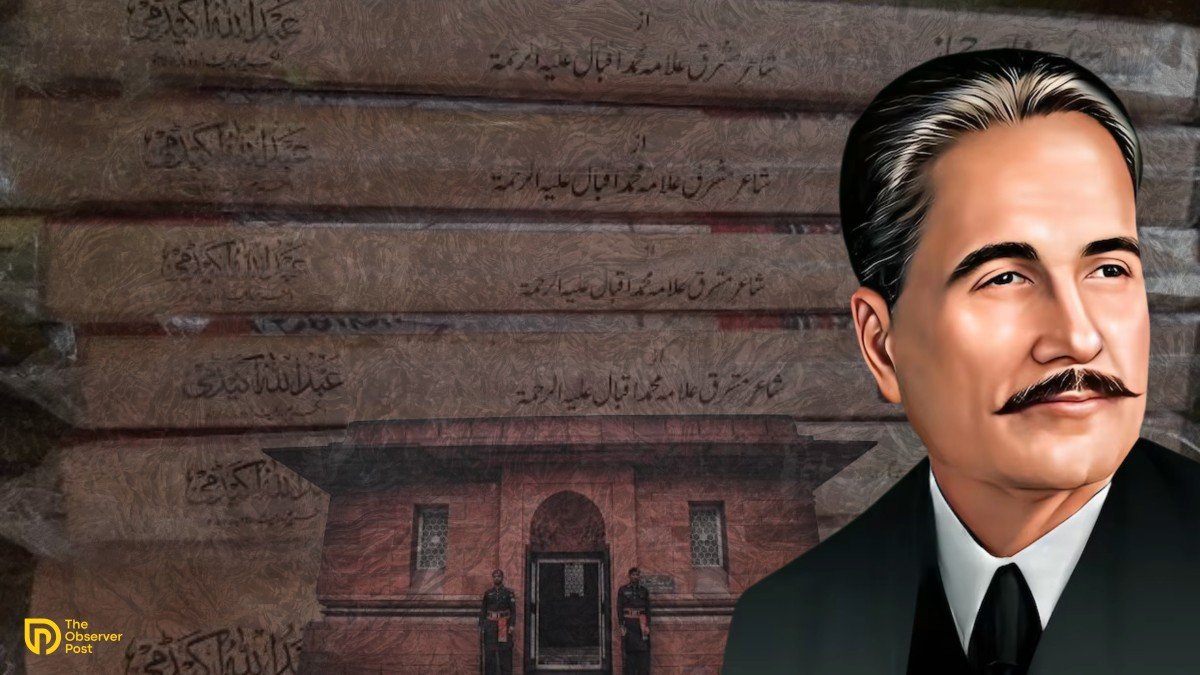
To understand Iqbal, beyond what we know and revere, it becomes important to humanise him. Dr Sir Muhammad Iqbal, or as the South Asians know him, Allama Iqbal, was born on November 9, 1877 (the same date that would mark the passing of his mother, Imam Bibi, in 1914), in Sialkot, Punjab, to a devout father and a humble mother. Their faith and kindness stayed with Iqbal all his life. A gifted philosophy student at Government College, Lahore, he was already a recognised poet by 1899. He went to Cambridge in 1905 and took his doctorate at Munich with a thesis on the development of metaphysics in Persia. Yet this polished record of degrees and honours hides the restless young man who, back in Lahore, still had to decide what all that learning was for.
The anxiety that the young people feel today was not very alien to Iqbal. At 32, two years after returning from Europe, after completing his doctorate, Iqbal was teaching and practising law in Lahore, yet felt deeply out of place. Like many people today, he was in search of a respectable place in the world, where he could express his ideas and identity as a Muslim, without fear of state or censorship. In a letter to his friend, Miss Atiya Fyzee, dated April 7, 1910, he wrote:
“I do not wish to enter any service, my object is to run away from this country as soon as possible… My life is extremely miserable… As a human being I have a right to happiness. If society or nature deny that to me, I defy both… The only cure is that I should leave this wretched country forever, or take refuge in liquor which makes suicide easier. These dead, barren leaves of books cannot yield happiness. I have got sufficient fire in my soul to burn them up and all social conventions as well”.
This anger did not deter Iqbal from his purpose. In fact, what made Allama Iqbal exceptional was not that he was a poet and philosopher who understood the nature of human destiny, but that he did not let the ache in his heart paralyse the objective of his existence. He channelised those anxieties into practical roadmaps for understanding the purpose of mankind. He refused to treat that tension as a sickness or sentence. He associated the loss of identity with the slavery of the mind and believed it to be the reason why the imperial powers were so successful in controlling British India. For him, the cure for a colonised mind was not escape but self-recovery, a conviction he compressed into a single couplet:
ہوئی ہے زیرِ فلک اُمتوں کی رسوائی
خودی سے جب ادب و دیں ہوئے ہیں بیگانہ
“When literature and religion of a nation both lose the originality and egohood,
The nations face humiliation and disgrace under the sky.”
In other words, a nation does not fall because it is conquered; it is conquered because it has first forgotten itself. How, then, was the self to be recovered?
Iqbal’s answer to the anxiety of his age begins with Asrar-e-Khudi (1915), in which he sets out his philosophy of the self or Khudi.
Khudi, often misread as pride or self-assertion, is for Iqbal closer to self-realisation: the slow, disciplined work of becoming everything one is capable of being, in relation to God.
But Iqbal did not stop at the role of the individual. In Rumuz-e-Bekhudi (1918), he turned to developing the communal ego. If Asrar-e-khudi taught the self to rise, Rumuz-e-Bekhudi reminded that it cannot rise alone. It established the idea that an individual is not complete without a community.
For him, the purpose of life was to be in a state of constant development of self. To achieve that development, it becomes necessary to be in a constant quest for knowledge.
In Javid Nama (1932), Iqbal urges his son, and through him the youth, to stop blindly imitating the West. He believed that the Western ideals, rooted in individuality and capitalism, are the biggest sources of anxiety and insecurity for the young people in the East. This is not a contradiction of khudi but its sharpest refinement. What Iqbal distrusted was not the self, but a self cut loose from God and community, measured only by what it owns and how it compares. It is a diagnosis that reads uncannily well in an age of endless scrolling and self-optimisation.
In the closing section of Javid Nama, Allama Iqbal promises his son, Javid, that he will pray for him even from the grave, and advises him:
رقص جان آموختن کاری بود
غیر حق را سوختن کاری بود
تا ز نار حرص و غم سوزد جگر
جان برقص اندر نیاید اے پسر
ضعف ایمانست و دلگیریست غم
نوجوانا “نیمہ پیری است غم
To learn soul’s dance is a difficult task;
To burn other than God is not a child’s play.
So long as the heart burns in the fire of avarice and grief
O Son, the soul does not dance till then.
Grief is the sign of weak faith and affliction,
O, young man! Grief is half old age.

Iqbal does not ask his son to deny grief, only to refuse to be ruled by it. In his telling, the soul begins to dance only when it stops being consumed by what it lacks. If Javid Nama speaks to one young man, Iqbal’s late poetry turns the same diagnosis on the world as a whole.
In Iblees ki Majlis-e-Shura, or ‘The Devil’s Council’, written in 1936, Iqbal has Satan review the state of the world he has worked to shape through capitalism, imperialism, and greed. He is able to maintain his position because humans are asleep in ignorance. Satan acknowledges the power vested in the human mind and knows he is bound to fail the moment man returns to fulfil his purpose:
ہے اگر مجھ کو خطر کوئی تو اس امت سے ہے
جس کی خاکستر میں ہے اب تک شرار آرزو
Also ReadNorwegian Journalist Helle Lyng Svendsen Says India Cancelled Her Visa Before Hyderabad SummitIf there is any danger to me, it comes from that community
In whose ashes the spark of longing still lives.

Even near the end of his life, Iqbal placed his hope not in power but in longing, in the refusal to stop wanting something better. The same clarity about where his own strength lay had guided his choices long before.
Iqbal’s refusal to accept the vice-chancellorship of Jamia Millia Islamia, as offered to him by Mahatma Gandhi, shows his self-awareness and clarity of purpose. By describing himself as a “peace-time worker,” he demonstrated an understanding of his own temperament, limitations, and role.
Despite the anxieties and uncertainties of his time, he did not allow the prestige of an important position to dictate his choices. Rather, he remained conscious of where he could contribute most meaningfully, showing that he valued purpose and self-understanding over power, position, or recognition. It is a lesson that sits uneasily with a generation taught to say yes to every opportunity, as if a life’s worth were measured in titles collected rather than purpose served.
The anxiety of everyday life that constantly follows us and makes us feel that we are not doing enough blinds us to the prospect of a better tomorrow. The same man who wrote about fleeing his country also wrote of contentment in the very same year. He did not actively seek to feel fulfilled; rather, he focused on what needed to be done in the moment. As written in entry no. 110 – The Poet As a Human Being
“Come dear friend: Thou hast known me only as an abstract thinker and dreamer of high ideals. See me in my home, playing with the children and giving them rides, turn by turn, as if I were a wooden horse! Ah! See me in the family circle lying in the feet of my grey-haired mother, the touch of whose rejuvenating hand bids the tide of time flow backwards, and gives me once more the school-boy feeling in spite of all the Kants and Hegels in my head! Here Thou will know me as a human being.”
Stray Reflections: The Private Notebook of Muhammad Iqbal
The philosopher with “all the Kants and Hegels” in his head was also a man on the floor with children, a son at his mother’s feet. The grandeur and the tenderness were never separate, and it is the tenderness that made the grandeur bearable.
My father’s insistence, and the guilt it stirred and still stirs, looks different after reading Iqbal as a man rather than a slogan. It became an inheritance, which made me and so many like me pause, reflect and ponder. At 32, he was angry and unsure where he belonged, and he wrote that down.
What makes him worth returning to is that he did not mistake that ache for a verdict that God had destined for him. He turned it into a question about who we could become, and he asked it for those who came after him as much as for himself.
Qurat Ul Ain is a PhD scholar in the Department of English at Aligarh Muslim University (AMU)
The information presented in this article represents the personal viewpoints of the author and does not necessarily reflect the opinions of The Observer Post.