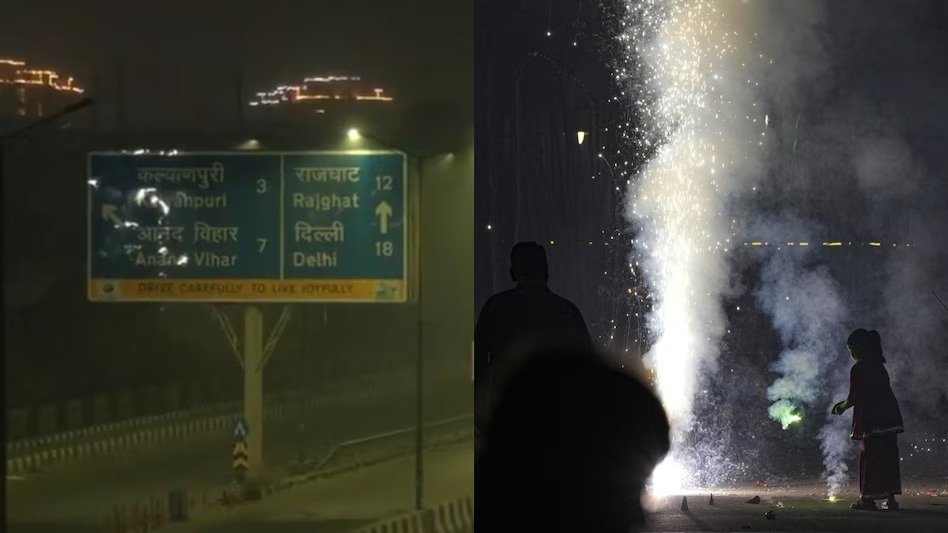
Delhi’s air quality remained in the “very poor” category on Monday morning, a day after Diwali celebrations, while several parts of the capital recorded pollution levels in the “severe” range.
At 7.05 am, the city’s average Air Quality Index (AQI) stood at 368, according to the Sameer application, which provides hourly data from the Central Pollution Control Board (CPCB). Fifteen of Delhi’s 59 monitoring stations recorded AQI levels above 400.
Burari Crossing recorded an AQI of 441, while Bawana reported 424 and Chandni Chowk 418. Other monitoring stations, including Sonia Vihar, Vivek Vihar and North Campus, also recorded severe air quality during the morning.
The readings followed a day in which Delhi’s average AQI settled at 376, compared with 369 on Saturday. The city was covered in a layer of smog, with visibility reduced in several areas.
Private air quality monitors reported even higher readings. Data from AQI.in showed an average AQI of 895 at 7.30 am, categorised as “hazardous”. Some locations, including Safdarjung Development Area, Man Singh Road and Sundar Nagar, recorded readings above 1,600. These figures use a different monitoring and calculation system from the CPCB’s official AQI.

Pollution rises across Delhi-NCR
Neighbouring cities also recorded poor air quality on Monday morning. According to CPCB data, the average AQI stood at 340 in Noida, 316 in Gurugram, 366 in Ghaziabad and 334 in Faridabad, all in the “very poor” category.
Greater Delhi’s pollution levels were also reflected in global rankings. AQI.in data showed that 98 of the 100 most polluted cities worldwide on Monday morning were in India.
The CPCB classifies AQI readings between 301 and 400 as “very poor”, while readings between 401 and 500 fall in the “severe” category.
Firecrackers add to existing pollution
Air quality had already deteriorated before Diwali celebrations began in full. On Sunday evening, the average AQI was around 376, with 12 of the 59 monitoring stations recording severe pollution. By 10 pm, 20 stations were in the severe category, with Sonia Vihar recording an AQI of 463.
The Supreme Court had allowed the sale and bursting of certified green firecrackers in Delhi-NCR for limited hours on November 7 and 8. The permitted timings were 6 am to 7 am and 8 pm to 10 pm. A complete ban was to return from November 9.
However, reports indicated that conventional firecrackers continued to be sold and used despite the restrictions.
PM2.5 was the predominant pollutant in Delhi on Sunday. Firecracker emissions added to pollution from vehicles, industries and other sources.
According to Delhi’s Decision Support System, the transport sector accounted for an estimated 19 per cent of the city’s pollution on Sunday. Stubble burning was estimated to contribute 3.5 per cent, with its contribution forecast to fall to around 2.99 per cent on Monday.
Unfavourable weather conditions have also made it harder for pollutants to disperse. The Air Quality Early Warning System said low wind speeds and a ventilation index below 6,000 square metres per second create conditions that limit the dispersal of pollutants.
The system had forecast that Delhi’s air quality could enter the severe category from November 9 and remain there for several days.