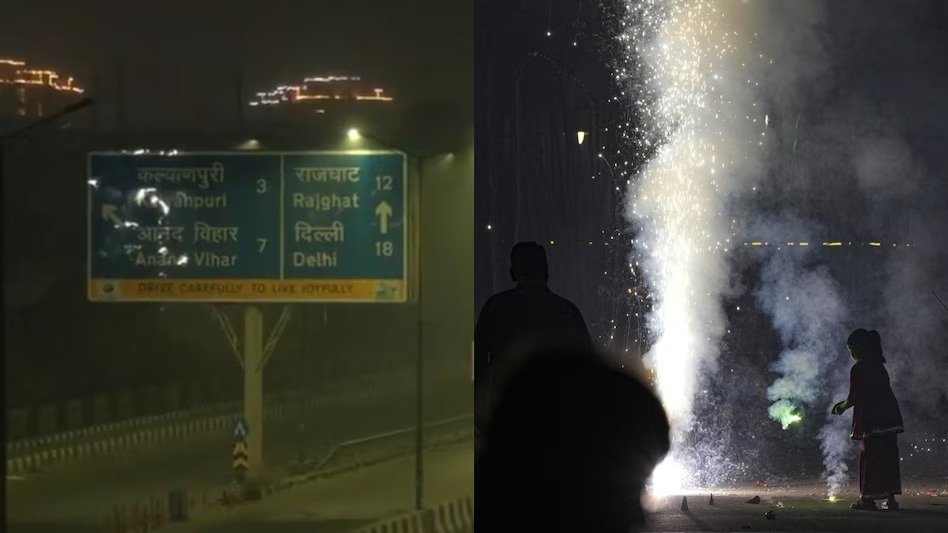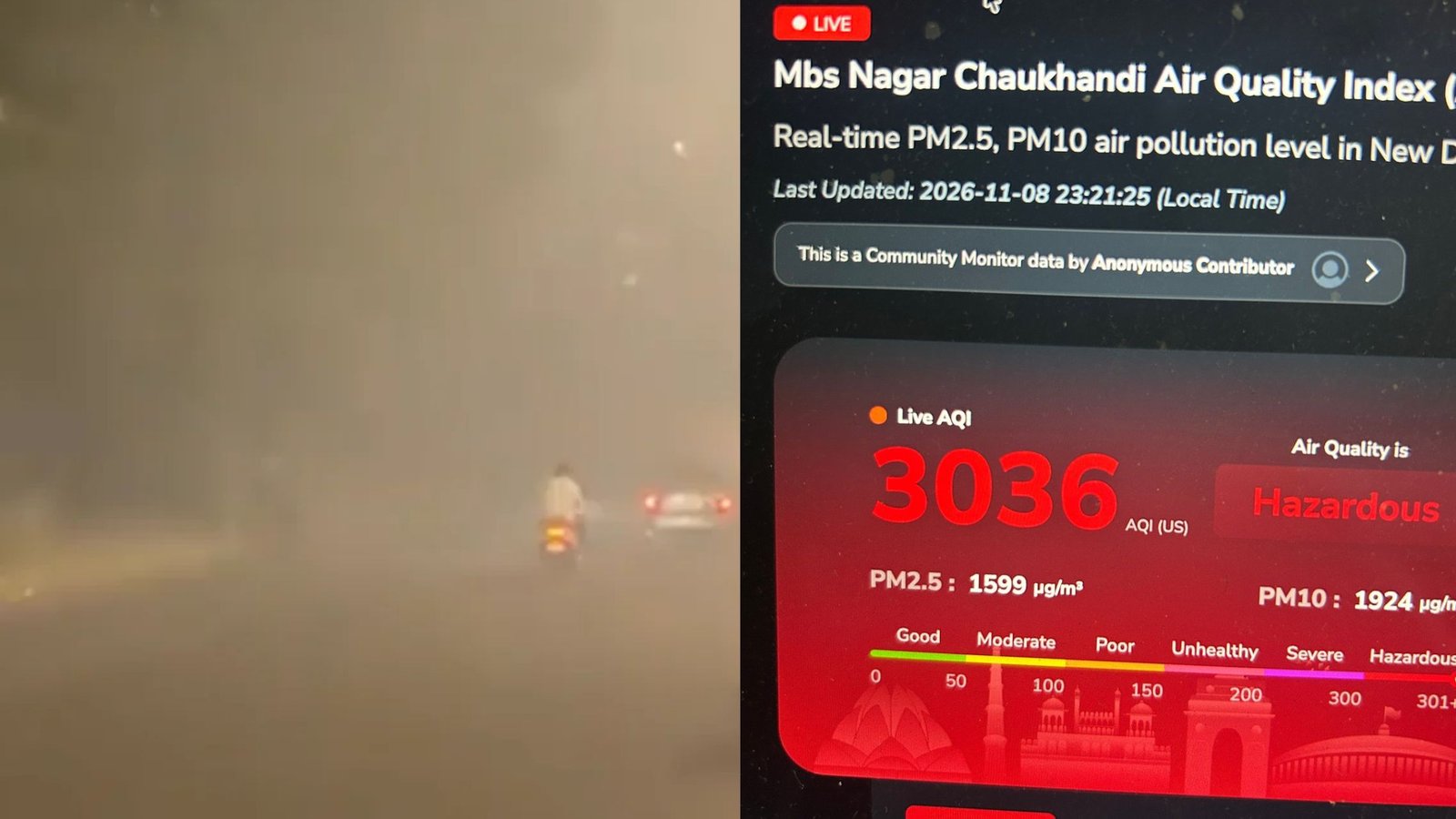
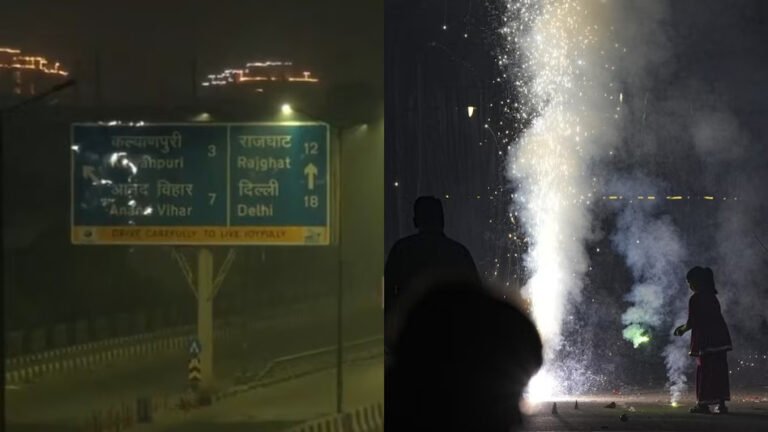
Delhi’s air quality deteriorated sharply on Monday, November 9, after Diwali celebrations, with the official Air Quality Index (AQI) reaching 483 in the morning. The reading placed the national capital in the severe category, even as some private monitoring platforms reported figures above 1,000 in parts of the city.
According to the Central Pollution Control Board (CPCB), Delhi’s AQI stood at 483 at 8.10 am. At least 15 monitoring stations recorded readings above 400, while thick smog reduced visibility across several neighbourhoods and major roads.
Burari Crossing recorded an AQI of 441, while Vivek Vihar registered 437 and Delhi Technological University recorded 434. Other locations reporting severe air quality included Jahangirpuri, Rohini, North Campus, Bawana, Ghazipur and Mundka.
The readings varied across the morning. Delhi’s average AQI was reported at 366 at 6 am, before climbing to 483 by 8.10 am.
Why are CPCB and private AQI readings different?
The gap between official and private readings has raised questions about how air pollution is measured.
The CPCB uses an AQI scale ranging from zero to 500. It classifies air quality as good (0–50), satisfactory (51–100), moderate (101–200), poor (201–300), very poor (301–400) and severe (401–500).
The official scale has an upper limit. When pollutant concentrations exceed the level corresponding to an AQI of 500, the reading is displayed as 500 or 500+. This means the index may not show how much pollution has increased beyond that threshold.
The concentration of fine particulate matter, particularly PM2.5, can continue rising even when the AQI has reached its upper limit.

Private platforms such as IQAir may use different methods to convert pollutant concentrations into an AQI figure. Some rely on systems derived from the US Environmental Protection Agency’s framework, while others use their own health-risk indices.
As a result, the same pollution concentration can produce different AQI readings on different platforms. An AQI figure above 1,000 on a private platform is therefore not directly comparable with the CPCB’s reading.
IQAir reported readings above 1,000 in areas including Shahdara and Defence Colony on Monday.
Monitoring gaps raise questions
The availability of official monitoring data also became a concern during the post-Diwali pollution spike.
Reports said several monitoring stations stopped displaying live readings around midnight on Diwali night, when pollution levels were rising. The Delhi Pollution Control Committee’s website also reportedly stopped showing data from some stations for a few hours.
An analysis by Hindustan Times found that around 80 per cent of the stations that continued reporting during the peak hours recorded severe air quality between 10 pm on Diwali night and 6 am the following morning.
The gaps made it difficult to establish the full extent of the pollution spike and compare readings consistently with previous Diwali celebrations.
Political allegations over pollution data
Aam Aadmi Party leader Saurabh Bharadwaj alleged that AQI levels crossed 3,000 in parts of Delhi on Diwali night, citing readings from independent monitoring platforms. He accused the BJP-led Delhi government of manipulating pollution data and described the alleged discrepancies as “AQI Data Fraud”.
Bhardwaj also claimed that new monitoring stations had been installed in relatively green areas, while water was being sprayed around existing stations in more polluted locations to bring down readings. These allegations have not been independently established.
Pollution worsens despite GRAP restrictions
The post-Diwali pollution spike occurred despite Stage III of the Graded Response Action Plan (GRAP) being imposed across Delhi-NCR on Friday, based on forecasts from the India Meteorological Department and the Indian Institute of Tropical Meteorology.
Stage III restrictions include a halt to non-essential construction and demolition activities, tighter controls on certain vehicles and hybrid classes for primary school students.
The impact of the smog was visible across the capital. At ITO, where the CPCB recorded an AQI of 407, commuters reported headaches and burning eyes. Visibility was also reduced around the Akshardham temple, which was obscured by a thick layer of haze.
Other cities also reported deteriorating air quality. Several parts of Lucknow were covered in smog, while monitoring stations in Mumbai recorded readings in the poor category, including 264 at Kherwadi-Bandra East, 226 at Sewri and 221 at Ghatkopar.