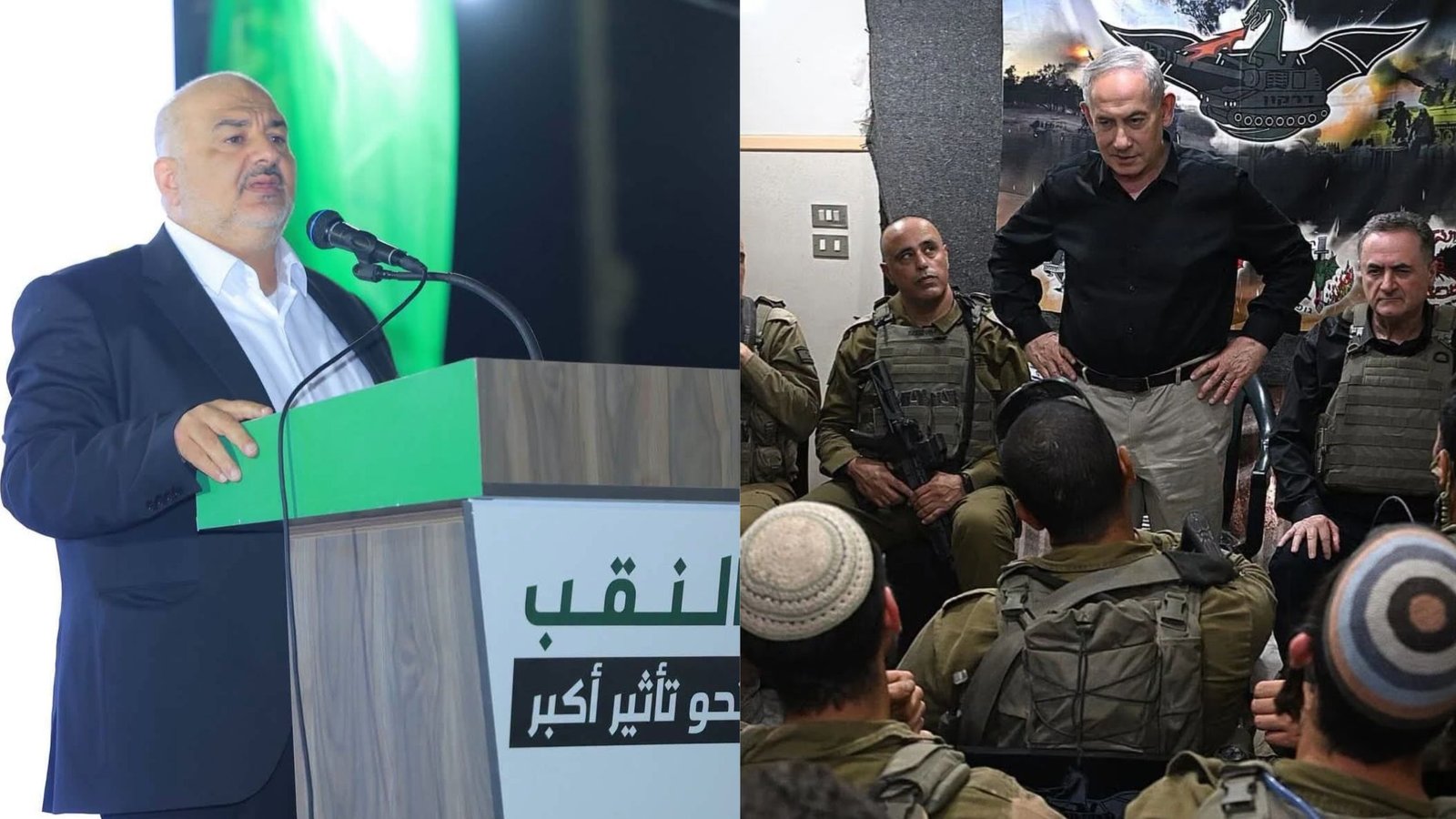
Israeli Prime Minister Benjamin Netanyahu’s ruling bloc and the opposition led by former military chief Gadi Eisenkot are both falling short of a parliamentary majority, as a surge in voting by Palestinian citizens of Israel reshapes the election outcome.
Partial results released by Israel’s Central Elections Committee on Wednesday showed Netanyahu’s bloc leading with 54 seats, while the opposition bloc was projected to secure 47 seats, with more than 76 per cent of ballots counted.
The Joint List and Ra’am, two political formations representing Palestinian citizens of Israel, have secured a combined 19 seats in the preliminary count, potentially marking a record number of Arab lawmakers in the Knesset.
Both major blocs remain short of the 61 seats required to form a government in the 120-member parliament. The results are provisional and could change as counting continues.
Record turnout among voters
Overall voter turnout reached 77.7 per cent, the highest since 1999, according to the Central Elections Committee.
The election, held on Tuesday, was the first since the Gaza war and Israel’s regional conflicts following the October 7, 2023, Hamas-led attack.
Palestinian citizens account for around 20 per cent of Israel’s population and have historically been largely excluded from governing coalitions.
The strong showing of Arab-led parties could give them greater influence in government formation negotiations, although their participation in a coalition remains politically contentious.
Opposition faces coalition challenge
Netanyahu’s Likud party is projected to emerge as the largest individual party, with 27 seats, while Eisenkot’s Yashar party has secured 20 seats in the early results.
Eisenkot said the results reflected a “lack of confidence” in Netanyahu’s leadership.

Former prime minister Yair Lapid described Netanyahu’s performance as a “crushing defeat”.
However, the opposition bloc also faces difficulties assembling a governing majority without support from Palestinian-led parties. Several opposition figures, including Naftali Bennett and Avigdor Lieberman, have ruled out a coalition with Arab parties.
Political commentator Meron Rapoport told Middle East Eye that the outcome could leave Israel facing further elections if no government can be formed.
Another possibility being discussed in Israeli media is a national unity government involving Netanyahu and Eisenkot, although political differences between the two leaders could complicate negotiations.
Netanyahu rejects reliance on Arab parties
Netanyahu has opposed forming a government dependent on Arab-led parties, describing such an arrangement as “a shame and a disgrace”.
“It is forbidden, simply forbidden, to endanger Israel and to establish a government that relies on anti-Zionist Arab parties,” he told supporters.
He also accused the parties of being “opposed to our very existence”.
Ra’am leader Mansour Abbas, meanwhile, accused Netanyahu of “lying and inciting” against his party after the prime minister alleged that senior Ra’am officials had been arrested with envelopes of cash in southern Israel.
Netanyahu accused them of attempting to “steal the election”. Israeli election officials said they found no evidence of wider electoral interference.
Abbas urged Palestinian citizens of Israel to turn out and vote for Ra’am.

Palestinian parties gain bargaining power
Analyst Ameer Fakhoury of Israel’s Van Leer Institute described the mobilisation of Palestinian citizens as a “truly historic development”.
He said Palestinian voters had mobilised amid concerns over the devastation in Gaza, violence in the occupied West Bank and discrimination against Arab citizens inside Israel.
Their electoral gains could now place them in a pivotal position in negotiations, even if they remain outside a formal governing coalition.
What happens next?
Netanyahu remains prime minister as coalition negotiations begin.
Under Israel’s parliamentary system, President Isaac Herzog will consult political factions after the official results are published and nominate a lawmaker he believes has the best chance of forming a government.
The nominee will have up to 42 days to assemble a coalition backed by at least 61 lawmakers.