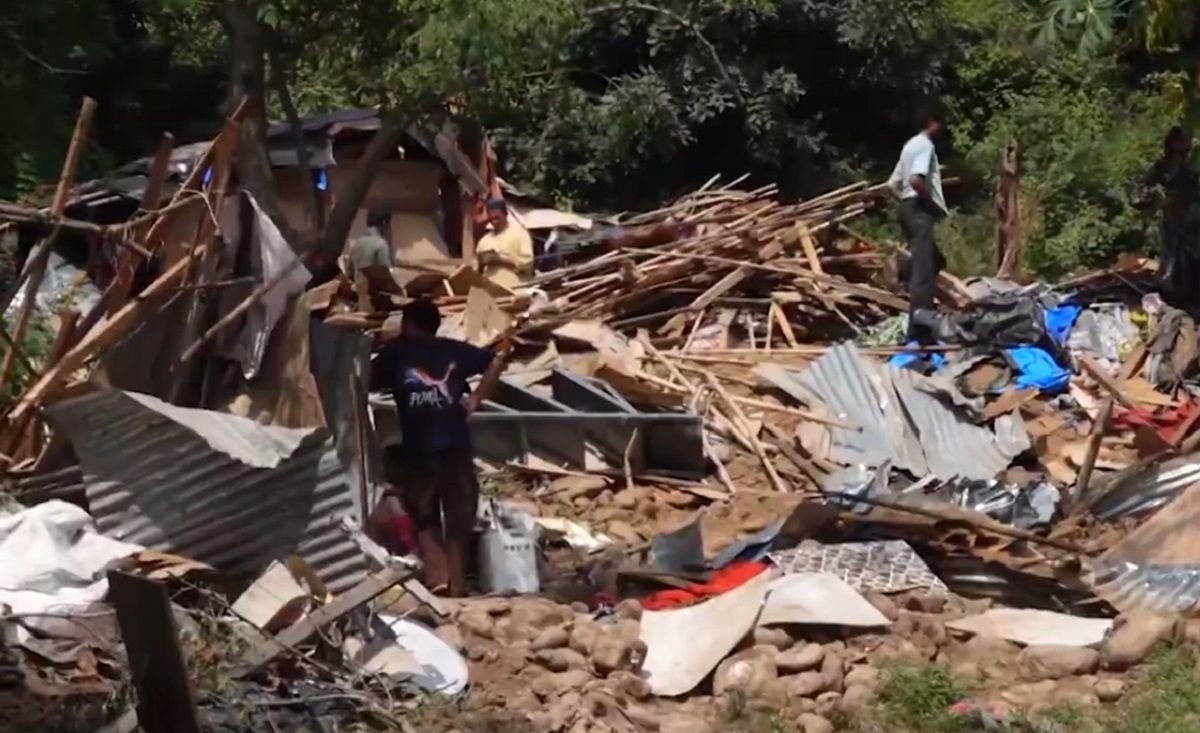
Authorities in Jammu on Saturday demolished nearly a dozen huts allegedly built “illegally on forest land, most of them occupied by Rohingya families”, in the second major eviction drive involving Rohingya settlements in the winter capital of Jammu and Kashmir within a month.
The operation was carried out in Rahim Nagar, inside the Raika Forest area on the outskirts of Jammu. The Forest Department conducted the drive with the Forest Protection Force, Revenue Department and police.
Officials said the structures had been identified as encroachments on forest land.
Resident Says No Prior Notice Was Given
Among those whose structures were demolished was Stephen, a Jammu resident, who alleged that he was not given prior notice.
He said the demolition team arrived early in the morning and gave the occupants little time to remove their belongings.
“I have been living here for the last 10-12 years. Now I have nowhere to go with my children,” Stephen said, expressing concern over belongings lost during the demolition.
A forest official, however, said residents had been warned twice within a fortnight before the action.
The official said occupants were given an opportunity to remove their belongings before the structures were demolished. Women and children were moved out with the assistance of women police personnel, he said.
“There are video recordings of the operation during which only structures identified as illegal were razed,” the official said.
The official said the affected area covers around five hectares and that the department had prepared detailed records of the encroachments.

“The action was not directed against any particular community or group, but was solely aimed at removing encroachment from forest land. The forest rules are the same for everyone. There is no question of targeting any particular group,” he said.
He added that action would also be taken against other identified encroachments and advised people needing accommodation to rent houses or acquire land through legal means.
Rohingya Families Say They Have Nowhere to Go
Several Rohingya families said they had been living in the area for nearly two decades after fleeing difficult conditions in Myanmar.
Abdul Khaliq, a Rohingya resident, said the latest demolition had left families without shelter.
“We escaped oppression in our country and took shelter here out of compulsion. We are not here to stay permanently. We hold identity cards issued by the United Nations,” he said.
“We have nowhere to go and are uncertain about the future of our children,” Khaliq added, appealing to the authorities to consider the situation of the affected families.
Second Major Eviction Drive in a Month
The latest action comes a month after a Rohingya settlement in Karyani Talab, Jammu, was cleared after authorities issued notices to landowners whose plots were reportedly being rented to immigrants.
Temporary shelters, huts and makeshift shops in several parts of Jammu have also been removed after notices were served to landowners. Authorities have said the action was linked to unauthorised use of private property rather than direct action against a particular community.
The issue gained renewed administrative attention after a Central High-Level Committee on Demographic Change visited Jammu from August 10 to 12. The committee was constituted on May 26 under the chairmanship of retired Justice Prakash Prabhakar Navalkar to examine demographic changes and recommend administrative and legal measures.
During its visit, the committee also visited a Rohingya settlement and met senior administrative and police officials.
Over 7,600 Rohingyas Identified in J&K
Government data presented to the committee showed that 7,656 Rohingyas had been identified across Jammu and Kashmir.
Of them, 6,737 were identified in the 10 districts of the Jammu region, while 919 were identified across the 10 districts of the Kashmir Valley.
The same data showed 504 Bangladeshi nationals identified across the Union Territory, including 46 in the Jammu region and 458 in Kashmir.
Rohingya families have previously been reported living in areas including Narwal, Bhatindi, Sunjwan, Bahu Fort, Ladakhi Colony, Upper Thather, Poonch Colony, Guda Brahmana and Chinore.
The government has not indicated that Rohingya or Bangladeshi nationals were officially settled in Jammu. Reports have said some families reached the region through local and family networks, while authorities have also raised concerns about unauthorised entry and documentation.