The Congress government in Karnataka is facing increasing criticism from sections of the Muslim community, with a federation of nearly 48 Muslim organisations accusing the ruling party of following “soft Hindutva” and failing to fulfil several promises made before the 2023 Assembly elections.
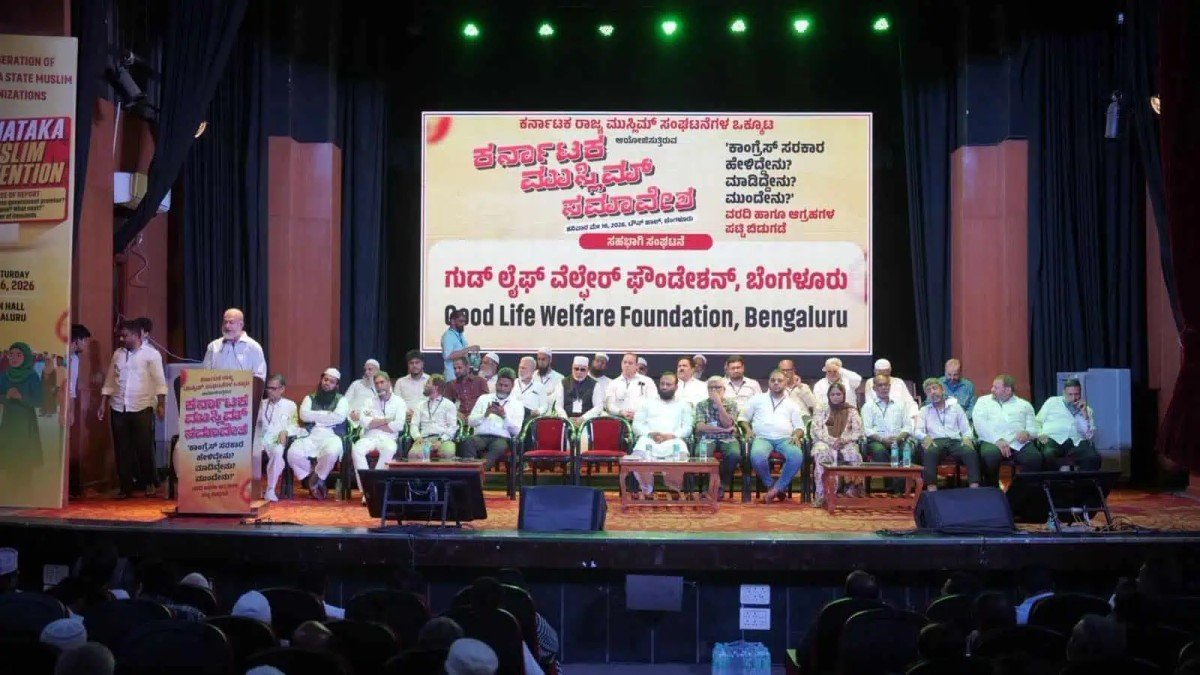
At a convention held at Bengaluru’s Town Hall on May 16, the Federation of Karnataka Muslim Organisations released a detailed report reviewing the Siddaramaiah government’s performance on issues related to minority welfare, reservations, political representation, communal harmony, and religious rights.
The convention, organised under the theme “What promises did the Congress government make? What has it delivered? What next?”, saw participation from Muslim leaders and activists from different districts of Karnataka.
‘Major Concerns Still Unresolved’
In its report, the federation said that although the Muslim community strongly supported Congress during the 2023 elections, many important issues remain unresolved.
“There have been improvements in education and welfare, but major concerns like reservation, dignity, livelihood, religious freedom, protection from hate, and political representation are still unresolved or only partly addressed,” the report stated.
The federation alleged that despite Congress promising strict action against individuals and organisations spreading communal hatred, the government had failed to act firmly.
It also raised concerns over what it called the continuation of BJP-era policies, especially the anti-conversion law and cattle slaughter legislation.
According to the report, the cattle slaughter law has affected the livelihoods of farmers, meat traders, transport workers, and people linked to the leather industry.
Demand to Restore and Increase Muslim Reservation
One of the key demands raised at the convention was the restoration and expansion of reservation for Muslims under Category 2B.
The federation said the Congress government had not fully restored the 4% reservation removed during the BJP government and demanded that it be increased from 4% to 8%.
The report also sought stronger legal measures against hate speech, communal violence, mob attacks, and vigilante groups.
Referring to incidents of communal violence, the report claimed that hate speech and provocative activities had continued despite a change in government.
The federation also demanded a state anti-lynching law and implementation of Supreme Court guidelines on mob violence.
Concern Over Political Representation
Political representation of Muslims emerged as another major concern during the convention.
The federation pointed out that Muslims make up around 13% of Karnataka’s population but have limited representation in the Assembly and Legislative Council.
It claimed that despite several opportunities through nominated and MLA quota seats, only one Muslim representative had been accommodated since the Congress government came to power.
The federation demanded that at least two Muslims be nominated to the Legislative Council in the upcoming 2026 vacancies.
It also urged political parties to provide fair ticket distribution in Muslim-majority constituencies and recommended that Congress field at least 21 Muslim candidates in Assembly elections.
Waqf Protection, SIR Concerns Raised
The convention also highlighted concerns over alleged encroachment of Waqf properties and weak legal mechanisms to protect Waqf land.
The federation demanded a dedicated Waqf land recovery mission and stronger tribunal systems for resolving disputes.
Another issue raised was the proposed Special Intensive Revision (SIR) of electoral rolls. Organisers expressed concern about wrongful deletion of voters and urged the Karnataka government to oppose the exercise.
Joint Convenor Suhail Maroor said the report, published in Urdu, Kannada, and English, would be circulated across districts and discussed with MLAs, ministers, and the Chief Minister.
At the event, some speakers warned that if community concerns remained ignored, Muslim voters had “political alternatives” and could support other parties in future elections.
However, organiser Hares Siddiqui clarified that the programme was not against any political party or Muslim leader.
“This programme is not against any party or any Muslim minister or MLA. The focus is only on resolving community issues and discussing the future,” he said.