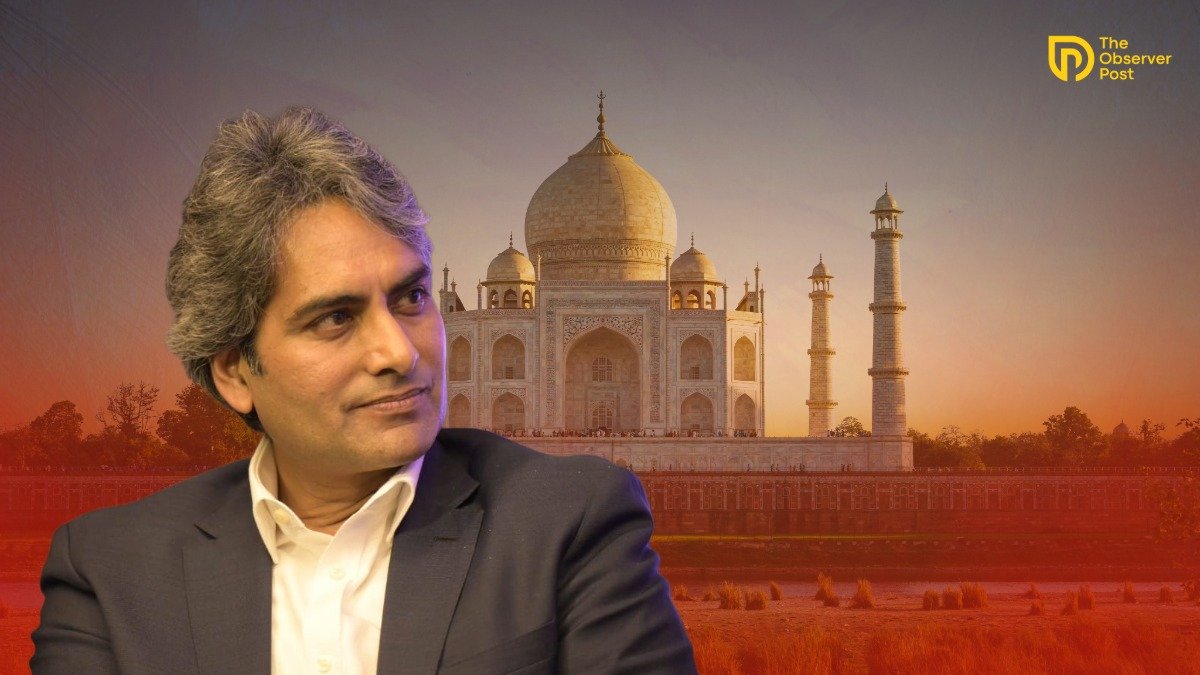
The News Broadcasting & Digital Standards Authority (NBDSA) has pulled up Hindi news channel Aaj Tak for airing a programme hosted by journalist Sudhir Chaudhary that repeated debunked claims suggesting the Taj Mahal was once a Hindu temple. The media watchdog said the show lacked neutrality and directed the channel to edit or suitably modify the portions related to the monument.
In an order dated May 28, NBDSA Chairperson Justice AK Sikri said the programme failed to meet standards of impartiality required under the authority’s Code of Conduct.
The case relates to an episode of Aaj Tak’s show Black and White, aired on November 29, 2024, in which Sudhir Chaudhary discussed historical claims surrounding religious structures, including the Sambhal Jama Masjid, Ajmer Dargah, Qutub Minar, and the Taj Mahal.
Complaint Challenged One-Sided Narrative
The complaint was filed by advocate Indrajeet Ghorpade, who argued that the programme pushed a one-sided narrative about Muslim rulers allegedly destroying Hindu temples. He specifically objected to the segment on the Taj Mahal, saying the show amplified a claim already rejected by the Archaeological Survey of India (ASI).
According to the complaint, the broadcast failed to include official findings that dismiss the theory that the Taj Mahal was originally a Hindu temple.
TV Today Network Ltd., the owner of Aaj Tak, defended the programme, saying it was presented in a documentary format and only discussed claims available in books, reports, and public records.
The broadcaster argued that Sudhir Chaudhary had clearly stated the show did not support demolition of religious places or seek to create communal tension, but was examining historical debates already present in the public domain.
Earlier Order Favoured Broadcaster
In December 2025, the NBDSA had initially dismissed the complaint. At the time, it accepted the channel’s argument that the anchor had relied on historical material, including ASI reports and books.
The earlier order stated, “During the broadcast, the anchor had given a narrative of the history of the destruction of Hindu temples over a period, which he supported with an ASI report and books written on the subject.”
Based on that reasoning, the authority had concluded there was no violation of its Code of Conduct.
Review Changed NBDSA’s View
However, after Ghorpade filed a review application, the NBDSA revisited the matter and found problems with how the Taj Mahal segment was presented.
The authority observed that Aaj Tak selectively used official records. It noted that while the broadcaster relied on ASI findings while discussing claims around the Qutub Minar, it failed to mention similar official evidence rejecting claims about the Taj Mahal.
“There was selective reliance on official records across different segments of the programme,” the NBDSA observed, adding that this omission affected the neutrality and impartiality expected from news broadcasts.
Rejecting Aaj Tak’s argument that neutrality does not always mean giving equal time to all sides, the authority said the issue was not about equal prominence but the complete absence of any counter-view based on official records.
The order stated, “The question raised herein was not whether sufficient prominence was given to other views, but rather whether the broadcaster had presented any counter view, at all, particularly, one which is grounded in official records.”

No Penalty, But Taj Mahal Segment Must Be Edited
The NBDSA directed Aaj Tak to edit or suitably modify the programme’s Taj Mahal-related content. However, it stopped short of imposing any monetary penalty on the broadcaster.
The authority also refused to reopen other concerns raised in the complaint, including allegations of communal framing and omission of legal context such as the Places of Worship (Special Provisions) Act, 1991.