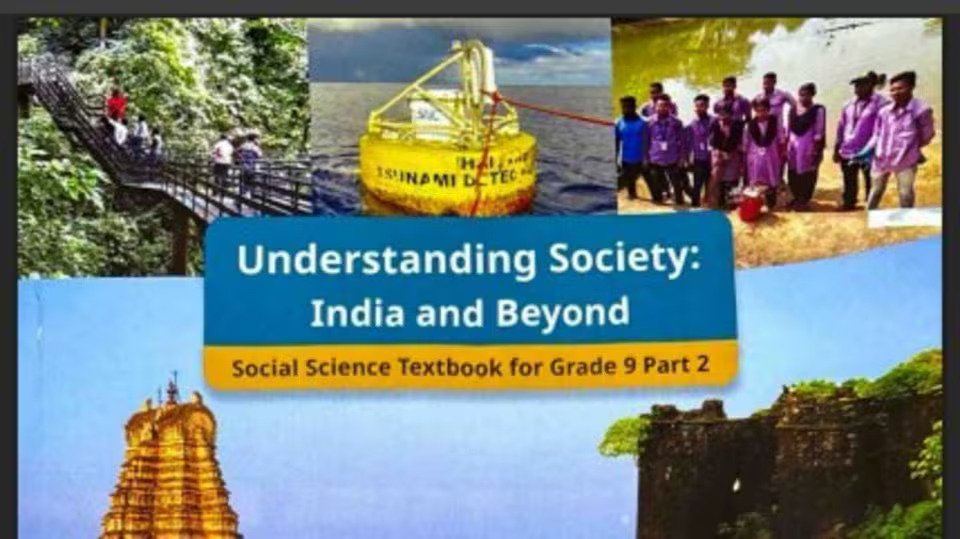
The new NCERT Class 9 Social Science textbook describes the Mughal state’s treatment of Sikh Gurus as exceptionally brutal and says it was rooted in “rigid religious and discriminatory practices”.
The reference appears in the history chapter “Resistance and Resilience (1000–1700 CE)” of Understanding Society: India and Beyond Part 2, released on Tuesday. The chapter discusses the experiences of Guru Arjan Dev, Guru Tegh Bahadur and Guru Gobind Singh and links their martyrdoms to the development of Sikh resistance.
Textbook Links Sikh Gurus’ Martyrdom to Resistance
The textbook says the “valour and sacrifice” of the Sikh Gurus “for the cause of the faith” became defining features of Sikhism.
“The brutality of the Mughal state against the Sikh Gurus, particularly Guru Arjan Dev, Guru Tegh Bahadur, and the tenth Guru, Guru Gobind Singh, has few comparisons in history,” it says.
It adds that their sacrifices strengthened the Sikh community’s belief that persecution had to be met with “firm resistance and resilience”.
According to the textbook, the Mughal state increasingly intervened in the affairs of the Sikh Gurus from the beginning of the 17th century as their socio cultural influence grew.
It says Mughal emperor Jahangir ordered the execution of Guru Arjan Dev on the grounds of his alleged support for Jahangir’s rebellious son, Khusrau Mirza. The textbook describes Guru Arjan’s martyrdom as a “significant turning point” in Sikh history.
The chapter also discusses Guru Hargobind’s detention at Gwalior Fort and the establishment of the Akal Takht as a centre of temporal authority. It links the concept of miri piri to the combination of spiritual and worldly authority.
Guru Tegh Bahadur and Guru Gobind Singh
On Guru Tegh Bahadur, the textbook says Aurangzeb ordered his execution in 1675 and describes his martyrdom as a turning point in Indian history.
It says persecution and political pressure contributed to the development of organised resistance, including collective organisation and armed resistance “as and when required”.

The chapter also discusses Guru Gobind Singh’s establishment of the Khalsa in 1699. It says the Khalsa adopted a distinct martial code in response to the changing socio political environment and that Sikh spiritual identity became closely connected with political identity.
The new account differs in emphasis from some earlier NCERT textbooks.
Older Textbooks Presented Different Interpretations
An older Class 11 NCERT history textbook by historian Satish Chandra described the conflicts between the Sikh Gurus and the Mughals under Jahangir and Shah Jahan as “political and personal rather than religious”.
On Guru Tegh Bahadur’s execution, the book presented several accounts and said it was difficult to establish the exact reasons. It referred to Persian accounts that alleged political disturbances and to Sikh traditions that attributed the execution to other factors.
An older Class 7 NCERT textbook, first published in 2007, similarly presented Guru Arjan’s execution mainly in the context of the Mughal state viewing the growing Sikh community as a political threat. It said Jahangir considered the Sikh community a potential threat and ordered Guru Arjan’s execution in 1606.
Historian Questions New Interpretation
Historian Ruchika Sharma, who specialises in medieval Indian history, criticised the new textbook’s interpretation. She argued that the Sikh Mughal conflict was primarily political rather than religious.
Sharma said Guru Arjan’s support for Khusrau was an act of political opposition to Jahangir and argued that the later establishment of the Akal Takht, military activities and other developments increasingly challenged Mughal authority.
The distinction is important because historians have long debated the relative importance of political, religious and social factors in the Sikh Mughal conflicts. Academic scholarship on Guru Arjan, for example, places his execution in the changing relationship between the Sikh community and Mughal authorities under Jahangir.
Chapter Focuses on Resistance Across India
The chapter is not limited to the Sikh Gurus. It also discusses resistance by the Jats, Ahoms, Rajputs and other groups against different ruling powers.
It highlights figures including Naiki Devi of the Chaulukya kingdom and Rani Abbakka Chowta of Ullal, along with Maharana Pratap and the Ahom victory over the Mughals at Saraighat. The chapter also discusses the Jat rebellions against the Mughal Empire and links them to taxation, exploitation and other grievances.

The new Class 9 Social Science textbook is part of NCERT’s ongoing revision of school textbooks under the National Education Policy 2020 and the National Curriculum Framework for School Education 2023. NCERT’s official textbook portal lists its current Class 9 publications.