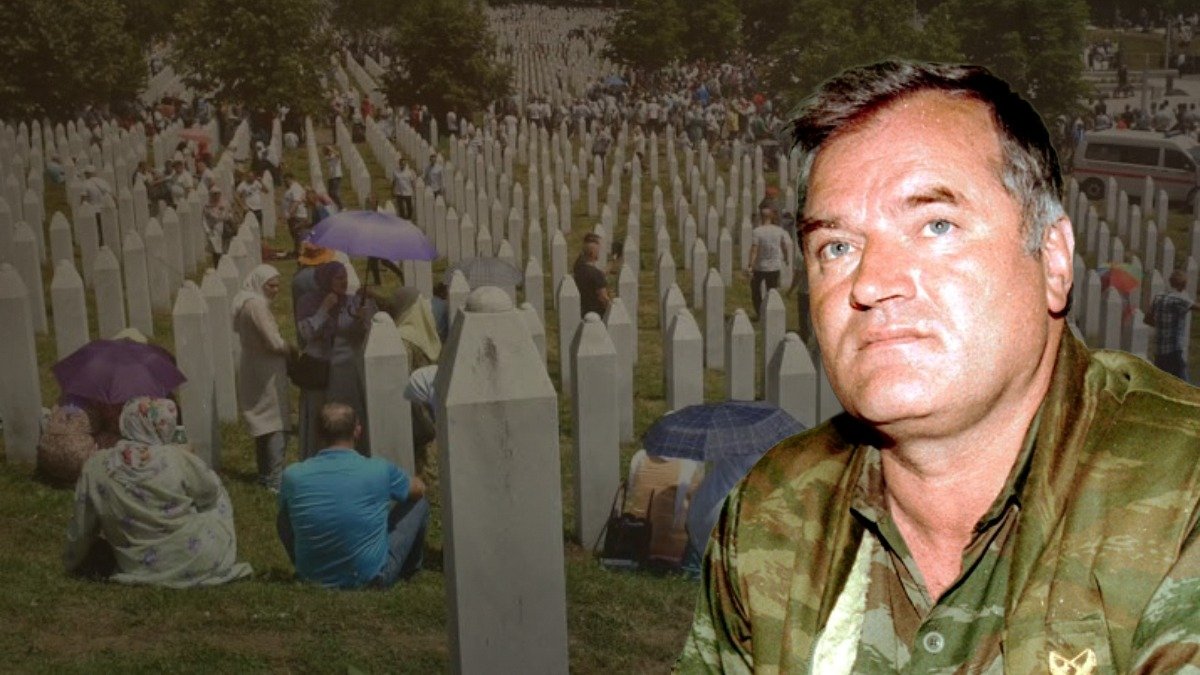
Former Bosnian Serb military commander Ratko Mladic, who was serving a life sentence for genocide, war crimes and crimes against humanity, has died at the age of 84 in a UN prison hospital in The Hague, the Netherlands.
Mladic, widely known as the “Butcher of Bosnia”, was convicted of playing a central role in atrocities committed during the 1992-1995 Bosnian war, including the 1995 Srebrenica genocide in which at least 8,000 Bosnian Muslim men and boys were killed.
The International Residual Mechanism for Criminal Tribunals confirmed his death on Thursday. The tribunal said Mladic died while hospitalised in The Hague and that Judge Graciela Gatti Santana had ordered “a full inquiry into the circumstances” of his death.
Ratko Mladic and the Srebrenica Genocide
Mladic was the commander of the Bosnian Serb army during the war. He was accused of overseeing a campaign aimed at removing Bosnian Muslims, Croats and other non-Serbs from areas claimed by Bosnian Serb forces.
The Srebrenica massacre in July 1995 became one of the worst atrocities in Europe since World War II. Thousands of Bosnian Muslim men and boys were rounded up and killed after Srebrenica, which had been declared a UN “safe area”, was captured by Mladic’s forces.

The International Criminal Tribunal for the former Yugoslavia (ICTY) and the International Court of Justice recognised the killings at Srebrenica as genocide.
The bodies of many victims were buried in mass graves. Some graves were later disturbed and the remains moved in an attempt to conceal evidence of the killings.
Life Sentence for Genocide and War Crimes
In 2017, the ICTY sentenced Mladic to life imprisonment after finding him guilty of genocide, crimes against humanity and violations of the laws and customs of war.
The tribunal described the crimes as among the most serious acts known to humanity.
Mladic rejected the tribunal’s authority during his trial. In 2014, he said, “I do not recognise this court.” After being sentenced to life imprisonment in 2017, he shouted, “This is all lies, you are all liars!”
His appeal against the conviction was rejected in 2021. His repeated requests for release on health and humanitarian grounds were also denied.
Siege of Sarajevo and War Crimes
Mladic was also held responsible for the prolonged siege of Sarajevo, where Bosnian Serb forces used artillery, tanks, mortars and sniper fire against the city.
More than 100,000 people were killed during the Bosnian war, while millions were forced to leave their homes.
The ICTY found that Mladic was part of a wider criminal conspiracy with former Serbian President Slobodan Milosevic and Bosnian Serb leader Radovan Karadzic to remove non-Serb populations from parts of Bosnia.
Mladic was arrested in Serbia in 2011 after spending 16 years as a fugitive.
Victims Remembered After Mladic’s Death
The death of Mladic does not change the legal findings against him or erase the suffering of the victims of the Bosnian war.
Remir Suljagic, head of the Srebrenica memorial, said Mladic’s death should not lead to his glorification.
“It doesn’t bring back the dead. It doesn’t clear mass graves. It does not change judgments,” Suljagic said.
For families of those killed at Srebrenica, Mladic’s death brings the end of the life of a man held responsible by an international tribunal for some of the worst crimes committed in Europe after World War II.