
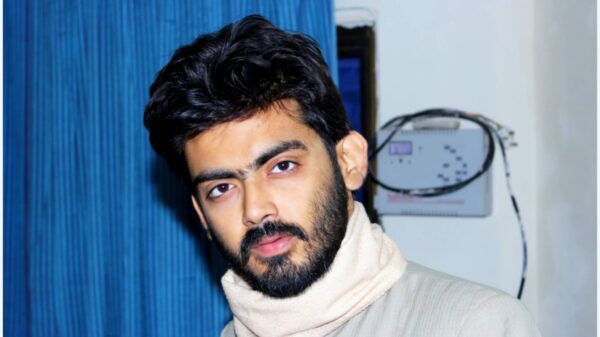

















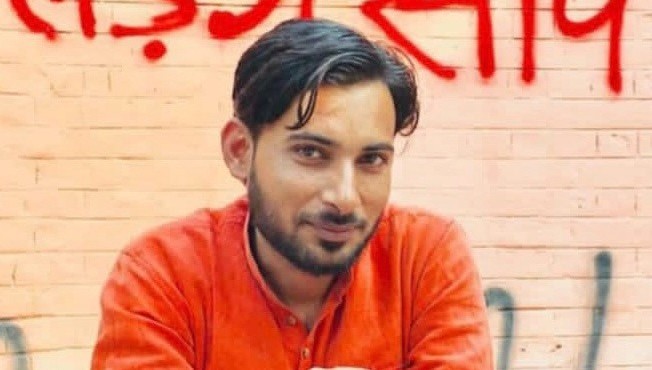
Nestled between hills and stretches of stony land, the village of Umariya in Madhya Pradesh reflects the hardships faced by many rural regions of India. Broken roads, chronic water scarcity and agriculture dependent entirely on rainfall define everyday life. Yet, amid these struggles, a quiet story of hope and resistance has taken shape through the work of Azmat Ullah Khan.
Azmat grew up in a modest household with five brothers, a sister and his parents. Money was scarce, but curiosity and compassion shaped his early years. He left school after Class 10 to support his family, but his connection with his community never weakened. Even while working, he found himself drawn to social service. After five years of community work, he returned to education and completed a Bachelor of Social Work, combining lived experience with formal learning.
“Iss desh me azaadi mili hai, lekin azaadi ka matlab sabke liye ek jaisa nahi hai (This country has gained independence, but the meaning of independence is not the same for everyone),” Azmat often says, reflecting on inequality and exclusion.
A defining moment came in 2007, when he attended a youth camp. What began as a casual visit transformed his worldview. “Wahan jo log the unki baatein mere dil ke bilkul kareeb thi. Woh jo bolte the, wahi karte the. Jhoot nahi, nuksaan nahi. Yeh baatein sirf bolne ki nahi thi, jeene wali thi (The people there spoke words that resonated deeply with me. They practiced what they preached. No lies, no harm. These weren’t just empty words; they were principles they lived by)” he recalls.
Soon after, during a visit to Jangela village, Azmat witnessed a moment that stayed with him forever. One night at around 2 am, he was awakened by sounds outside. Stepping out, he saw villagers walking silently in the darkness, carrying empty containers. When he asked where they were going, a woman replied, “Abhi nahi jaayenge to paani nahi milega (If we don’t go now, we won’t get any water.)”
The villagers were walking two kilometres in the dead of night to fetch water. Watching them disappear into the darkness, Azmat felt shaken. “Yeh sirf garibi nahi hai, yeh asamman hai (This is not just poverty, it is humiliation),” he thought to himself.
That night, he returned to the writings of Mahatma Gandhi and found his own thoughts reflected in Gandhian ideas of truth, nonviolence and collective strength. Since 2003, Azmat has been associated with the Rashtriya Yuva Foundation, working on issues of rural development. In 2024, he founded his own organisation, Nav Srijan Vikas Samvad Samiti, to focus deeply on 25 villages around Umariya.
His work centres on forming youth and women’s groups and training them on nutrition, health, livelihoods and awareness of rights. But the path has been fraught with resistance. “Pehle log samuhik the. Aaj har koi sirf apne liye sochta hai (In the past, people were community-oriented. Today, everyone thinks only of themselves),” he says. “Gaon me sab milke baithte the, ab rajneeti ne logo ko baant diya hai(In the villages, everyone used to sit together, but now politics has divided the people)”
When Azmat attempted to build a community-owned water system, political actors spread suspicion, accusing him of working for personal gain. Support from authorities did not come easily, and threats followed. Still, he refused to step back.
Instead, he turned to a new idea rooted in joy, dialogue and unity. This led to the birth of the Samvidhan Picnic. Every month, people from different castes, religions, genders and villages gather in open spaces. They cook together, play games and discuss constitutional values through conversation rather than lectures.
“Yeh picnic nahi, ek soch hai (This isn’t just a picnic, it’s an idea)” Azmat explains. “Ladka ladki ek saath khaana banate hain, sab ek saath baith ke khate hain. Yehhi toh samvidhan hai, ekta, samaanta aur nyay (The boy and the girl cook together, and everyone eats together. This is what the constitution is all about: unity, equality, and justice)”
In 2023, Azmat attended a training under We The People Abhiyan. Activities like the Tapu exercise and the pen game helped him realise that while he had been working on rights for years, he had rarely named their source. “Hum samvidhan ka zikr nahi karte the, bas kaam karte the. Training ke baad samjha ki jab hum samvidhan ka naam lete hain, toh baat aur mazboot hoti hai (We didn’t mention the constitution; we just did our work. After the training, we understood that when we invoke the constitution, our arguments become stronger),” he says.
Today, the Constitution forms the backbone of his conversations and campaigns. His work has reached more than 10,000 people across 25 villages. He focuses on training others, especially young people and women, to carry the movement forward.
“Phone se zyada kuch nahi hai mere paas. Par jab dil me vishwas ho, toh rasta khud ban jaata hai (I don’t have much besides my phone. But when you have faith in your heart, the path opens up on its own),” Azmat says quietly.
Azmat Ullah Khan’s voice may not be loud, but his resolve is firm. He believes real change does not begin in government offices but under trees, in kitchens, on playgrounds and during meals shared by people who once saw each other as strangers.
“Yeh desh tabhi badlega jab log ek dusre ko doosra nahi, apna samjhen (This country will only change when people start seeing each other not as strangers, but as their own)”.