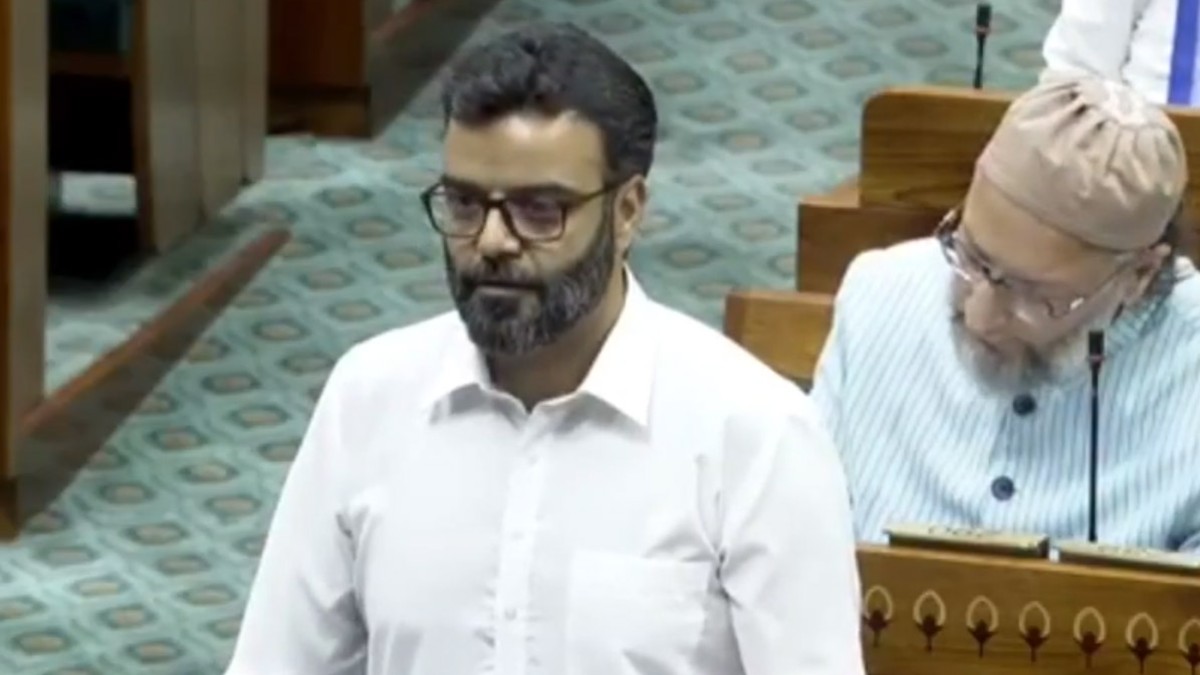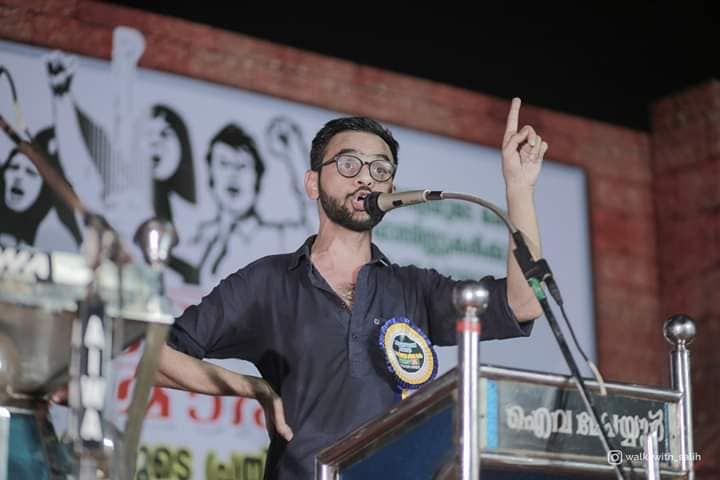
After the Supreme Court on Monday denied him bail in the 2020 Delhi riots larger conspiracy case, activist and scholar Umar Khalid told a friend that prison had now become his life, even as he expressed happiness for his co-accused who were granted bail.
Khalid, who has been in jail since September 2020 under the Unlawful Activities Prevention Act, said he was relieved that others had secured their freedom. His friend Banojyotsna Lahiri shared his reaction on social media, quoting him as saying, “I am really happy for the others, who got bail. So relieved.” When she told him she would come the next day for mulaqat, Khalid replied, “Good good, aa jana. Ab yahi zindagi hai.”
A bench of Justices Aravind Kumar and N V Anjaria refused bail to Khalid and Sharjeel Imam, while granting bail to activists Gulfisha Fatima, Meeran Haider, Shifa Ur Rehman, Mohd Saleem Khan and Shadab Ahmad. All the accused are booked under the UAPA and provisions of the Indian Penal Code in connection with the alleged larger conspiracy behind the February 2020 northeast Delhi riots.
The Supreme Court held that all the accused do not stand on the same footing and that bail cannot be decided by applying a uniform standard. Referring to a “hierarchy of participation,” the bench said each bail application must be examined individually based on the role attributed to the accused and the material on record.
“This court is satisfied that the prosecution material disclosed a prima facie allegation against the appellants Umar Khalid and Sharjeel Imam. This stage of the proceedings does not justify their enlargement on bail,” the bench said. It added that while Article 21 of the Constitution requires the state to justify prolonged pre-trial custody, delay in trial cannot operate as a “trump card” that automatically displaces statutory safeguards under the UAPA.
The court observed that Khalid and Imam stand on a qualitatively different footing compared to the other accused, noting that the statutory threshold under Section 43D(5) of the UAPA is attracted in their case. At the same time, it clarified that granting bail to the five others does not dilute the allegations against them.
Opposing the bail pleas, the Delhi Police argued that the 2020 riots were not spontaneous but a pre-planned and well-orchestrated conspiracy aimed at destabilising the state. Additional Solicitor General S V Raju told the court that in a conspiracy, the acts of one accused can be attributed to others, and that speeches made by the Imam could be read against Khalid and vice versa.
The February 2020 riots broke out during protests against the Citizenship Amendment Act and the proposed National Register of Citizens. The violence left 53 people dead and more than 700 injured. Khalid, Imam and several others have been in custody for over five years in the case.
Khalid’s father, S Q R Ilyas, declined to comment on the Supreme Court’s decision. “I have nothing to say. The judgment is before you,” he said.
While refusing bail to Khalid and Imam, the Supreme Court left open a limited window for them to apply again after the examination of protected witnesses or after one year. The bench also directed the trial court to ensure that the proceedings are not unnecessarily delayed, reiterating that deprivation of liberty before conviction should not be arbitrary even under special laws like the UAPA.