Sayima Ahmad
The Jammu and Kashmir administration on Friday, April 24, slapped the stringent Public Safety Act (PSA) against six Kashmiri youngsters for their alleged involvement in vandalism during a recent student protest in the Sopore town of Baramulla district.
The action was taken weeks after an Urdu male lecturer at a local school, identified as Ghulam Hassan Mir, was accused of harassment and inappropriate behaviour by a ninth-grade female student, which triggered a student-led mass protest that reportedly spiralled into vandalism and stone-pelting, forcing authorities to shut down educational institutions across Sopore town from April 15 to 18 to prevent spillover.
Soon after the peaceful protests turned violent, the senior superintendent of Sopore police, Iftikhar Talib, addressed the media, assuring that Mir was placed under suspension in an order by the Directorate of School Education, and a police case was also filed against him. The police official also issued a stern warning against “perpetrators”, saying, “Any attempt to exploit sensitive situations or engage in acts that disturb public order will invite strict and immediate action under the law”.
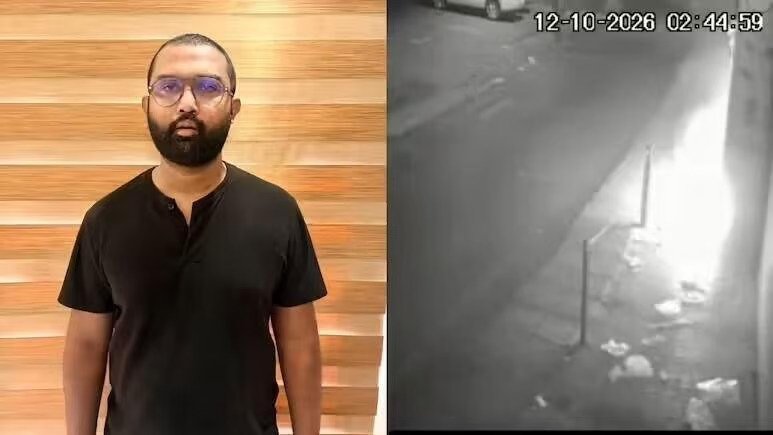
Speaking on the recent development, a police spokesperson stated that during the investigation, a series of CCTV footage was examined, and dozens of students as well as locals were taken for questioning, leading to the arrest of the six men involved in the vandalism and stone pelting.
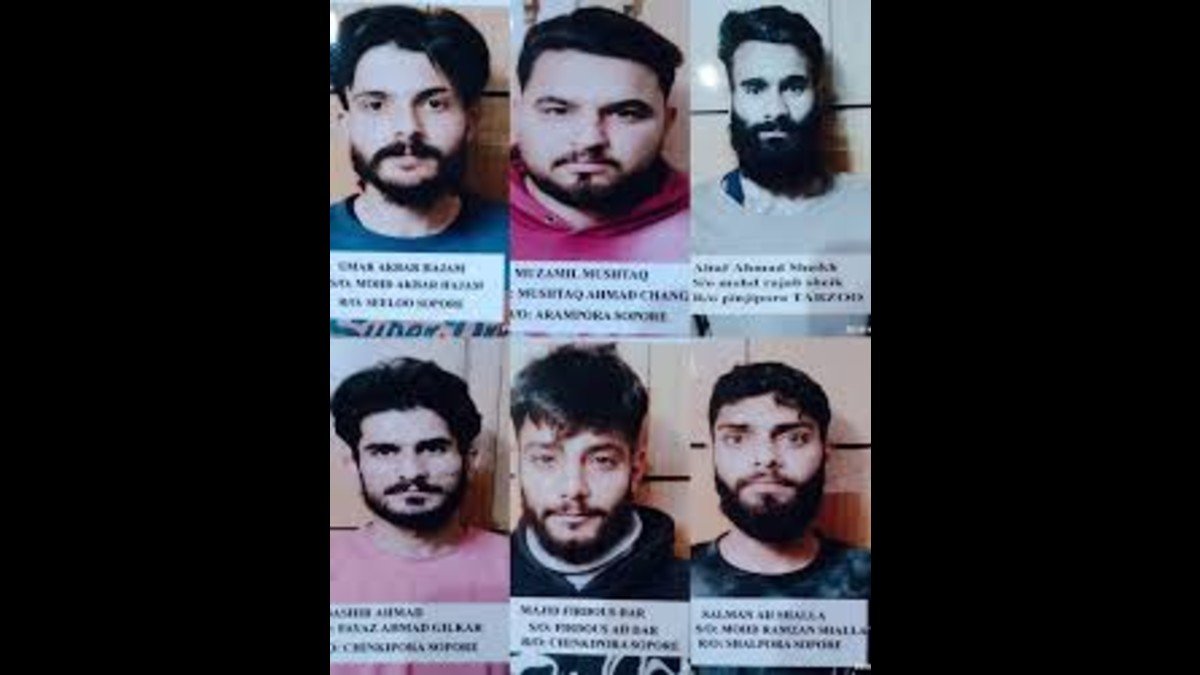
The police officials released photographs and names of the six detainees identified as Umar Akbar Hajam, Salman Ahmed Shala, Altaf Ahmed Sheikh, Mubashir Ahmed Gilkar, Muzammil Mushtaq Changa and Majid Firdous Dar, all residents of Sopore town. However, the police officials have not revealed their age or occupation.
The authorities stated that the six accused have been charged with “Instigating unrest, damaging property and attempting to disrupt peace”. The officials further said that the accused have been sent to the District Jail Bhadarwah in the Doda district of Jammu region, adding that the investigation is still underway and more individuals involved in the incidents are being identified and will face similar legal action, including detention under the PSA.
What is PSA?
The Public Safety Act (PSA) is a specialised preventive detention law applicable only within Jammu and Kashmir, now a Union territory. It allows authorities to detain individuals for up to two years without trial to prevent actions harming the security of the state or the maintenance of public order
It enables detention of persons over 18 for up to 6 months (renewable) for public disorder, without immediate bail rights or legal representation. It is a local law enacted in 1978 by the erstwhile state government led by Sheikh Muhammad Abdullah. It received the governor’s assent and officially became law on 8 April 1978. The law is not enforced anywhere else in India.
While its initial stated purpose was related to environmental protection and forestry, it is now frequently used against political opponents, journalists, activists, and protesters.
In recent years, the law has been criticised by many activists and Human rights organisations, including Amnesty International, which famously labelled it a “lawless law” because it circumvents ordinary criminal justice safeguards
In 2025, All India Majlis-e-Ittehadul Muslimeen (AIMIM) president Asaduddin Owaisi also criticised the law, while describing it as “untold suffering and human rights violations”. On his X account, he wrote, “The law has been misused by virtually every elected CM & unelected Governors. Over 20,000 people have been jailed since 1978 without criminal charges, fair trials or even a proper appeals process”.
The Jammu and Kashmir High Court has frequently quashed individual detention orders, slamming authorities for using the law in a “mechanical” manner. In late 2025, the court quashed an order where an innocent man was detained because he shared a name with a suspect.
On October 28, while addressing the media, J&K Chief Minister Omar Abdullah said, “We said in the manifesto that we would remove the PSA from Jammu and Kashmir. To remove it, we must have statehood. Security, law and order, all these things should be under the control of the elected government. The day these things are ours, I won’t even wait for the assembly session. We will remove the PSA through an ordinance”.