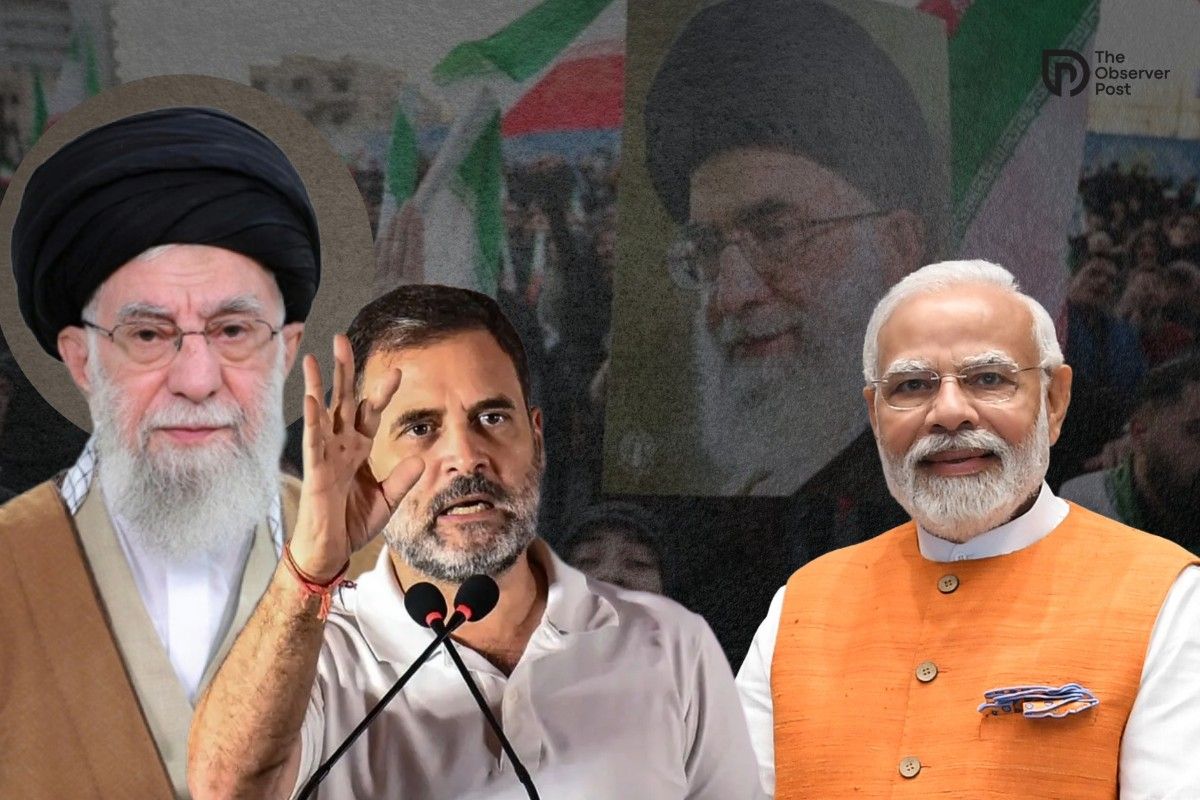
Congress leader Rahul Gandhi on Tuesday asked Prime Minister Narendra Modi to clearly state his position on the killing of Iran’s Supreme Leader Ayatollah Ali Khamenei. Khamenei was killed on March 1 in a joint military operation carried out by the United States and Israel.
In a post on social media, Rahul Gandhi said the rising tensions between the US, Israel and Iran were pushing an already fragile region towards a wider conflict. He warned that crores of people, including Indians living in West Asia, were facing uncertainty due to the escalating crisis.
“While security concerns are real, attacks that violate sovereignty will only worsen the crisis,” Gandhi wrote. He added that unilateral attacks on Iran, as well as Iran’s retaliatory strikes on other countries in the region, must be condemned.
“India must be morally clear,” he said. “We should have the courage to speak plainly in defence of international law and human lives.”
Rahul Gandhi further said that India’s silence at such a crucial moment reduces its global standing. “PM Modi must speak up. Does he support the assassination of a head of state as a way to define the world order?” he asked.
Sonia Gandhi Calls Silence a Grave Concern
Congress Parliamentary Party chairperson Sonia Gandhi also criticised the government’s response. Writing in The Indian Express on Monday, she described the killing of a sitting head of state during an ongoing diplomatic process as a serious break in international relations.
“Yet, beyond the shock of the event, what stands out equally starkly is New Delhi’s silence,” she wrote.
Sonia Gandhi said that silence in this situation cannot be seen as neutrality. According to her, it amounts to abdication. She pointed out that Prime Minister Modi had initially condemned Iran’s retaliatory strike on the United Arab Emirates without mentioning the events that led to it. Later, he expressed concern and called for dialogue and diplomacy, though diplomatic efforts were already underway before the attacks.
“Silence, in this instance, is not neutral,” she wrote. She added that the targeted killing, carried out without a formal declaration of war, challenges the principles of sovereignty and international law laid down in the United Nations Charter.
Background of the Conflict
The conflict began after Israel and the United States launched a joint operation targeting Iran’s leadership. Israel claimed that Iran’s actions posed an existential threat and said Tehran was closer than ever to developing a nuclear weapon.
Iran has repeatedly maintained that its nuclear programme is meant for civilian purposes and denies any plan to build nuclear weapons.
The killing of Ayatollah Ali Khamenei, who had led Iran since 1989 and controlled key branches of the government and armed forces, has sharply escalated tensions in the region. Many observers fear that the crisis could lead to a larger war affecting West Asia and beyond.
India’s Official Position
So far, New Delhi has not issued a direct statement on Khamenei’s killing. However, Prime Minister Modi has spoken to leaders in the region.
On Sunday, Modi said he spoke to UAE President Sheikh Mohamed bin Zayed Al Nahyan and condoled the deaths in the UAE. “We support de escalation, regional peace, security and stability,” Modi said, adding that he thanked the UAE leadership for taking care of the Indian community there.
On Monday, Modi also held a phone conversation with Israeli Prime Minister Benjamin Netanyahu. He said he conveyed India’s concerns over recent developments and emphasised that civilian safety must be a priority. “India reiterates the need for an early cessation of hostilities,” Modi said.
The Congress has now demanded a clearer and stronger stand from the government as tensions continue to rise in West Asia.