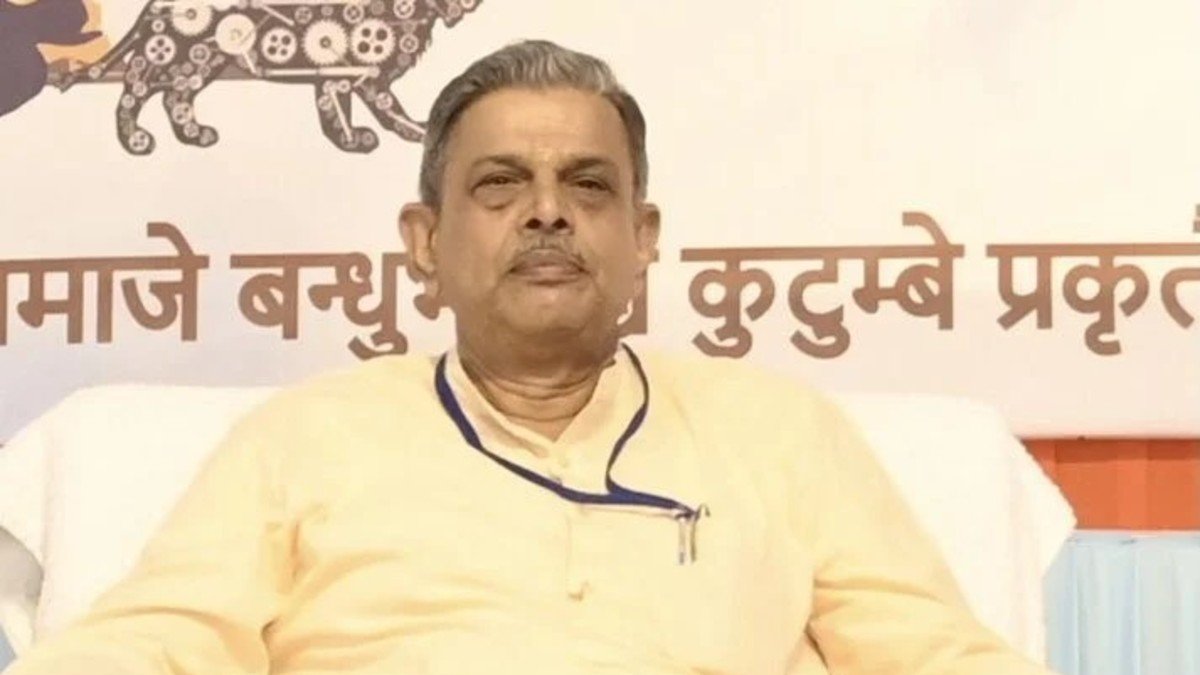
Rashtriya Swayamsevak Sangh (RSS) General Secretary Dattatreya Hosabale has rejected comparisons between the RSS and the American white supremacist group Ku Klux Klan, saying such narratives are based on misunderstanding and misinformation.
Speaking at the New India Conference organised by the Hudson Institute, Hosabale said the RSS has often been wrongly portrayed as a “Hindu supremacist” or “anti-minority” organisation.
“The narrative that has been built for decades is that RSS is a Hindu supremacist organisation or anti-Christian, anti-minority, anti-development and anti-modernisation,” he said.
He added, “So what is pro is not highlighted; instead, the anti has always been propagated… some Indian version of the Ku Klux Klan, which we are not.”
RSS Described as Cultural and Volunteer-Based Organisation
Hosabale said the RSS is a volunteer-driven organisation rooted in India’s civilisational and cultural traditions.
“RSS is a people’s voluntary movement inspired by cultural ethos and civilisation values of ancient India, which is generally known as Hindu culture,” he said.
He explained that the organisation works through daily and weekly gatherings called shakhas, where volunteers are trained in discipline, service and character building.
“Through these one-hour gatherings called shakhas, we inculcate values of life,” he said.
According to him, the RSS operates around 83,000 shakhas across India and engages in relief work during natural disasters as well as activities related to education, health, rural development and environmental issues.
Hindu Identity and Civilisational View
Hosabale said the RSS sees Hindu identity as a civilisational concept rather than a narrow religious identity.

“We see oneness in everything, living and non-living. When that is the basic philosophy, the question of supremacism does not arise,” he said.
He also said that, historically, Hindu society has not been expansionist or militaristic.
“In history, Hindus have never invaded any country,” he said.
On Relations With Minorities and Neighbours
The RSS leader said tensions involving minorities or neighbouring countries arise due to political misunderstandings and misinterpretation of history.
“Tensions with minority groups and neighbouring countries stem from political interests and wrong interpretations of history,” he said, adding that dialogue is important to resolve differences.
Referring to regional geopolitics, he said issues with neighbouring countries are linked to political leadership and historical developments.
“The problem is only with one neighbouring country which was born out of the Indian womb,” he said, without naming Pakistan.
Culture and Modernisation Can Coexist, Says Hosabale
Hosabale also spoke about the relationship between cultural values and modernisation, saying the two are not contradictory.
“Both modernisation and cultural values require adaptation according to the times,” he said.
He added that countries like India, Japan and China have modernised while maintaining their cultural identities.
“Whether it is Hindu society, Indian society, Japan or China, all have modernised while keeping their civilisational values intact,” he said.
Reception in United States
Hosabale’s visit included a reception hosted by members of the Indian American diaspora in Virginia, where he interacted with attendees from the Washington region.