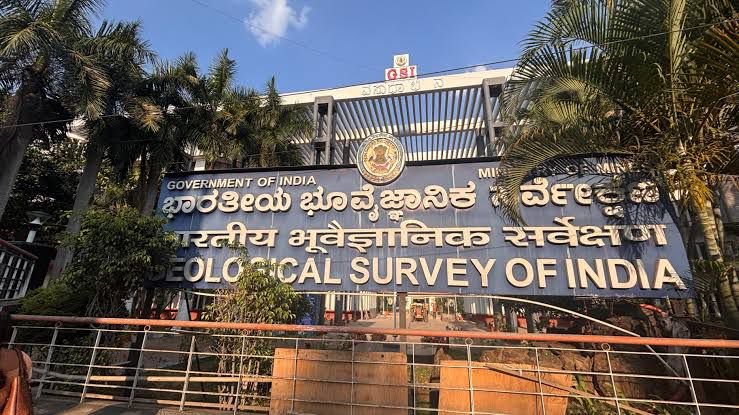
The Geological Survey of India (GSI), which claims to read what lies beneath the nation’s surface, cannot account for who is missing from within its own walls. New data shows Muslims hold fewer than 3% of central headquarters posts in one of the country’s oldest scientific institutions.
The Geological Survey of India was founded in 1851 to read the earth beneath the subcontinent’s feet — its coal, its rock, its hidden mineral wealth. One hundred and seventy-five years later, a new accounting of its human composition reveals something the agency has not surveyed: the near-total absence of Muslims from its workforce.
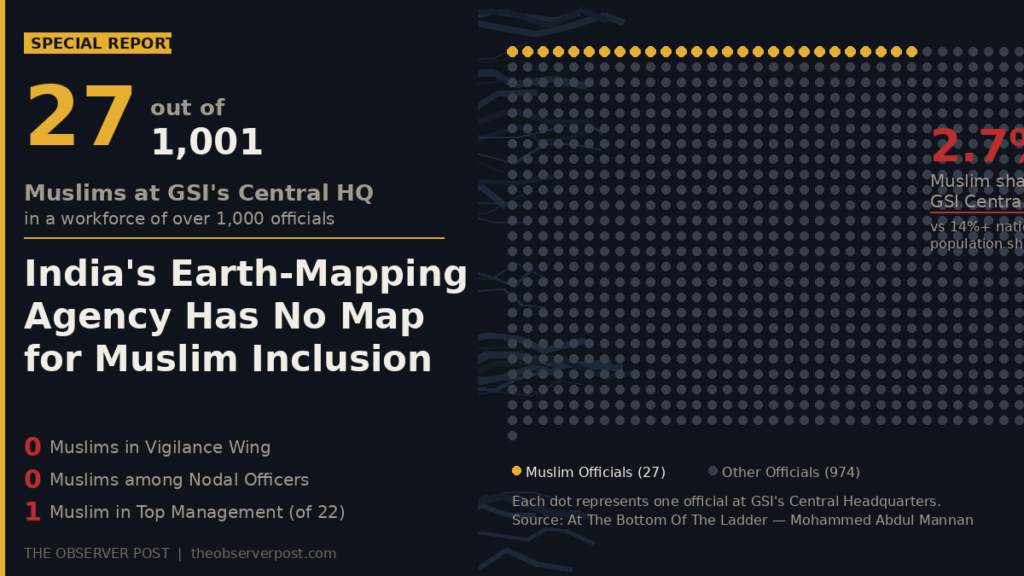
According to data compiled in Mohammed Abdul Mannan’s recently published book At The Bottom Of The Ladder: State Of The Indian Muslims, only 27 Muslims are employed among the 1,001 officials at the GSI’s Central Headquarters in Kolkata. That is a representation rate of approximately 2.7% — in an organisation serving a country where Muslims make up over 14% of the population.
No Muslim in Vigilance. None Among Nodal Officers
Of the GSI’s 22-member top management team, just one official is a Muslim — N Shareef Mohamed, a Deputy Director General posted in Mangalore. Among the organisation’s 11 Nodal Officers, there is no Muslim. Among the 12 Vigilance officials — the very personnel entrusted with internal accountability and oversight — there is no Muslim. Among the nine Grievance officials, there is no Muslim.
A Region-by-Region Picture of Absence
Across the GSI’s regional spread, the numbers offer little variation. The Northern Region, with 839 officials, has 46 Muslims. The Southern Region’s headquarters, one of the larger offices with 1,214 officials, counts 51 Muslims.

The Western Region, with 836 officials, has 32. The Eastern Region, with 1,142, includes four director-level Muslim officials and 17 others, alongside 15 in administrative roles. The North Eastern Region in Assam records 12 Muslims among 584 officials. The Remote Sensing and Aerial Survey wing has just four Muslims among 123 officials.
The GSI Training Institute, which shapes the next generation of the organisation’s scientific workforce, has four Muslim officials out of 83.
The pattern is not an anomaly. It is structural. The data on the GSI appears as part of a broader audit conducted in Mannan’s book, which maps Muslim representation across 150 key central government organisations, ministries, and departments. The findings at the GSI are not isolated. They are consistent with a pattern documented across India’s public scientific institutions — where Muslims, already underrepresented in higher education pipelines, find diminishing presence as institutions grow in seniority and authority.
The Sachar Committee Report of 2006 had flagged Muslim underrepresentation in government employment as a crisis requiring urgent corrective action. Nearly two decades on, data from organisations like the GSI suggests that the crisis has not been yet resolved.
The GSI currently operates as an attached office of the Union Ministry of Mines and maintains six regional offices across Lucknow, Jaipur, Nagpur, Hyderabad, Shillong, and Kolkata, with unit offices in nearly every state. It is among the world’s oldest active geoscientific institutions.