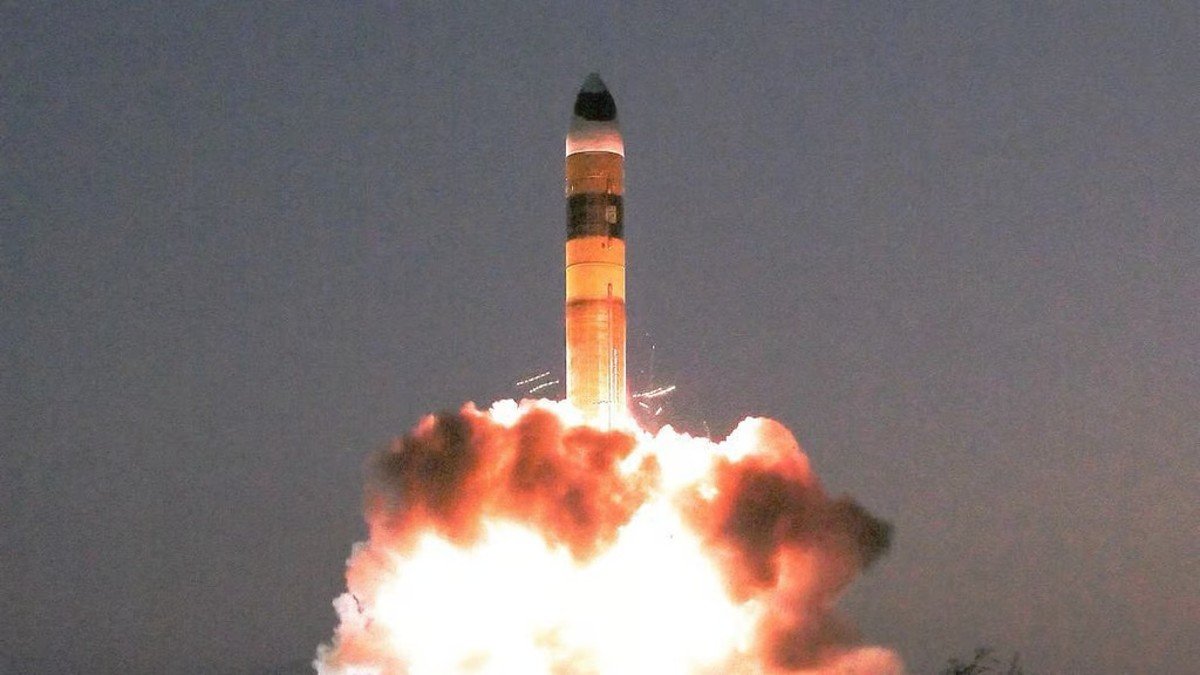
India has successfully carried out another flight test of the advanced Agni-5 missile equipped with Multiple Independently Targetable Re-entry Vehicle (MIRV) technology, further strengthening the country’s nuclear deterrence capability.
The test was conducted on Friday from Dr APJ Abdul Kalam Island, according to the Defence Ministry.
Officials said the missile successfully carried multiple payloads aimed at different targets spread across a large geographical area in the Indian Ocean region.
In a statement, the ministry said, “The missile was flight-tested with multiple payloads targeted at different locations spatially distributed over a large geographical area in the Indian Ocean Region.”
The ministry added that telemetry and tracking systems stationed on the ground and ships monitored the missile’s entire trajectory from launch to impact and confirmed that all mission objectives were achieved successfully.

MIRV capability allows multiple nuclear strikes from one missile
The MIRV system allows a single missile to carry several nuclear warheads capable of striking different targets independently over long distances.
Although officials did not confirm the exact number of warheads the missile can carry, defence experts estimate the MIRV-equipped Agni-5 can deliver four to five warheads simultaneously.
The successful test places India among a small group of countries possessing operational MIRV capability, including the United States, Russia, China, France, and the United Kingdom.
Defence Minister Rajnath Singh praised the achievement and said it significantly strengthens India’s defence preparedness.
Second successful test of MIRV-capable Agni-5
The latest launch marks the second known test of the MIRV-enabled Agni-5 variant, also referred to as “Divyastra.”

India had first tested the system in March 2024 under the codename Mission Divyastra, announced by Prime Minister Narendra Modi.
The missile is still expected to undergo additional validation trials before being formally inducted into the Strategic Forces Command.
Agni-5 can strike targets over 5,000 kilometres away
The Agni-5 missile has a strike range of more than 5,000 kilometres and uses a three-stage solid-fuel engine system.
The missile is part of India’s Agni missile series developed by the Defence Research and Development Organisation (DRDO). Other variants include Agni-1, Agni-2, Agni-3, and Agni-4, with ranges varying from 700 km to 4,000 km.
According to defence sources, one major improvement in the latest Agni-5 version is the use of a lighter carbon composite missile casing instead of maraging steel. This reduces the missile’s overall weight while improving payload efficiency.

Part of India’s nuclear deterrence strategy
India follows a “No First Use” nuclear doctrine, under which nuclear weapons are intended only for retaliation in response to a nuclear attack.
The country maintains a nuclear triad capability, meaning it can launch nuclear weapons from land, air, and sea platforms.
Earlier this year, India also inducted INS Aridaman, strengthening the sea-based leg of its strategic nuclear forces.
According to the Stockholm International Peace Research Institute (SIPRI), India possessed around 180 nuclear warheads as of January 2025, compared to Pakistan’s estimated 170 and China’s 600.