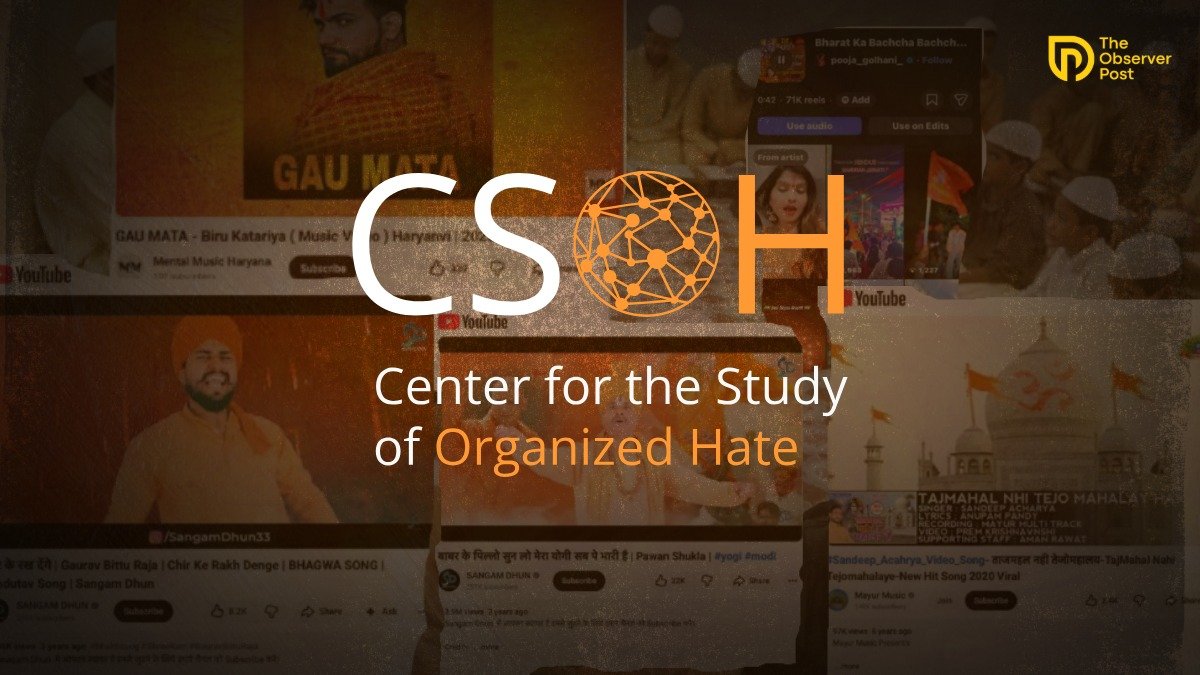
A new study by the Washington-based nonprofit think tank The Center for the Study of Organized Hate (CSOH) has identified more than 500 alleged hate songs linked to Hindutva pop music across major digital platforms, raising concerns about online hate speech targeting religious minorities, particularly Muslims and Christians.
CSOH, a nonprofit and nonpartisan research organisation, said the songs violate platform content policies by promoting hatred, dehumanisation and incitement to violence. The organisation said its work focuses on advancing research and informing policies to combat hate, extremism, violence, radicalisation and disinformation.
According to the report, researchers identified 523 Hindutva pop hate songs across YouTube, Spotify, Apple Music and Meta’s Music Library. The study found 210 songs on YouTube, 109 on Spotify, 103 on Meta’s Music Library and 101 on Apple Music.
Researchers said the content often included threats against mosques, communal slurs, conspiracy theories and language encouraging hostility toward minority communities, especially Muslims and Christians.
Half of the Songs Allegedly Promote Violence
The report claims that nearly one in every two songs explicitly calls for violence. Out of the 523 songs examined, 263 allegedly contained direct threats or incitement to violence against religious minorities, while the remaining songs reportedly spread hate through dehumanising language and abusive stereotypes.

“The overall effect is a self-reinforcing ecosystem in which hateful rhetoric and violent threats against religious minorities are encouraged, rewarded, and largely free from scrutiny or consequence,” the report stated.
The study warned that such online content risks contributing to fear, discrimination and violence in real life.
Millions of Views and Monetisation Raise Questions
According to CSOH, hate songs on YouTube alone received more than 198 million views, while songs available through Meta’s Music Library were used in over 5.9 million Instagram Reels.
The report further alleged that just three YouTube channels account for over 40 percent of the identified hate songs, yet continue to function as verified and monetised channels.
Researchers also found advertisements from 103 brands appearing alongside such videos. Advertisers reportedly included ChatGPT, Google’s NotebookLM, Amazon Prime, Adobe, Dell, Flipkart, Kellogg’s, Levi’s and the Reserve Bank of India.
The study also highlighted YouTube’s monetisation features, stating that 55 percent of the identified videos had “Super Thanks” enabled, allowing creators to earn directly from viewers. One channel, Mayur Music, which allegedly hosted 25 violative songs, had also received YouTube’s Silver Creator Award.
On Meta platforms, researchers said 20 out of 30 prominent Hindutva singers studied had monetised Facebook accounts, enabling them to generate revenue through engagement.
Platforms Accused of Weak Enforcement
The report criticised digital platforms for what it described as weak enforcement of their own content rules.
Researchers said a sample of 225 songs was reported to the platforms in October 2025, but by May 2026, 207 songs — or 92 percent — were still online, while only 18 had been removed.
The study also pointed to difficulties in reporting content on some platforms. While YouTube and Meta were described as relatively easier to report, researchers said Spotify and Apple Music lacked effective reporting systems, claiming that submitting a complaint on Spotify could take more than 33 minutes through live chat.

Call for Stronger Action
The report urged technology companies to improve moderation in Indian languages, increase transparency around monetisation and recommendation systems, and take stronger action against repeat offenders.
Researchers warned that creators whose accounts are suspended often return through new channels. The report cited singer Sandeep Acharya, whose accounts were allegedly suspended several times, while 21 of his 26 identified songs remained available on other YouTube channels.
CSOH concluded that stronger intervention is urgently needed to prevent online hate content from further deepening social divisions and fuelling hostility against minority communities.