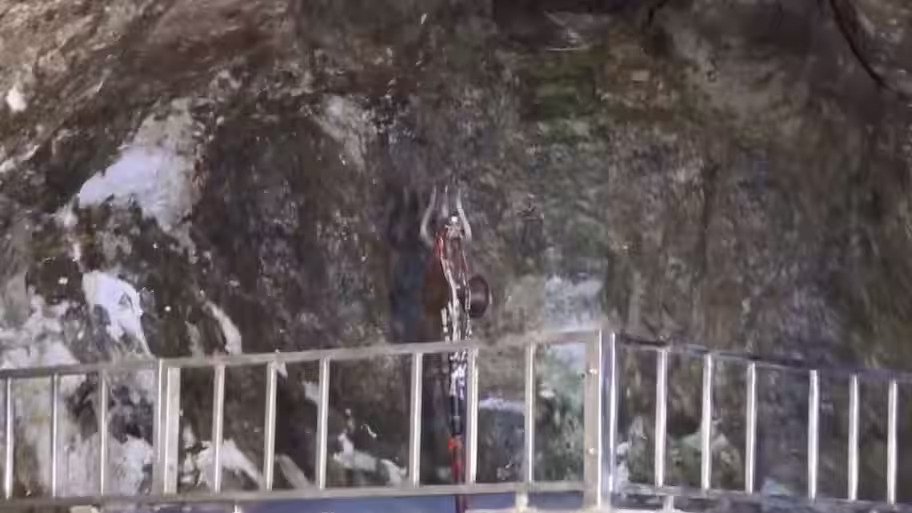
The naturally formed ice Shivling inside the sacred Amarnath Cave has almost completely melted within the first week of the annual Amarnath Yatra.
The ice stalagmite, popularly known as Baba Barfani, was nearly seven feet tall in May but had shrunk drastically by July 7. According to experts, rising temperatures, reduced snowfall, recurring heatwaves and heavy pilgrim footfall inside the cave have contributed to the rapid melting.
Despite the disappearance of the ice formation, the 57-day Amarnath Yatra is continuing without interruption, as thousands of devotees continue to visit the shrine, saying the cave itself holds immense spiritual significance.
Devotees say faith is greater than the ice formation
Many pilgrims who recently completed the yatra said the melting of the Shivling had not affected their devotion.
Shashank Gupta, a devotee, praised the arrangements made for the pilgrimage and said, “The arrangements were excellent. We did not face any problems during the Yatra. Baba Ji has almost disappeared, and we could only see a faint trace of the Shivling. But faith remains strong. Our purpose was to reach Baba’s darbar, offer prayers and seek His blessings.”

Another pilgrim, Aman Chawla, said the growing number of visitors reflected people’s devotion.
“We had a wonderful darshan. There is a much larger crowd this year. Baba has not disappeared because He lives in everyone’s heart. The ice formation is still visible today, but it may completely melt soon. I believe the pilgrimage should begin 10 to 15 days earlier so that more devotees can witness the holy Shivling. The security arrangements are excellent,” he said.
Divyanshu Khanna also said the spiritual experience remains unchanged even after the melting of the ice formation.
“Baba has vanished, yet faith remains. People still come because they can feel His presence throughout the cave. One possible reason for the early melting is pollution and the huge number of pilgrims visiting every day,” he said.
Another devotee, Jatinder Dullat, who travelled with a group of 52 pilgrims from Ludhiana, said, “Everyone had a blessed darshan. Baba has now completely disappeared, but the Yatra is being managed well. The only challenge is the huge rush of pilgrims and difficulty in getting registration slots.”

Experts blame climate change and rising temperatures
Environmental experts say the early melting is the result of several factors working together.
The ice Shivling forms naturally when water dripping from the cave roof freezes layer by layer, creating an ice stalagmite. This process requires sustained sub-zero temperatures inside the cave.
Experts say warmer summers, weak winter snowfall and repeated heatwaves have made it increasingly difficult for the formation to survive.
They also point out that between 13,000 and 20,000 pilgrims can visit the cave on peak days. The collective body heat generated inside the enclosed cave, along with dust and pollutants settling on surrounding glaciers, further accelerates melting.
This is the third consecutive year that the ice Shivling has melted within the first week of the pilgrimage.

How the ice Shivling forms naturally
Scientists explain that the Amarnath Shivling is not carved or man-made. It is a naturally occurring ice stalagmite formed when glacier meltwater seeps through cracks in the rocks above the cave and freezes on the cave floor.
Research by earth scientists has shown that the formation depends on weather conditions, snowfall, meltwater supply and cave temperature. While science explains the natural process behind its formation, devotees continue to regard it as a sacred manifestation of Lord Shiva.
Yatra continues with security and registration restrictions
The Amarnath Yatra, which began on June 28, will continue until Raksha Bandhan. Pilgrims are travelling through both the traditional Pahalgam route and the shorter Baltal route under heavy security.
The administration has also advised devotees not to travel without valid registration, stating that only registered pilgrims are being allowed to proceed due to heavy rush and security protocols.