Habeeba Haneef Mohammad
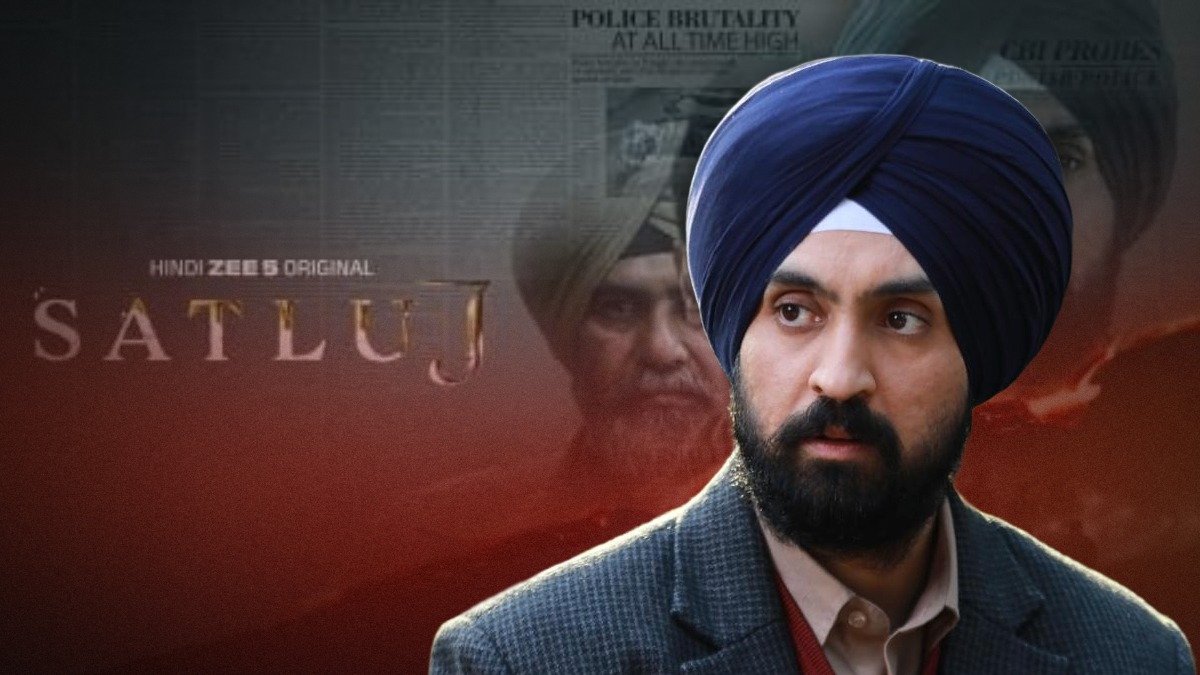
Satluj, previously Punjab 95, was released on Zee5 on 3rd of July, 2026, soon to be taken down in less than two days. The platform pulled out the film within hours of its release and issued a statement announcing that, “In the light of current developments, Satluj will be unavailable in India until further notice.” Later, PTI reported that the Union Government had directed the streaming platform to remove the film, citing security concerns and obligations under the Information Technology Rules, 2021.
The film, directed by Honey Trehan and featuring Diljit Dosanjh, Survinder Vicky and Arjun Rampal, has been battling for its release for the last four years, since 2022. The Central Board of Film Certification had demanded a new title and 127 cuts. The makers of the film challenged this in the Bombay High Court but later withdrew the petition. After years of delay, the film was renamed Satluj and released without cuts on Zee5.
The film follows the life of Jaswant Singh Khalra, a bank employee turned human rights activist who uncovered what is said to be one of the darkest chapters in Punjab’s history. In the 1990s, Khalra alleged that thousands of unidentified bodies had been secretly cremated during the state’s battle against militancy. He exposed thousands of extrajudicial killings and illegal mass cremations by the Punjab Police before he was abducted and murdered in 1995.
Diljit, who plays Khalra in the film, had urged his fans to watch the film as soon as possible and predicted that it might not stay online for too long. Post the removal of the film from Zee5, Diljit expressed his satisfaction with the film being already watched and downloaded. In an Instagram post, he wrote, “Satluj suffered the same fate as Jaswant Singh Khalra.”
Diljit’s career has been shaped by films such as Punjab 1984, Udta Punjab, Jogi, and now Satluj, works deeply entangled with questions of state violence, memory, displacement, and Sikh political history. In 2020, his vocal support for the farmers’ protest further reinforced an image of an artist willing to engage politically. In 2022, during the promotions of his film, Jogi, which was centred around the anti-sikh violence following the assassination of Indira Gandhi in 1984, a clip where Diljit can be seen correcting and asking a film critic to call the violence “genocide” and not riots went viral and gained applause.
At a moment when cultural exchanges with Pakistan had become increasingly contentious within majoritarian nationalist discourse, Diljit chose to collaborate with a Pakistani artist, Hania Amir, for his film Sardaar Ji 3. However, due to the Pahalgam Attack, the film wasn’t released in India as a result of massive backlash and calls for a boycott.
Yet his subsequent public trajectory suggested a different mode of engagement. Within the same year, his meeting with the Prime Minister complicated public perceptions, especially when viewed alongside his earlier support for the farmers’ movement. The meeting did not erase his previous interventions, but it signalled that celebrities increasingly require negotiating with institutions of power rather than remaining permanently opposed to them.
Recently, in an Instagram live, Diljit was asked about the ongoing protest at Jantar Mantar, to which he replied, “He’s an artist and not a politician,” urging his fans to keep him away from protests. The temptation is to read Diljit Dosanjh’s recent declaration as hypocrisy or inconsistency. To insist on a separation between art and politics appears inconsistent. But inconsistency is perhaps the wrong lens.
Diljit’s politics are better understood as selective, not because he lacks conviction, but because contemporary celebrities operate within a field where political expression is constantly negotiated against economic interests, state power, and cultural legitimacy. The issue is not whether he is political; it is under what conditions politics becomes possible, profitable, or costly.
The statement “I am an artist, not a politician”, therefore, should not be understood as escaping politics. It is itself a politically produced identity. It reflects a regime in which artists are expected to remain visible, marketable, and emotionally relatable while distancing themselves from sustained political confrontation. Neutrality is not the absence of politics; it is a particular political position made possible by existing power relations.
Selectivity is not simply an individual trait; it is produced by the intersection of state power, market incentives, celebrity culture, and media visibility. The contemporary celebrity is expected to be politically aware but not politically disruptive. They are encouraged to perform conscientiously without threatening the institutions that sustain their careers. They are expected to speak, but not too much; to dissent, but not too radically; to be political, but never so political that the market or the state withdraws its consent.
Satluj exposes the fragility of this balancing act, reminding us that while an artist may choose when to speak, neither the state nor the market grants art the same privilege. Diljit appeared to draw a neat boundary between art and politics. Yet the fate of Satluj exposes the impossibility of separating art from politics. The controversy surrounding Satluj is not simply about what the film depicts; it is about who gets to decide which histories remain visible, under what conditions, and for how long.
Diljit Dosanjh is not simply another Bollywood actor; he is a figure whose legitimacy was first produced by Punjabi audiences, Punjabi music, and Punjabi history. His artistic identity remains deeply rooted in the region’s language, memory, and political imagination. They are constitutive of the very cultural world from which he comes.
His active pro-farmers stance during the farmers’ movement marked one of the clearest moments of political identification in his career, and he emerged as one of its most visible celebrity supporters. He defended protesting farmers publicly and challenged narratives that sought to delegitimize the movement. The movement itself had become deeply intertwined with Punjab’s social and political identity, making silence difficult for an artist whose career had been built upon Punjabi language, music, and culture.
The irony, then, is structural rather than personal. Diljit Dosanjh’s attempt to distinguish art from politics reflects the conditions under which celebrities operate. But Satluj demonstrates that art cannot negotiate with power on its own terms. The same structures that reward cultural production also regulate its visibility. The same networks that enable celebrities can constrain artistic circulation. The irony of Satluj lies not merely in its delayed release or its subsequent disappearance, but in what those events reveal about the relationship between power and celebrities like Diljit.
Diljit has been attempting to distance himself from political identification even while continuing to act in films that are deeply political in both subject and consequence. This positioning can be read as an attempt to navigate, rather than directly confront, the institutions that regulate cultural production. Yet Satluj demonstrates the limits of such accommodation. The very institutional structures that an artist may seek to coexist with ultimately retain the power to determine which histories remain visible, remembered, under what conditions, and for how long.
His political trajectory reveals a politics that is selective, contingent, and constantly negotiated in relation to changing configurations of state power, public sentiment, and the cultural marketplace while remaining anchored in one constant: the pressures of being a Punjabi cultural icon operating within the Indian nation-state and a global entertainment market.
Habeeba Haneef Mohammad is a third-year student pursuing Sociology Hons at Jamia Millia Islamia. Her writing and research interests range from gender, media discourse, decolonial epistemologies, to the nexus of politics, culture, religion and society.
The views expressed in this article are the author’s own and do not necessarily reflect the policy of the platform.