The National Council of Educational Research and Training (NCERT) has reconstituted its textbook development team for Class 11 and 12 Political Science, with the new panel asked to incorporate themes such as cultural rootedness, Indian knowledge systems and inclusion.
The move has drawn attention because at least four members of the team have documented associations with the RSS-affiliated Akhil Bharatiya Vidyarthi Parishad (ABVP), BJP or organisations linked to the RSS.
The team has been tasked with completing the Class 11 Political Science textbook by November 2026, while the Class 12 textbook is expected to be ready by July 2027.
Who Is Leading the Textbook Team?
The team will be headed by Sandeep Shastri, an academic and political analyst who is also vice president of Karnataka-based Nitte University.
Among the members is Yadunath Deshpande, currently a senior consultant with the Ministry of Education. Records of the ABVP identify Deshpande as having previously served as its joint state organising secretary in Maharashtra and later as an organising secretary in its Mumbai-Konkan structure. His professional profile also lists experience as a political consultant for the BJP.
Prashant Divekar has been associated with Pune-based Jnana Prabodhini, an institution with links to the RSS. On the National Council for Teacher Education’s National Mission for Mentoring portal, Divekar describes his educational approach as being “rooted in Bhartiya educational philosophy”.
Another member, Vandana Mishra, a professor at Jawaharlal Nehru University’s Centre for Political Studies, is a former national secretary of the ABVP.
Ravi Rameshchandra Shukla, an associate professor at JNU, has served on the editorial board of the Indian Journal of Democratic Governance, published by the Indian Institute of Democratic Leadership-Rambhau Mhalgi Prabodhini, an organisation associated with the RSS.
NCERT Lists New Themes for Textbooks
According to an NCERT notification issued by Director Dinesh Prasad Saklani, the textbook team will work with curricular groups covering social sciences, languages, Indian knowledge systems, environmental education, innovative pedagogy and teaching-learning material.
The team will also coordinate with other groups to promote links between different grades, interdisciplinary learning and multilingual perspectives.
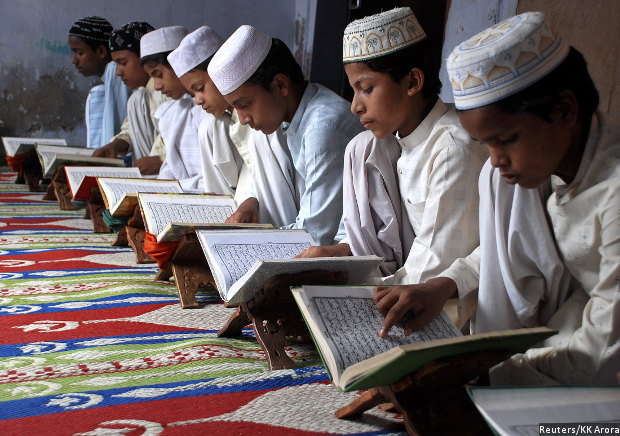
The notification said the textbooks would be reviewed to ensure the inclusion of “cross-cutting themes” such as “cultural rootedness, Indian knowledge systems, inclusion, educational technology, assessment” and other areas.
Concerns Over Political Representation
The composition of the panel has raised questions about the ideological balance of those involved in rewriting textbooks, particularly given the documented organisational backgrounds of some members.
Shukla, for instance, has conducted research on cultural and spiritual nationalism and is the principal investigator of an ICSSR-funded JNU project titled “The Role of Fests in Shaping of Spiritual and Cultural Nationalism of Bharat: A Study of Kumbha and Magh Mela.”
The wider team includes academics and educators from institutions such as JNU, Delhi University, IGNOU, National Law University, Jindal Global Law School, Pondicherry University and Utkal University, along with NCERT officials.
The reconstitution comes amid an ongoing debate over changes to school textbooks and allegations from the Opposition that the curriculum is being reshaped to reflect the ideological priorities of the present government.