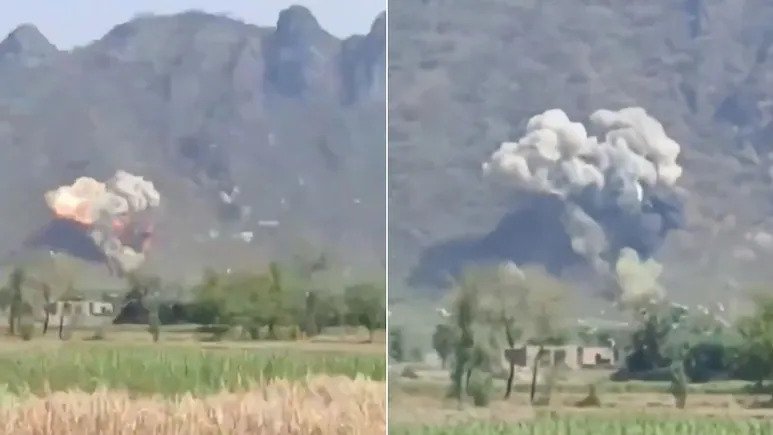
Former Chief of Defence Staff General Anil Chauhan has said that an Indian loitering munition may have struck Pakistan’s Kirana Hills during Operation Sindoor, but the site was not deliberately targeted.
Speaking at an event organised by the Vivekananda International Foundation in New Delhi, Chauhan said Indian loitering munitions had been deployed to search for radars around Sargodha, near the Kirana Hills area.
Drone Ran Out of Fuel Near Kirana Hills
Kirana Hills, located around 10 km north of Sargodha, is associated with Pakistan’s nuclear facilities. The possibility of an Indian strike there had previously triggered speculation during Operation Sindoor.
Chauhan said the Indian weapons were looking for radar targets in and around Sargodha but had a limited flight time.
“So the loitering mission is looking for radars which are in and around Sargodha, and it has a lifetime, which means it will loiter for about two hours and once it does not find a target, it comes down and hits somewhere,” Chauhan said.

“It must have come and hit one of those hills,” he added.
Chauhan said this could explain images circulated by Pakistani media showing smoke rising from the Kirana Hills area.
He also referred to former Air Marshal AK Bharti, who served as the Indian Air Force’s Director General of Air Operations during Operation Sindoor, saying Bharti had correctly clarified that India had not deliberately targeted Kirana Hills.
Possible Harop Drone Used
Chauhan did not identify the weapon by name, but reports have described the Indian loitering munition as likely being an Israeli-designed Harop drone.
Loitering munitions are weapons that can remain airborne while searching for a target before striking it. Their ability to wait for targets has made them increasingly important in modern warfare.

The former CDS’s comments provide the clearest explanation so far for the reports of an explosion or smoke near the strategically sensitive Kirana Hills during Operation Sindoor.
Skardu Strike Was Also Approved
Chauhan also revealed that the Indian Air Force had received approval to strike Skardu in Pakistan-occupied Kashmir, but the mission was later changed because of bad weather.
He said the Air Chief had sought his approval to strike Sargodha after Pakistan indicated that it wanted talks.
“Once the Pakistanis had picked up the phone and said they wanted to talk at about 10 AM. The Air Chief asked me whether he should strike Sargodha, I said, ‘Go ahead,’” Chauhan said.
He added that he asked the Air Force to identify two additional targets, one of which was Skardu.

“We gave a yes, but after some time the weather was bad over it and they had to change over to Bholari,” he said.
Bholari Became Key Target
The Indian Air Force subsequently struck a Pakistani military facility at Bholari. Satellite imagery later showed extensive damage to a hangar at the site, including a large breach in its roof and debris scattered around the structure.
Chauhan said military operations always involve a balance between operational risks and political objectives.
“Each option has a certain kind of risk involved in it, and also it will satisfy the political need for which it was to be used,” he said.