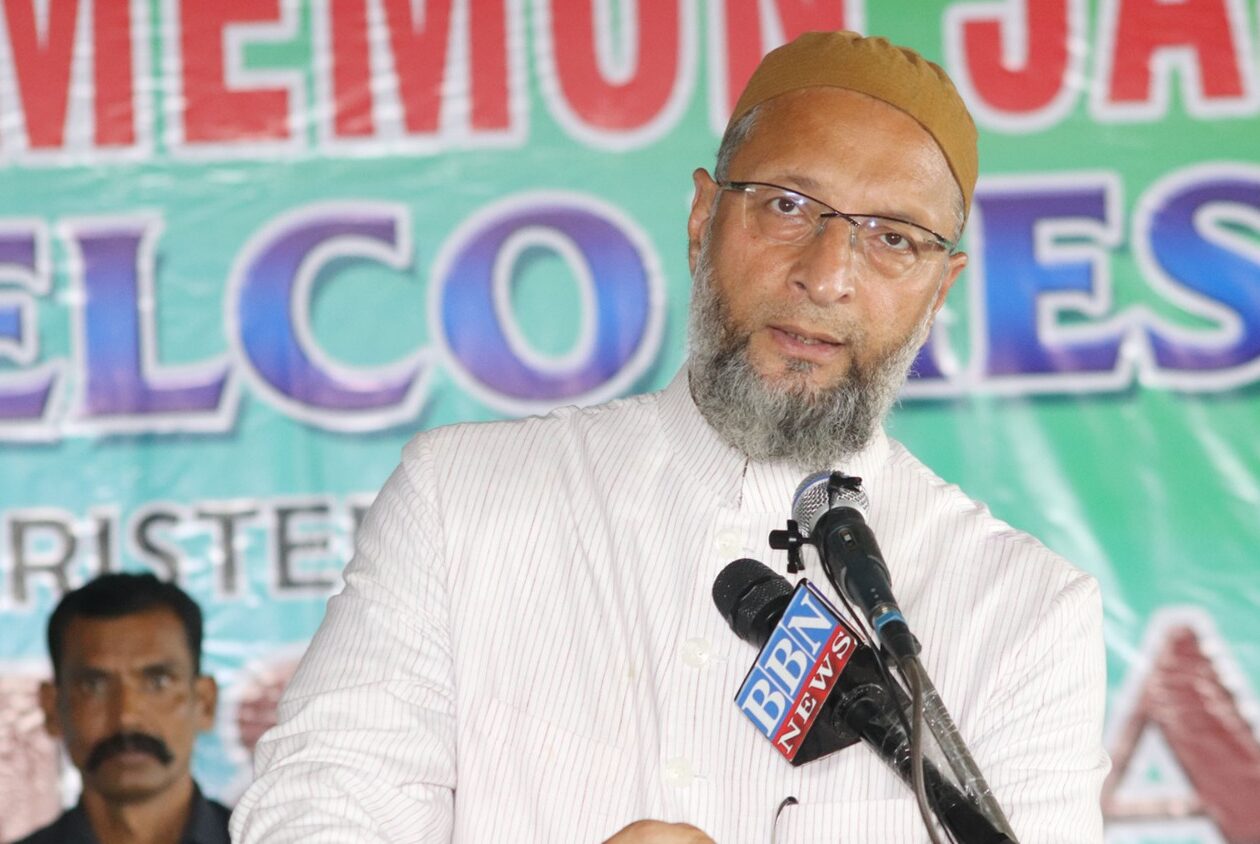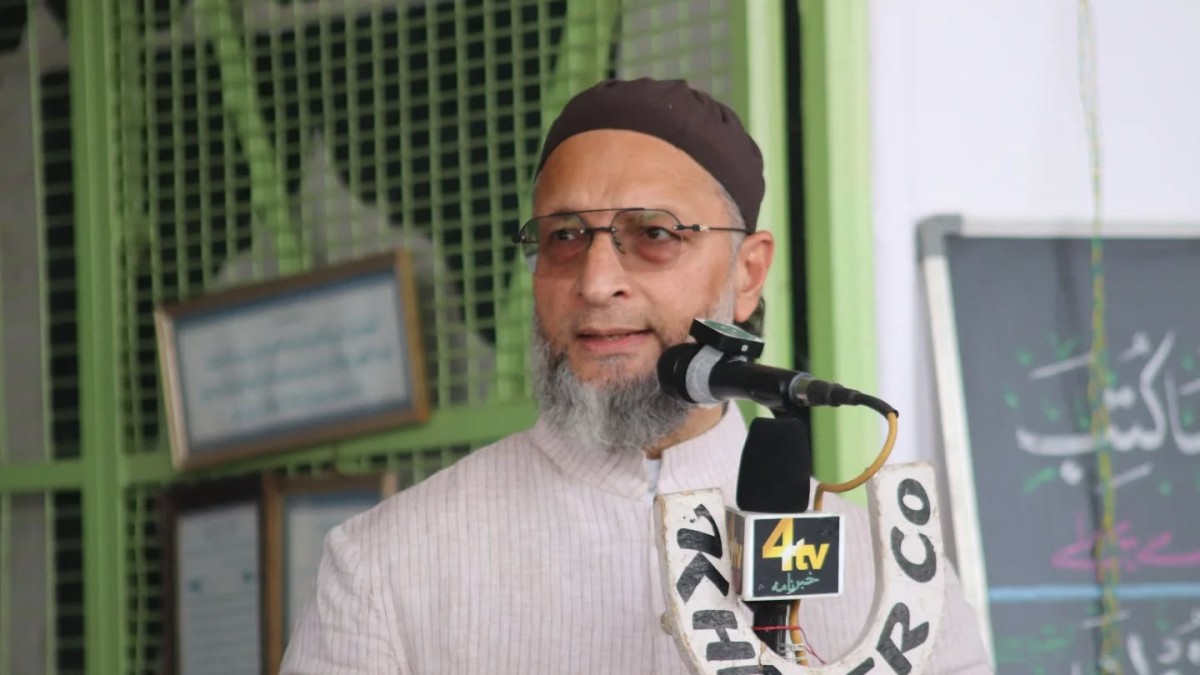
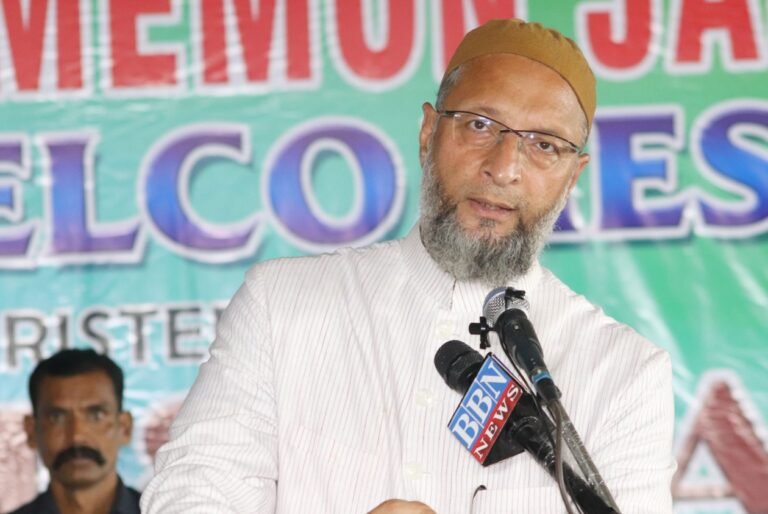
AIMIM president and Hyderabad MP Asaduddin Owaisi has criticised the Allahabad High Court’s recent ruling dismissing a Muslim student’s plea to wear a hijab with her school uniform, calling the judgment an “attack on Islam” and questioning whether courts should determine what constitutes an essential Islamic practice.
Speaking at a Jalsa-e-Rahmatul-lil-Alameen gathering at the AIMIM headquarters in Darussalam on August 25, Owaisi said he disagreed with the ruling and argued that the judgment violated Articles 19 and 25 of the Constitution.
“Who are you to decide what is essential to Islam?” Owaisi said, adding that the girl was “wearing hijab on her head, not on her mind”.
The Allahabad High Court on August 21 dismissed a petition filed by a minor student from a private school in Prayagraj who sought permission to wear a headscarf in addition to the prescribed school uniform.
A division bench of Justices J.J. Munir and Indrajit Shukla held that a uniform, non-discriminatory dress code framed in good faith falls within the school’s authority. The court also rejected the argument that wearing a headscarf is an essential religious practice of Islam.
The court observed that the petitioner had not provided sufficient religious material to establish that wearing a headscarf was an essential part of Islamic faith. It also noted that other students from the same community had been seen without scarves in photographs submitted before the court.
The student, who had completed Class 10 at the same school, was seeking admission to Class 11. The school management had cited its dress code in relation to her admission.
Owaisi questioned the court’s decision to rule on the issue of religious essentiality while the Supreme Court is considering related questions in the Sabarimala case.
“The Sabarimala case is already before the Supreme Court, where nine judges are deciding what is essential,” he said.
Owaisi also argued that the ruling could affect the education of Muslim girls. “Uniformity is not equality,” he said.
Owaisi attacks UCC moves in Assam, Uttarakhand
Owaisi also criticised moves towards implementing a Uniform Civil Code (UCC) in Assam and Uttarakhand, arguing that the proposed framework draws heavily from Hindu personal laws.
He questioned why Muslims should be required to follow laws based on the Hindu Marriage Act, Hindu divorce laws and the Hindu Succession Act, and said Muslims who remain committed to their faith would continue to follow the Quran and Sunnah.
Questions Vande Mataram and ‘Bharat Mata’ politics
Owaisi also spoke about the debate surrounding Vande Mataram, invoking Rabindranath Tagore, Subhas Chandra Bose and Mahatma Gandhi.
He argued that only the first two stanzas of the song were intended to be sung and questioned whether Prime Minister Narendra Modi considered himself wiser than the three leaders.
“This country belongs to everyone,” Owaisi said, arguing that citizens should not be compelled to treat the nation as a deity.

He also criticised what he described as the government’s focus on issues such as the UCC, vigilante politics and religious polarisation instead of employment.
Renews attack on RSS, BJP over Manusmriti
Owaisi also renewed his criticism of the RSS and BJP over their alleged historical preference for the Manusmriti over the Constitution.
He referred to an article published in an RSS mouthpiece in November 1949 and questioned the organisation’s commitment to the Constitution drafted by B.R. Ambedkar.
Owaisi also criticised V.D. Savarkar over his conduct during his imprisonment in the Andaman Cellular Jail, contrasting it with the experiences of Muslim freedom fighters such as Allama Fazl-e-Haq Khairabadi.
He further claimed that the RSS had made no sacrifices during India’s freedom struggle and cited figures such as Turrebaz Khan while arguing that Indian Muslims should not have their patriotism questioned.