Sheema Sarwar
There is a particular kind of anger that does not begin with hatred. It begins with fear.
The kind of fear that makes a girl check whether the hostel door is properly locked before going to sleep. The kind that makes her call her roommate when she is walking back late. The kind that makes a group of students gather outside a hostel because they have heard that something terrible may have happened to one of their own.
And sometimes, that fear becomes a protest.
That is what happened at Lovely Professional University.
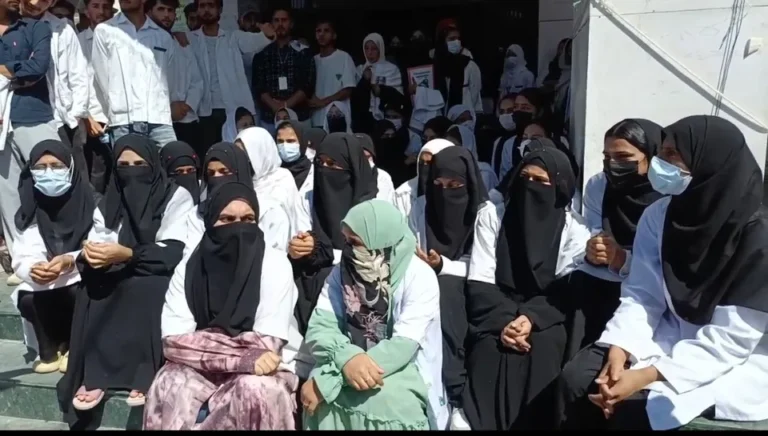
What began with allegations of the sexual assault of a female student at the girls’ hostel quickly became a massive student protest. The situation eventually descended into vandalism, arson, clashes and a blockade of

NH-44, the Jalandhar-Phagwara National Highway. The police registered an FIR under Section 64 of the Bharatiya Nyaya Sanhita and constituted a Special Investigation Team to investigate the allegation. The university, however, denied that the alleged assault had occurred and described the claims as baseless and fabricated. There are therefore facts that remain unsettled.
But there is one fact that cannot be dismissed so easily: Students were afraid.
And when thousands of students, particularly women living in hostels, are afraid that something as serious as rape may have happened inside their own campus, the appropriate response cannot simply be to tell them to calm down.
There is something deeply disturbing about the way we talk about rape. Sometimes, we doubt the woman before we even hear her. Sometimes, we ask for proof before we offer protection. Sometimes, we tell people to “wait for the investigation” as though waiting is easy when the fear of being unsafe has already entered your home, your hostel and your everyday life.
And sometimes, when people finally take to the streets because they feel that nobody is listening, we become more concerned about the noise of their protest than the reason behind it. The unrest at LPU is one such moment.
Rape is not “just another crime”
Under Section 63 of the Bharatiya Nyaya Sanhita, 2023, rape includes specified forms of sexual penetration committed under circumstances including against a woman’s will or without her consent. The law also recognises circumstances involving threats, incapacity to understand consent, and cases involving minors.
But the legal definition does not fully capture what sexual violence means to a human being. Rape is not merely about an act committed against a body. It is an attack on bodily autonomy, dignity, privacy and personal integrity.
That is why Article 21 of the Constitution matters here. The right to life and personal liberty is not simply the right to remain alive. Constitutional jurisprudence has expanded it to include the right to live with dignity.
The Supreme Court has repeatedly recognised the seriousness of sexual violence and has emphasised that courts dealing with sexual-offence cases must approach the evidence with sensitivity.
In State of Punjab v. Gurmit Singh, the Court stressed that rape causes profound physical and psychological harm and that the judicial process must not compound the victim’s suffering.
We should not have to wait for proof of rape to take women’s safety seriously. This is perhaps where our understanding of law becomes painfully mechanical.
We say: “There is no proof yet.” Fine.
But what exactly does that mean? It means an investigation has not yet established the allegation.
It does not mean that the fear surrounding the allegation is imaginary. It does not mean that students should remain silent. And it certainly does not mean that the administration gets to treat the entire matter as an inconvenience.
A rape allegation is not an ordinary hostel complaint.
So, when students ask for an investigation into an allegation of sexual assault, they are not asking for some extraordinary favour. They are asking the institutions around them to take their safety seriously and that demand deserves to be heard.
Protest is not the enemy
The Constitution gives citizens the right to freedom of speech and peaceful assembly under Article 19. Students do not lose these rights simply because they enter a university campus. In fact, universities should be among the places where young people learn how to question authority.
If students believe that their safety has been compromised, they should be able to demand answers. They should be able to question the administration and be able to demand an impartial investigation. They should be able to protest.
And sometimes, a protest is the only language institutions understand before they finally begin listening. That is why I do not believe the LPU protest should be reduced to images of broken windows and burning vehicles.
The administration needs to look inward
One of the most disturbing aspects of this entire episode is the apparent distrust between students and authorities.
The police have said that the preliminary investigation did not substantiate the allegation, while an FIR was nevertheless registered and an SIT was subsequently formed. Students reportedly remained dissatisfied with the initial investigation and continued demanding accountability.
That gap between what authorities say and what students believe is itself a serious institutional problem.
Because when students trust the system, they report.
Once institutional trust disappears, even a legitimate investigation can begin to look suspicious. Not because every student allegation must automatically be accepted as fact, but because students deserve to know that allegations are being investigated seriously, independently and without pressure.
A woman should not have to become a headline to be safe
There is another uncomfortable dimension to this entire episode. Once an allegation of rape becomes public, everyone begins speaking.

The police speak. The university speaks. Politicians speak. News channels speak. Students speak. Social media speaks, and the woman at the centre of the allegation can disappear beneath all of that noise.
Her identity must be protected. Her dignity must be protected. Her privacy must be protected.
If she has been assaulted, she deserves justice without being forced to relive her trauma in public, and if the allegation is ultimately not established, the person accused still deserves a lawful investigation. This is not a contradiction; this is what the rule of law is supposed to look like.
Due Process Should Not Mean Doing Nothing
As law students, we hear the phrase “due process” all the time. And rightly so. No one should be declared guilty simply because a crowd believes they are guilty. An allegation must be investigated, evidence must be examined, and guilt must be decided according to law.
But due process should never become an excuse for inaction.

When a woman reports sexual assault, an institution has a responsibility to listen, protect her, preserve evidence, cooperate with the police and ensure that students feel safe while the investigation takes place.
There is a huge difference between not declaring someone guilty and not taking an allegation seriously.
This is why the anger of the LPU students deserves to be understood. Their demand was not simply for a verdict without an investigation. They were demanding answers, safety and accountability from an institution where they live and study. For students living away from home, safety is not some abstract constitutional principle.
And perhaps that is the question we should ask before judging their protest: Why did so many students feel that they had to come onto the streets to be heard?
Due process must protect the accused from an unfair conviction, but it must also protect the victim from being ignored. Both can exist together.
And if students have reached the point where they feel they must scream to be heard, perhaps the first question should not be, “Why are they protesting?”. It should be, “Why did we not listen before they had to?” When Silence Breaks
Ultimately, the LPU protests are about more than one allegation or one university. They reflect a deeper fear shared by many women, the fear of being unsafe and unheard. Students have the right to demand safety, accountability and a serious investigation, while guilt must still be determined through due process and proved beyond reasonable doubt.
Rape is not merely a provision in a statute. It is a violation of bodily autonomy, dignity and safety. That is why every allegation deserves to be taken seriously, investigated sensitively and without delay.
The LPU students should not have had to raise their voices so loudly to be heard. Perhaps the real lesson is simple: justice must protect the victim, respect the accused’s rights and hold institutions accountable.
Because when it comes to rape, listening should not begin after the protest. It should begin before it.

If a woman says she has been raped, listen.
If students say they are afraid, listen.
If an accused is named, investigate.
If evidence exists, preserve.
If a crime occurred, punish.

And if the system failed, hold the system accountable.
Because the answer to rape cannot be silence.
The views expressed in this article are the author’s own and do not necessarily reflect the policy of the platform.