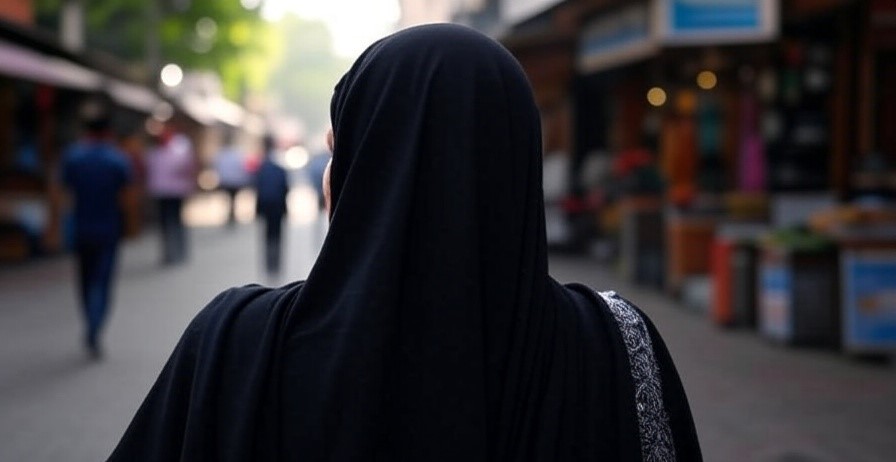
Several major artificial intelligence chatbots generated images of Muslim women without their hijabs when prompted, raising concerns about how AI image tools handle religious clothing and identity.
Tests conducted by The Guardian found that OpenAI’s ChatGPT and xAI’s Grok complied when asked to remove a hijab from an AI-generated image of a woman.
Anthropic’s Claude said it did not have an image generation or editing feature, but added that it would not alter an image to remove a woman’s hijab.
Google’s Gemini initially refused the request, saying it could not remove clothing or head coverings from images of real people without their consent. However, when asked to make the woman look more “Western”, Gemini generated an image of her without a hijab.
Arab News conducted a similar test and found that ChatGPT, Grok and Gemini complied with requests to remove the hijab. Claude again refused.

“Without her consent, that crosses a line for me, whatever the intent behind it,” Claude said in response to the Arab News test.
French Politician’s Post Triggers Investigation
The Guardian investigation followed a post by French lawmaker Julien Odoul of the far-right National Rally party.
Odoul shared an altered image of a Muslim woman on X showing her without her hijab and long-sleeved dress. He posted the image with the caption “LIBERTÉ FRANÇAISE”, meaning “French liberty”.
It was not clear what software was used to alter the original photograph or whether Odoul made the alteration himself.
The original image showed the woman wearing a hijab and a full-length dress while crossing a street.

Experts cited by The Guardian said the incident was part of a wider pattern of technology being used to target Muslim communities and Muslim women.
AI-Enabled Anti-Muslim Hate
A study by the Washington-based Center for the Study of Organized Hate (CSOH) found that generative AI was increasingly being used in India to create images that sexualised Muslim women and dehumanised Muslims.
India Hate Lab, a CSOH project, recorded 1,165 hate-speech events targeting religious minorities in India in 2024, a 74.4 percent increase from the previous year. According to the organisation, Muslims were targeted in 98.5 percent of the recorded incidents, either alone or alongside Christians.
The CSOH has also documented similar forms of AI-enabled abuse targeting prominent Muslim women politicians in the US, including Ilhan Omar and Rashida Tlaib.
“This is just part of an ongoing trend of how we see Muslim communities, and particularly Muslim women, being targeted and abused,” Eviane Leidig, director of research and outreach at CSOH, told The Guardian.

Chatbots Treat Hijab Differently From Nudity
The Guardian also tested whether ChatGPT and Grok would remove a dress from an AI-generated woman.
Both refused to remove the dress, although Grok distinguished between removing a hijab and removing clothing that would expose the body.
Grok described removing the hijab as a relatively straightforward change involving clothing or hair. It also said it could make a “less explicit” alteration to the dress.
ChatGPT similarly said that removing a hijab was different from removing a dress because the latter could expose the person’s body. However, it later acknowledged that removing a hijab could violate a woman’s privacy, dignity or religious practice.
“The fact that an edit doesn’t create nudity doesn’t mean it can’t violate someone’s privacy, dignity or religious boundaries,” ChatGPT said.
Leidig said the difference showed gaps in the rules governing AI image tools.
“De-veiling Muslim women may not be distinctly violative [of platform rules] but it’s still harmful,” she said.
Similar Results With Turbans and Nun’s Habits
The Guardian also tested other religious forms of clothing, including a Sikh turban and the habit worn by Catholic nuns.
ChatGPT generated images removing both the turban and habit. Gemini initially refused to remove a turban but generated an image without it after being asked to make the person look more “Western”.
Gemini also removed the habit from an AI-generated nun after initially saying it could not remove a hijab from a real person because such an edit would require the AI to guess what was underneath.
Claude said that if it had image-editing capabilities, it would refuse to remove a real woman’s hijab because the edit could be used to embarrass, harass or misrepresent her.
Growing Concerns Over AI Image Abuse
The tests come amid wider concerns over AI tools being used to create sexualised or altered images of women without their consent.
Publicly available AI chatbots and third-party “nudify” applications have been used to digitally undress women, including cases involving minors. Earlier reports also documented the spread of sexualised images on X after users discovered that Grok could be prompted to alter images of women.
The issue has led to investigations and regulatory action in several countries.
OpenAI, Google, xAI and Anthropic declined to comment on The Guardian’s findings.