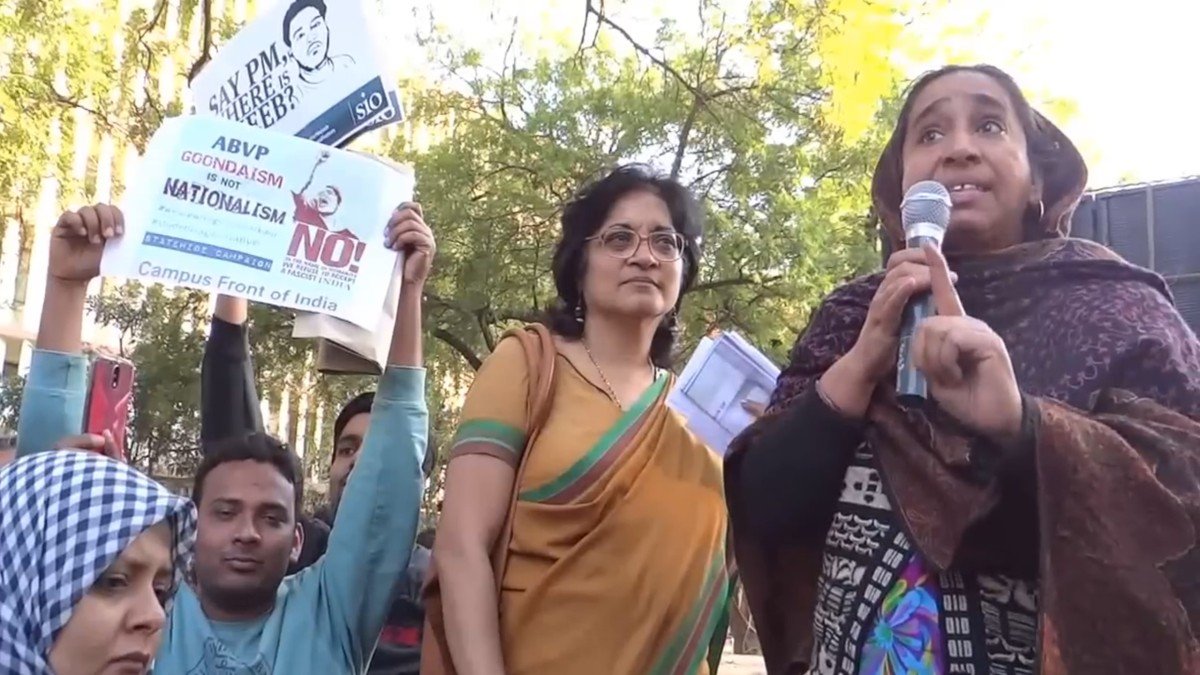
BAPSA, the Fraternity Movement and the Muslim Students Federation (MSF) have called a joint “Justice for Najeeb” march at Jawaharlal Nehru University (JNU) on October 14, demanding answers about the disappearance of student Najeeb Ahmed, who went missing from the campus on October 15, 2016.
The march will begin at 9 pm from Barak Hostel and proceed towards Ganga Dhaba, a day before the tenth anniversary of his disappearance.
In a joint statement titled “Does JNU Remember Najeeb?”, the organisations questioned the failure to establish what happened to the first-year MSc Biotechnology student. They also demanded accountability from the investigating agencies, the university administration and the then JNU Students’ Union leadership.
“Even after 10 years, the question remains, ‘Where is Najeeb?’” the statement said. “To this we must add one more, ‘Who is responsible for his forced disappearance?’ and ‘What happens to the culprits?’”
Najeeb Ahmed Disappeared After Alleged Hostel Assault
Najeeb went missing on October 15, 2016, a day after an alleged altercation with members of the Akhil Bharatiya Vidyarthi Parishad (ABVP), a right-wing student organisation. The groups calling the march allege that Najeeb was assaulted by ABVP members in his hostel.

His disappearance led to protests by students and a prolonged campaign by his mother, Fatima Nafees, who has continued to demand answers about her son’s whereabouts.
An FIR was registered on October 15, 2016. Dissatisfied with the progress of the investigation, Fatima approached the Delhi High Court, which transferred the case to the Central Bureau of Investigation (CBI) in May 2017.
The CBI subsequently reported that it had found no evidence establishing that a crime had been committed against Najeeb. A Delhi court accepted the agency’s closure report in June 2025, and the Delhi High Court upheld the decision in December 2025. His whereabouts remain unknown.
Organisations Accuse Former JNU Leadership of Failing Najeeb
The three organisations alleged that the university administration and the then left-led JNUSU leadership helped portray Najeeb as responsible for the violence rather than as someone who had allegedly been attacked.
The statement specifically accused former JNUSU president Mohit Pandey, who was associated with the All India Students’ Association (AISA), and another student of signing letters that allegedly portrayed Najeeb as a criminal and mentally ill.
It further alleged that the hostel administration and student leaders failed to inform the wider student community about the incident during the crucial initial period.
The organisations also accused the Delhi Police and the CBI of investigative failures, including not adequately examining the phones of alleged attackers and not conducting custodial interrogation of them. These are allegations made in the statement and have not been established as findings by a court in this account.
The groups further alleged that narratives linking Najeeb to terrorism and suggesting that he had left the campus voluntarily diverted attention from the circumstances of his disappearance.
Fatima Nafees Continues Her Search for Answers
The statement said the march was not simply an event to mark an anniversary but an effort to keep the demand for justice alive.
“We are not here to simply mark this day; we are certainly not here to accept the false narratives of ‘vanishing into thin air’ and ‘missing without trace’,” the organisations said.
Fatima has repeatedly spoken about the uncertainty surrounding her son’s disappearance and the toll it has taken on the family. She has continued to participate in protests and seek accountability despite years passing without a definitive answer.
The organisations said they would continue supporting Najeeb’s family and called for solidarity among students from marginalised communities.
“We owe this to Najeeb, as his fellow students from JNU. We owe this to Fatima Nafees (Najeeb’s mother) and his family in their search for Najeeb,” the statement said.