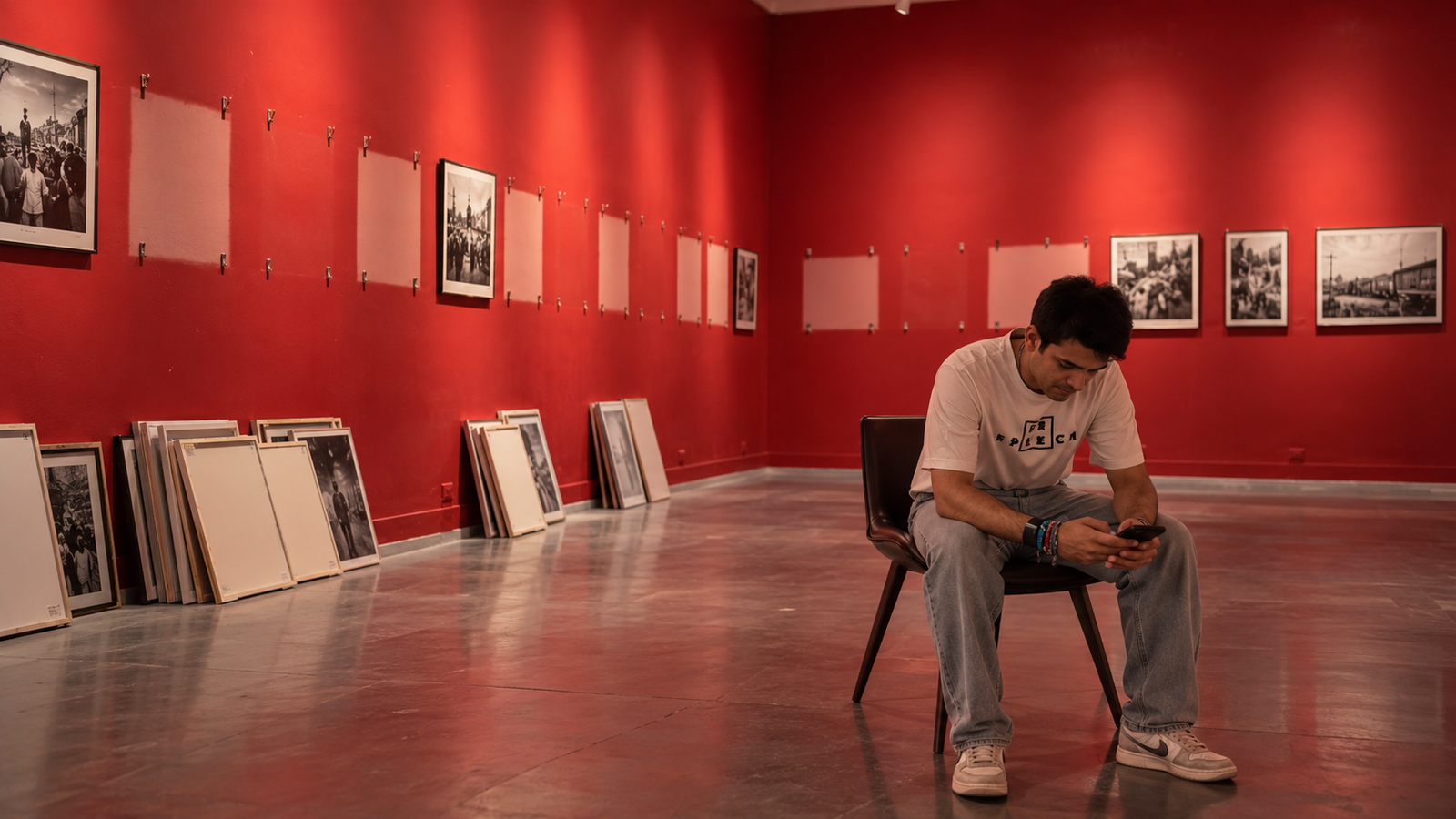
Seventy-five of the 105 photographs planned for Raihan Vadra’s solo exhibition at Delhi’s Bikaner House were taken down hours before it opened on Wednesday, October 21, after the venue’s management objected to their political content, according to the photographer.
The show, titled “No Idea Is Final”, was due to open at 7 pm. Vadra is the son of Congress MP Priyanka Gandhi Vadra and Robert Vadra. The removed pictures documented youth-led protests across Delhi, including those at Jantar Mantar, over the past six months. By opening time, the walls in two rooms were left bare, with nails and red paint where the frames had hung, and a catalogue showing visitors what had been taken down.
Vadra said he was told about four and a half hours before the opening that he must remove 75 photographs or the show would be cancelled. He told The Wire the exhibition was meant to be the first time he used his work as a direct reflection of the present climate, and that the venue’s management considered the pictures “political”. “This is my entire career – 75 photos have been removed,” he said, and asked whether any other artist would have faced the same treatment.
According to Vadra, the management also cited the timing of the show in its objection. He maintained that the photographs were visual documentation of protests, not political commentary, and said he could not hold an exhibition that only showed how beautiful things are. He said the details of the show had been settled long ago, when his proposal was accepted.
Vadra has not given up on the removed works. He told ThePrint he intends to find another venue in Delhi to show the 75 photographs, and told The Wire he is determined to exhibit them in the city he belongs to, which he said has witnessed this moment in time. The remaining 30 photographs are on display at Bikaner House.
Bikaner House, a heritage building near India Gate, is run as a cultural space with state government involvement, and holds art, craft and design events.
The episode follows months of protests in Delhi, including demonstrations against the Election Commission’s Special Intensive Revision of electoral rolls, and the recent shift of designated protest sites away from Jantar Mantar.
Police action and detentions at some of these demonstrations have drawn criticism from opposition parties and press bodies. Vadra’s photographs record the same period.
The removal has also raised wider questions about how much freedom artists have in publicly accessible venues to show work on recent political events, and who decides what is too political for a gallery wall.