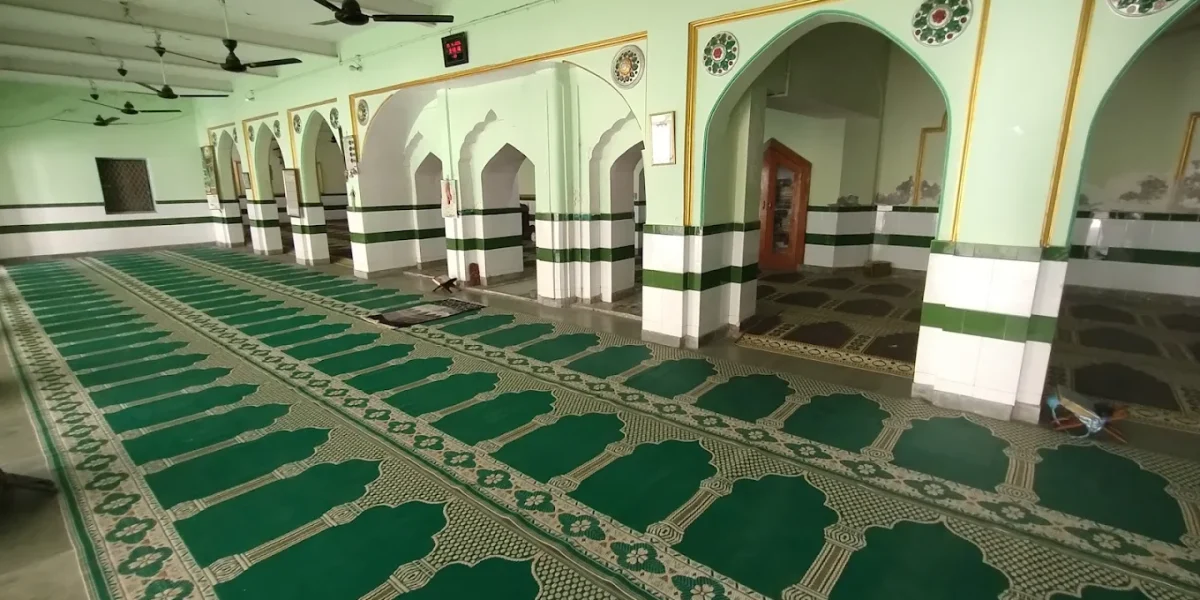
The Union government on Thursday assured the Delhi High Court that no coercive action would be taken against the Race Course Masjid in New Delhi for four weeks while the Land and Development Office (L&DO) considers a representation filed by the Delhi Waqf Board.
However, the court declined to direct the authorities to restore access to the mosque for worshippers, citing safety concerns over ongoing demolition work in the surrounding area.
Justice Anish Dayal recorded the Centre’s assurance that the L&DO would decide the Waqf Board’s representation within four weeks. The matter has been listed for further hearing on December 16, when the government must submit a status report accompanied by photographs of the site.
The court was hearing a petition filed by Syed Ahmed Saud, a worshipper who sought protection for the mosque against demolition and the restoration of unrestricted access for prayers.
Court Declines to Order Access for Prayers
Appearing for the union, standing counsel Ashish Dixit argued that allowing people to enter the premises would be unsafe because demolition work was underway nearby. He said access to a neighbouring temple had also been restricted for safety reasons.
Saud’s counsel, M Sufian Siddiqui, disputed the submission, arguing that the demolition work had already been completed.
The court declined to intervene, observing that it could not compel the authorities to allow access while safety concerns remained. Justice Dayal questioned who would be responsible if someone were injured during the demolition work.
The union also questioned whether an individual worshipper could maintain the petition, arguing that allowing multiple worshippers to approach the L&DO separately could lead to similar claims.
Dixit told the court that the department would consider the Waqf Board’s representation rather than Saud’s separate plea, saying the authorities were attempting to work towards a solution.
Waqf Board Seeks Restoration of Utilities
The Delhi Waqf Board submitted its representation to the L&DO on October 19, seeking the restoration of the mosque’s electricity and water connections. According to the petition, the electricity supply was disconnected on October 7, while the water connection had been provided in 2008.

The representation described the mosque as a Waqf-notified property and a Grade II heritage structure. It raised concerns about possible demolition and requested that the matter be examined on priority.
Saud submitted a separate representation on October 22, seeking the restoration of access and protection against demolition, dismantling, sealing, dispossession and other coercive action.
The court’s order provides temporary protection against such action while the Waqf Board’s representation is considered. It does not, however, resolve the dispute over access to the mosque.
Mosque’s Heritage Status Cited in Petition
The Race Course Masjid is located within the Race Course Club complex, which covers around 53 acres near the Prime Minister’s residence at 7, Lok Kalyan Marg.
The petition states that the mosque has existed since before Independence and was included in a Waqf properties notification issued on July 27, 1977, which was subsequently published in the Delhi Gazette on September 8 that year.
It also cites an October 1, 2009, notification that, according to the petitioner, grants the structure Grade II heritage status.
Saud has argued that the mosque was not identified as an encroachment during an earlier survey of the adjoining settlement or in a Delhi High Court Division Bench judgment dated August 25, 2026, concerning encroachments and settlements in the area.
The petition further alleges that the mosque’s utility connections were disconnected without prior notice or a disclosed legal justification. These claims remain part of the ongoing legal dispute.
Land Reclamation in the Surrounding Area
The mosque is situated in an area where the L&DO, under the Union Ministry of Housing and Urban Affairs, is reclaiming land parcels that include the Delhi Race Club and Jaipur Polo Ground. Demolition work has also affected nearby informal settlements, where around 700 families were reportedly living.
The petitioner has invoked Articles 14 and 25 of the Constitution, arguing that the restrictions interfere with his rights and ability to practise his religion. He has also sought directions requiring the Delhi Waqf Board to fulfil its statutory responsibilities under Section 32 of the Waqf Act, 1995.

The next hearing on December 16 is expected to follow the union’s submission of a status report and photographs. Until then, the government’s assurance prevents coercive action against the mosque for four weeks, while access for worshippers remains restricted.