Sayima Ahmad
When India’s Ministry of External Affairs (MEA) strongly condemned the deadly attack on a Greek Orthodox church in Jordan’s Karak region on October 23, which killed seven people and injured 34 others, every Indian citizen agreed. It was undoubtedly the right thing to do. This is the India we believe in, the kind we wish to see, and the kind everyone hopes for.
While condemning the gruesome attack, the MEA described it as a “heinous” and “cowardly” act. However, this strong condemnation also highlighted the double standards that every Indian Christian felt at that moment. We have a voice and tears for a church located in another country, 4,000 km away. But we have never uttered a single word for Christians being attacked and humiliated, or for churches being burnt across our own country.
Flagging concerns and highlighting issues is neither an act of defaming my country nor an expression of animosity. It is about exposing a dangerous hypocrisy that is hollowing out our country’s constitutional soul like termites and costing it moral credibility abroad. We dream of becoming Vishwaguru and advising the world on tolerance and peace, but ignore the fact that the United States Commission on International Religious Freedom (USCIRF), in its 2025 report, recommended that the US Department of State designate India as a Country of Particular Concern (CPC) “for its toleration of systematic, ongoing, egregious religious freedom violations”.
The scale of suffering and hardship faced by Indian Christians across our own country is no longer hidden. These incidents are visible to all, and reports, including videos, emerge every single day.
An ecumenical group, including A.C. Michael, national convenor of the United Christian Forum (UCF), reported that “Between 2014 and 2024, incidents of violence against Christians in India rose sharply from 139 to 834, a staggering 500 per cent increase.”
Rights advocate Tehmina Arora asserted that tribal Christians face “coercion, social boycotts, and violence” and are often denied burial rights, housing and basic dignity.
The modus operandi of Hindutva groups primarily involved in these attacks is similar. Radical mobs barge into churches or Christian homes carrying batons, attack devotees, tear Bibles and vandalise places of worship. Last year, during Christmas in Kerala’s Palakkad, RSS-BJP worker Aswin Raj assaulted children participating in a carol procession and damaged their musical instrument. According to Christian Solidarity International (CSI), in 2025, nearly 900 cases of physical assaults, disruptions to church services and threats against worshippers were reported across multiple states. At least 60 Christmas-related events were also attacked or disrupted by these groups across the country, ranging from street-level intimidation to raids on religious gatherings. In these cases, the police arrive and book the pastor or attendees. The victim becomes the accused.
These attacks are increasing year after year rather than decreasing, while the attackers continue to evade legal consequences. This year, on Sunday, May 31, a Hindutva mob barged into a place of worship and brutally attacked those attending the service, injuring at least 25 worshippers, including the pastor’s pregnant wife. The incident took place in the remote village of Sadrapal in Chhattisgarh’s Sukma district.
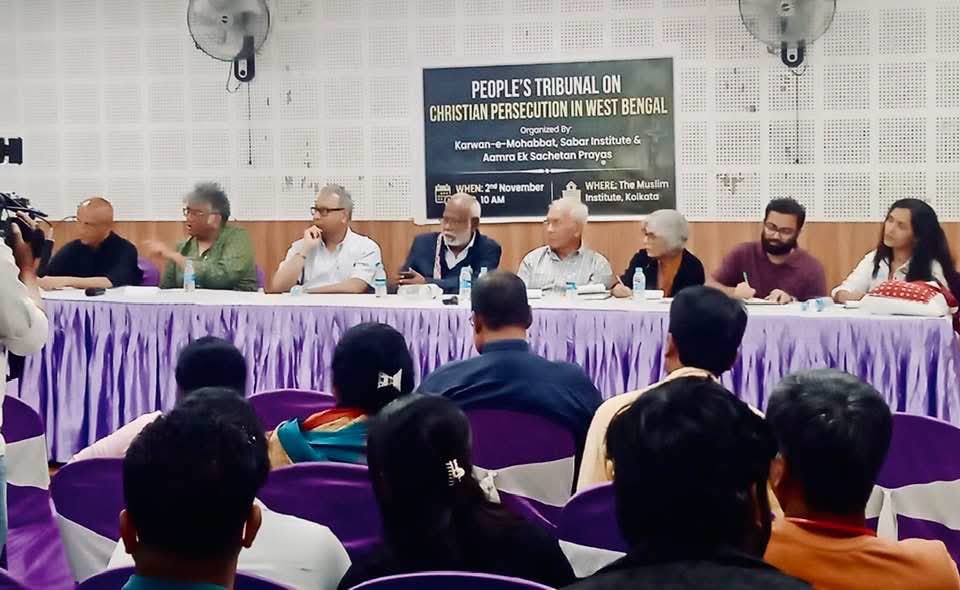
For decades, Bengal was proof of how multicultural coexistence could work. The state, the land of Mother Teresa and convent schools, has now become a new target for Hindutva radical groups. In recent months, since the BJP came to power in the state, alarming attacks have been unfolding across Bengal. Every single day, heart-wrenching reports of attacks on Christians are emerging from the state.
On October 9, in Nadia district, an armed Hindutva mob of about 200 people arrived in vehicles, shouting anti-Christian slogans, and assaulted Santhali Christians, members of one of the poorest tribal communities, who had gathered for the Annual Santhali Mega Bible Convention Retreat. In another incident on November 1, a Hindutva group vandalised a church during its inauguration in West Bengal’s South 24 Parganas district and attacked priests and devotees, injuring several of them. Just a week earlier, three Christian families in West Bengal’s Paschim Medinipur district complained to the police that they had been threatened and assaulted by members of Hindutva groups who were forcing them to renounce their faith.

In just six months, Bengal has changed before our eyes, and so drastically that we are still rubbing our eyes, wondering if it is actually true. As if to underscore this, just as I was writing this article, fresh reports and videos emerged showing a Christian prayer and discussion meeting being disrupted by members of the Bajrang Dal and Hindu Jagran Manch in the Gola More area of Harishchandrapur in West Bengal’s Malda district. The incident reportedly involved vandalism and physical assaults, leaving several attendees injured.
These reports are just a few examples of the persecution faced by Christians in our own country. In reality, much more has happened and continues to happen, with countless other incidents likely never even being reported because of fear or pressure. Who will answer for all of this? Who will condemn these actions, and who will raise their voice for those affected? Unfortunately, it is the Church itself that has to submit a memorandum to the state’s Chief Minister, Suvendu Adhikari, and Union Home Minister Amit Shah, pleading for the legal right to live safely and practise their faith.
And we all know that these attacks will not be broadcast on India’s mainstream television channels. No aggressive panel discussion will be held in their studios about this hostility because these incidents do not generate TRPs. Nor is the 2.3 per cent minority community considered a vote bank capable of fitting into the political narrative and swinging elections in Delhi or Uttar Pradesh. This is why the community suffers in silence. Its members are well aware of their situation. They know that if they complain, they may end up in jail; if they pray, they may be raided; if they build a church, it may be attacked; and even their dead may be subjected to a boycott.
These targeted attacks are not just attacks on Indian Christians; they are also an attack on Article 25 of the Constitution, which guarantees the fundamental right to freedom of conscience and the right to practise religion.
They are also an attack on India’s image. With what moral standing can we condemn attacks on minorities in other countries when the Open Doors World Watch List 2026 reports that more than 315 million Christians face “very high” or “extreme” levels of persecution and ranks India 12th on its list, after Afghanistan and Somalia? After seeing and reading all this, one is left with the same impression and question: how can we preach tolerance and condemn the attack on a church in Jordan when we cannot practise it in our own country?
The question is not whether Christians can survive in India. They have lived here since 52 AD and will continue to do so. After all, where else would they go? This is especially true of the poorest Christian Adivasis, for whom this is home too. The real question is whether India itself can survive such communal violence and unrest.
The information presented in this article represents the personal viewpoints of the author and does not necessarily reflect the opinions of The Observer Post.