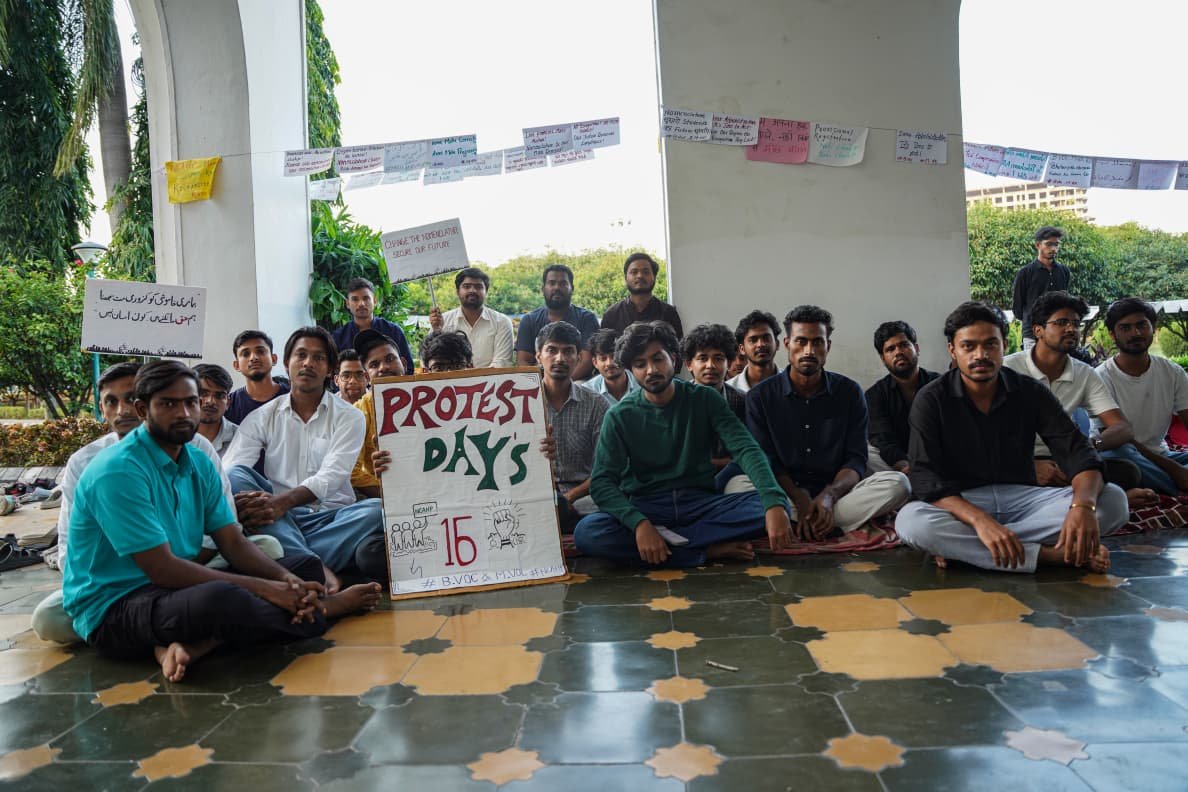
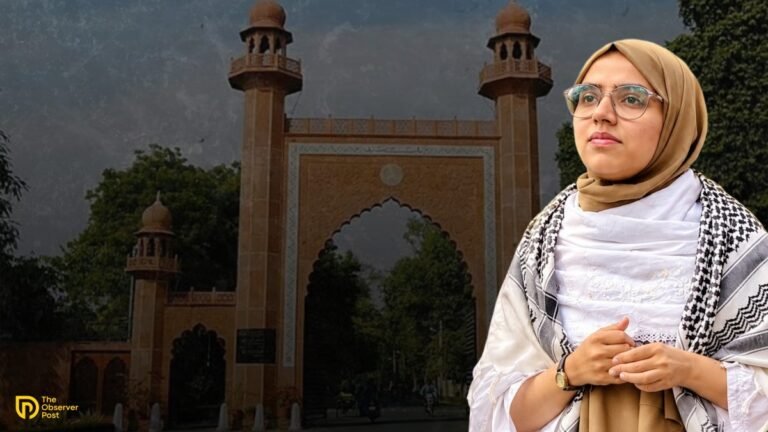
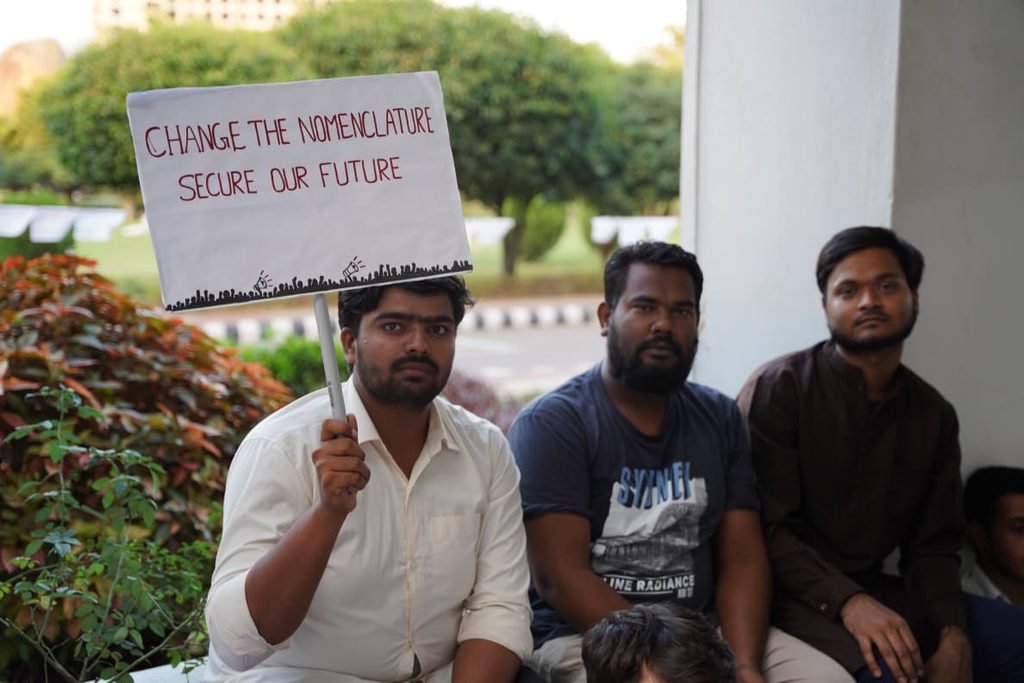
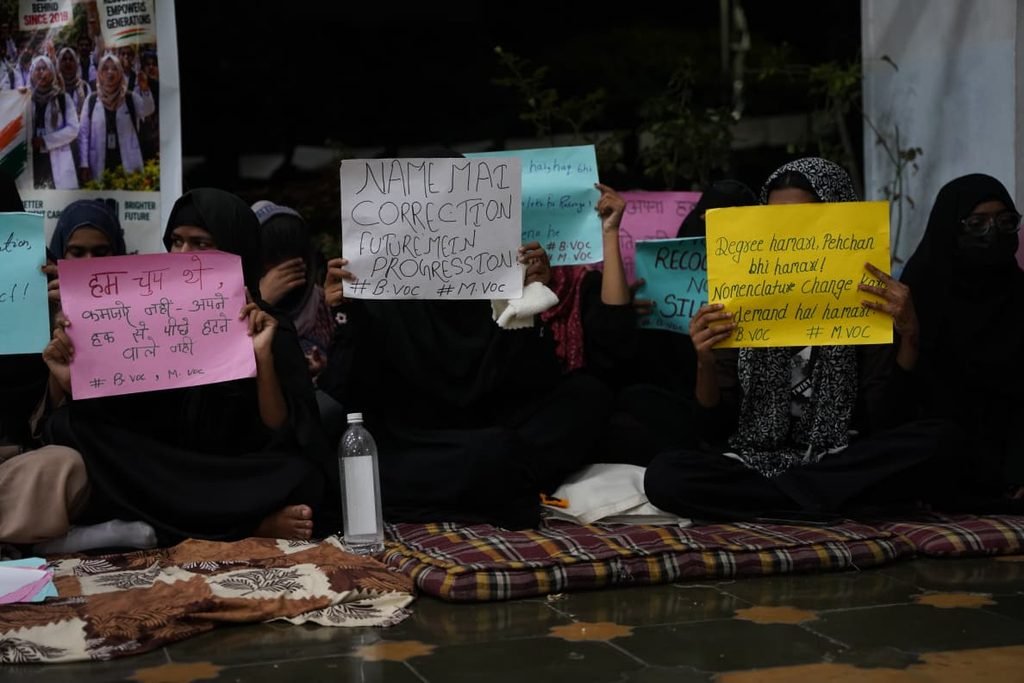
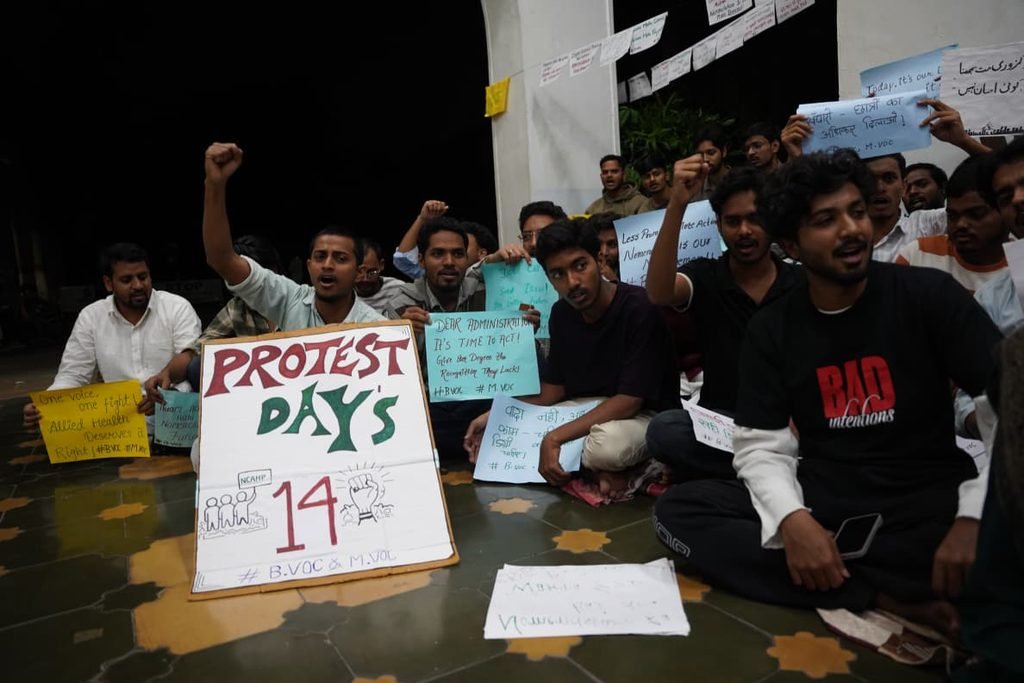
Students at Maulana Azad National Urdu University (MANUU), a central university in Hyderabad, have entered the 17th day of an indefinite protest, demanding professional registration and recognition of their healthcare qualifications. A regulatory transition has left them questioning whether years of university-approved education will translate into employment, further studies and professional recognition.
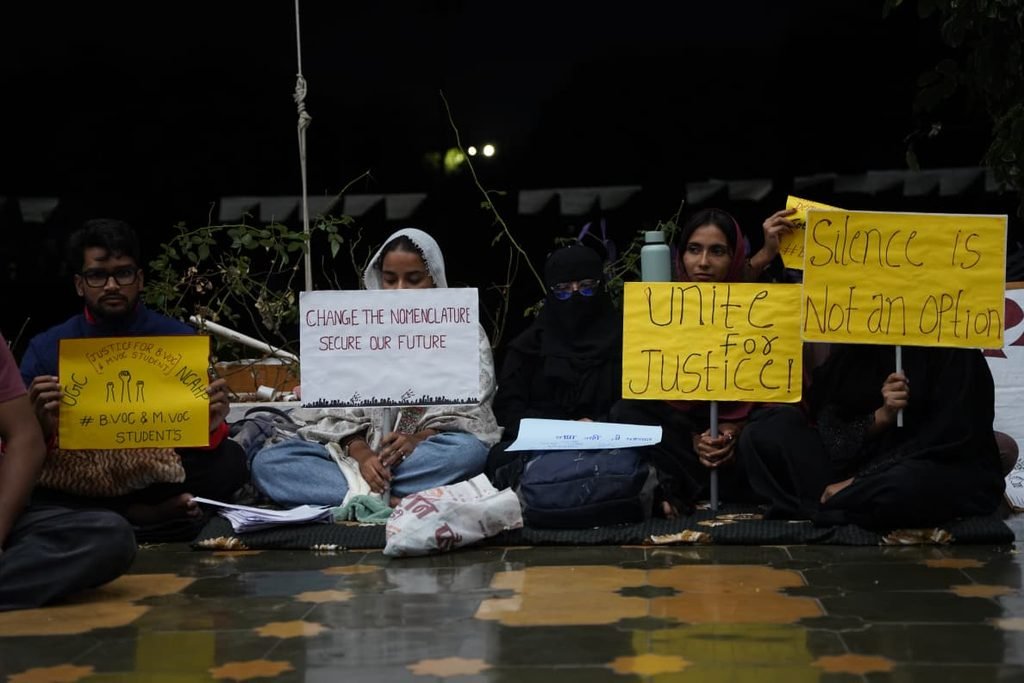
The protest, which began on October 21, involves students pursuing Bachelor of Vocation (B.Voc.) and Master of Vocation (M.Voc.) programmes in Medical Laboratory Technology (MLT), Medical Imaging Technology (MIT), and Emergency and Trauma Care Technology (ETT). Students have been staging a sit-in outside the university’s administrative building, demanding recognition of their qualifications under India’s new regulatory framework for allied health professionals.
At the centre of the dispute is the National Commission for Allied and Healthcare Professions (NCAHP), the national regulatory body responsible for overseeing standards and professional registration in allied healthcare professions.
Students say their programmes have not been adequately reflected in the prescribed qualification nomenclature, leaving them uncertain about their eligibility for professional registration, hospital employment and postgraduate education.
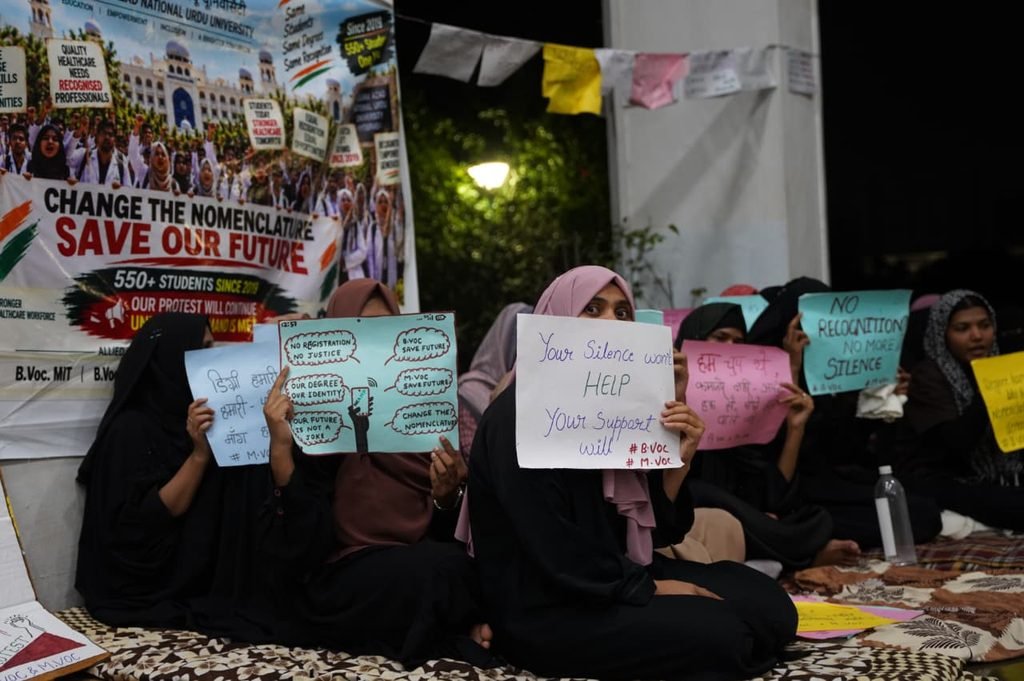
For many, the uncertainty comes after years of academic investment and considerable financial sacrifices by their families. Some have travelled hundreds of kilometres to study at MANUU, believing that a degree from a central university would provide a pathway towards professional independence.
‘We cannot work, and we cannot study further’
Saif Meraj, a fourth-year B.Voc. Medical Imaging Technology student, says the uncertainty threatens to undermine his entire academic journey.
“We have spent four years studying, completing our academic requirements and undergoing practical training. But if we cannot get professional registration, we cannot work in hospitals or pursue further education,” Meraj told The Observer Post.
The university introduced its B.Voc. programmes in 2019, before Parliament enacted the National Commission for Allied and Healthcare Professions Act in 2021.
An August 2018 letter from the University Grants Commission (UGC), reviewed by The Observer Post, approved B.Voc. programmes in Medical Laboratory Technology and Medical Imaging Technology under the National Skills Qualifications Framework (NSQF), permitting 54 students per course for the 2018–19 academic session.
The approval predates the establishment of NCAHP and the subsequent regulatory framework governing allied healthcare professions.
Meraj said students previously had a pathway to seek registration through state paramedical boards, including the Telangana State Paramedical Board. However, the introduction of the national framework has raised questions about whether their existing qualifications meet the requirements for professional registration.
“We fulfil the academic requirements. Our credit points are higher than the prescribed criteria, and we receive practical training in hospitals. But we are being excluded simply because our degree carries the name B.Voc.,” he alleged.
Students say their programmes include classroom instruction, practical training and clinical exposure, with hospital arrangements involving Omega Hospital and Medicover Hospital in Hyderabad. They argue that their academic and clinical training should be assessed on its merits rather than excluded because of the nomenclature attached to their degrees.
A farmer’s daughter who fought to attend university
For one female Medical Imaging Technology student, who requested anonymity, the dispute has brought back painful memories of the struggle she faced simply to pursue higher education.
Coming from a rural farming family in Bihar, she said convincing her parents to allow her to study in Hyderabad was itself a major achievement.

“In my family, girls are not usually allowed to leave the village for education. My father initially refused. I had to convince my parents and ask my brothers, sisters and other relatives to speak to him,” she told The Observer Post.
Her family eventually agreed, believing the degree would help her become financially independent. But the financial burden was enormous.
According to the student, her father borrowed money to support her education. When the family struggled to repay the debt, they sold land.
“My father is a farmer. We do not have much money. He borrowed money for my education, and when he could not repay it, he had to sell land,” she said.
Now approaching the final stages of her programme, she fears that her family’s sacrifices may not translate into a viable career.

“We spent three years studying and working hard. We cannot simply start another four-year degree. Our parents will not allow it, and we cannot afford it,” she said.
She also worries about the consequences for younger members of her family.
“If my degree is not accepted, my parents will ask why they should send my younger siblings to study. They will say it is a waste of money and time.”
For her, the dispute could determine whether other girls in her family are given the same opportunity to pursue higher education.
‘Our parents trusted us’
Another female student, a third-year B.Voc. Medical Laboratory Technology student who also requested anonymity, described the emotional toll of the continuing uncertainty.
She said students from Bihar, Uttar Pradesh, Kerala and Kashmir had travelled to Hyderabad with hopes of building careers in healthcare.
“Many girls here are role models for their families. Our parents trusted us and sent us far away from home because they believed education would give us a better future,” she said.
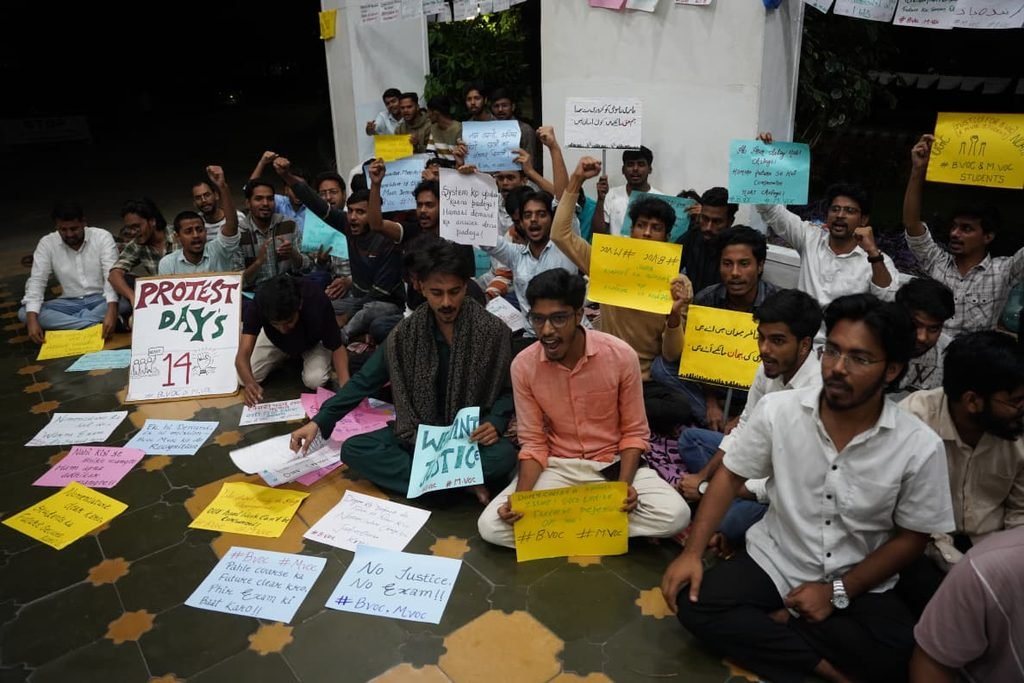
The student, who enrolled in 2024, said she had chosen MANUU partly because of its status as a central university.
“We thought that because this was a central university, we would not face problems concerning the recognition of our degrees,” she said.
She claimed students had repeatedly approached department heads, deans, the registrar and the vice-chancellor, but had not received a satisfactory resolution.
“If I know that my degree may not be accepted, what comes next?” she asked.
How a regulatory change created uncertainty
The dispute over the courses predates the current protest.
In August 2018, the UGC approved MANUU’s B.Voc. programmes in Medical Laboratory Technology and Medical Imaging Technology under the NSQF framework. The university was permitted to admit 54 students to each programme.
Another significant development came in June 2022, when the Telangana State Paramedical Board wrote to MANUU asking the university to send its students for registration.
A university notice dated June 3, 2022, reproduced the board’s letter of June 2, which instructed MANUU to send students for registration in diploma and degree courses after completion.
The correspondence established that students had previously been directed towards a state-level registration pathway. It did not, however, establish that every student was automatically registered or that the programmes had received permanent recognition under every subsequent regulatory framework.
The regulatory landscape subsequently changed with the implementation of the NCAHP Act, 2021.
According to student representative Kazim Mohammad Zulkarnain, concerns intensified after a draft regulatory list issued on September 25, 2025, did not include the B.Voc. and M.Voc. nomenclature under which the university’s programmes were being offered.
Students said they submitted objections through the consultation process and repeatedly approached university officials, hoping that the course titles would be incorporated into subsequent notifications. They allege that university representatives assured them that their programmes would either be included in the NCAHP framework or their nomenclature would be revised.
However, the UGC’s Fifth Amendment to the Specification of Degrees, dated August 27 and published in the Gazette on August 27, 2026, introduced specified allied healthcare qualifications, including Bachelor of Medical Laboratory Science (B.MLS), Bachelor of Medical Radiology and Imaging Technology (B.MRIT), and Bachelor of Emergency Medical Technology (B.EMT).
The B.Voc. and M.Voc. nomenclature used by the protesting students was not included in the newly specified list.
The NCAHP’s Registration of Allied and Healthcare Professionals Regulations, 2026, subsequently established a formal framework for registration in state and central registers. The regulations link professional registration to recognised qualifications and other prescribed eligibility requirements.
For students whose course titles do not clearly correspond with the new framework, this has raised concerns about their ability to obtain professional registration.
A question of provisional registration
On September 23, students staged an earlier demonstration and sought the university administration’s intervention. They said university officials requested additional time to resolve the issue.
On October 8, student representatives met NCAHP Secretary Umesh Balonda in New Delhi, according to their accounts.

Students said the university subsequently communicated that provisional registration could be provided, with the possibility of converting it into permanent registration later.
However, they argue that this does not adequately address their concerns.
“Provisional registration is temporary. We need permanent registration because we have completed the required academic and clinical training,” Zulkarnain said.
Students also claim that their course titles were absent from a subsequently issued provisional registration list. They want the university to secure permanent registration for them and change their degree nomenclature to that of an equivalent recognised qualification.
For them, this is important not only for professional registration in India but also for applying to postgraduate programmes and seeking employment abroad.
When a degree becomes a barrier to employment
Beyond professional registration, students say the B.Voc. nomenclature has already created obstacles in recruitment.
Zulkarnain cited the case of a former student who, he alleged, successfully completed a recruitment process at AIIMS Kalyani but was subsequently informed that his qualification did not meet the eligibility requirements.
“His interview and other stages were completed, but he was later told that the B.Voc. qualification was not eligible for the position,” he said.
Students also fear similar difficulties when applying for postgraduate programmes or healthcare positions overseas, particularly in Gulf countries where professional licensing and qualification equivalence requirements apply.
Meraj said automated recruitment systems could make the problem worse.
“If the system is programmed to reject B.Voc. qualifications, we will not even get an opportunity to explain that our course was regular, that we completed clinical training and that we meet the required standards,” he said.
The dispute raises an important distinction between academic recognition and professional eligibility. A degree awarded by a recognised university does not automatically guarantee registration under a professional regulator. Equally, the absence of a particular nomenclature from a registration framework does not, by itself, establish that the underlying academic degree is academically invalid.
For students, however, the practical consequences remain significant. Without clarity on registration eligibility, their ability to enter the healthcare workforce or pursue certain professional pathways remains uncertain.
A wider national regulatory dispute
The concerns at MANUU come amid wider questions about the implementation of the NCAHP framework.
In August 2026, the Federation of Self-Financing Technical Institutions approached the Supreme Court, challenging the mid-cycle implementation of the new NCAHP regulations for the 2026–27 academic session.
The petition reportedly raised concerns affecting approximately 20,000 students, particularly over affiliation issues involving two universities in Punjab and the potential impact on institutions offering allied and healthcare programmes.
The case was not specifically about MANUU’s B.Voc. students. However, it highlighted broader concerns about the implementation of a new regulatory framework and the difficulties faced by institutions and students during the transition.
Earlier, on April 7, the Supreme Court had directed NCAHP officials to explain delays in bringing regulations into force in separate litigation involving paramedical institutions in Rajasthan. The Commission subsequently moved forward with regulatory notifications in 2026.
University forms committee as protest continues
MANUU’s administration has taken a formal step in response to the students’ concerns.
An order issued by the university on October 26, reviewed by The Observer Post, confirms that the Vice-Chancellor constituted a committee of four deans to examine the concerns of B.Voc. and M.Voc. students regarding NCAHP registration.

The committee was formed following a representation submitted by the MANUU Students’ Union and was directed to submit its report to the Vice-Chancellor.
Students, however, say they are yet to receive a concrete written assurance explaining how and when their registration concerns will be resolved.
The protest has also led to a boycott of classes and internships. Students say they see little purpose in continuing their clinical training without clarity over whether they will be eligible to practise after graduation.
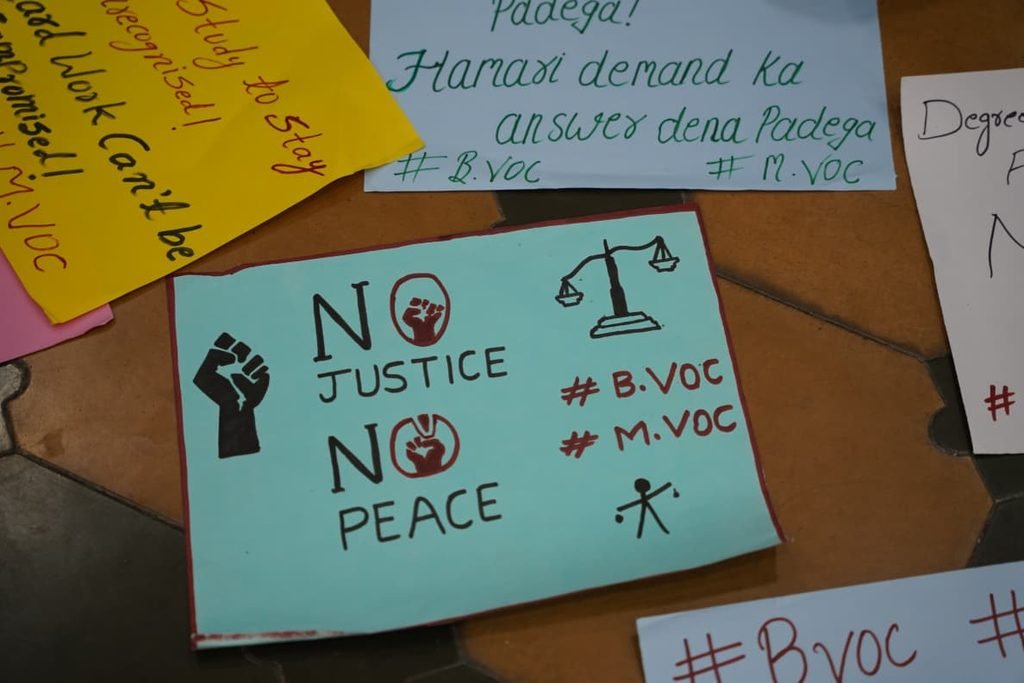
They have accused the administration of pressuring them to end the demonstration and return to examinations without addressing their principal demands.
Meraj alleged that university officials repeatedly urged students to attend examinations, warning that their academic progress could suffer.
“They keep telling us to attend examinations because otherwise we will suffer academic losses. But they do not give us anything in writing about when or how our registration issue will be resolved,” he said.
Students further alleged that notices were sent to their parents regarding their absence from classes.
The female student from Bihar said the notices exposed a situation she had deliberately concealed from her family to avoid causing further distress.
“We had not told our parents because they had already sacrificed so much for our education. We thought the university would resolve the issue,” she said.
Students described the repeated requests to end the protest, combined with uncertainty over their qualifications, as mental harassment.
Sleeping outside, waiting for answers
The protest has also taken a physical toll.
Male students have remained at the protest site overnight, while female students said they generally participate during the day because of hostel restrictions.
Students reported that rain had soaked their bedding and personal belongings, while mosquitoes and changing weather conditions made sleeping difficult. Despite these hardships, they insist the demonstration will continue until a concrete resolution is provided.
“We have been sitting here day and night. The weather is changing, students are falling ill, but we will continue until we receive a satisfactory solution,” Zulkarnain said.
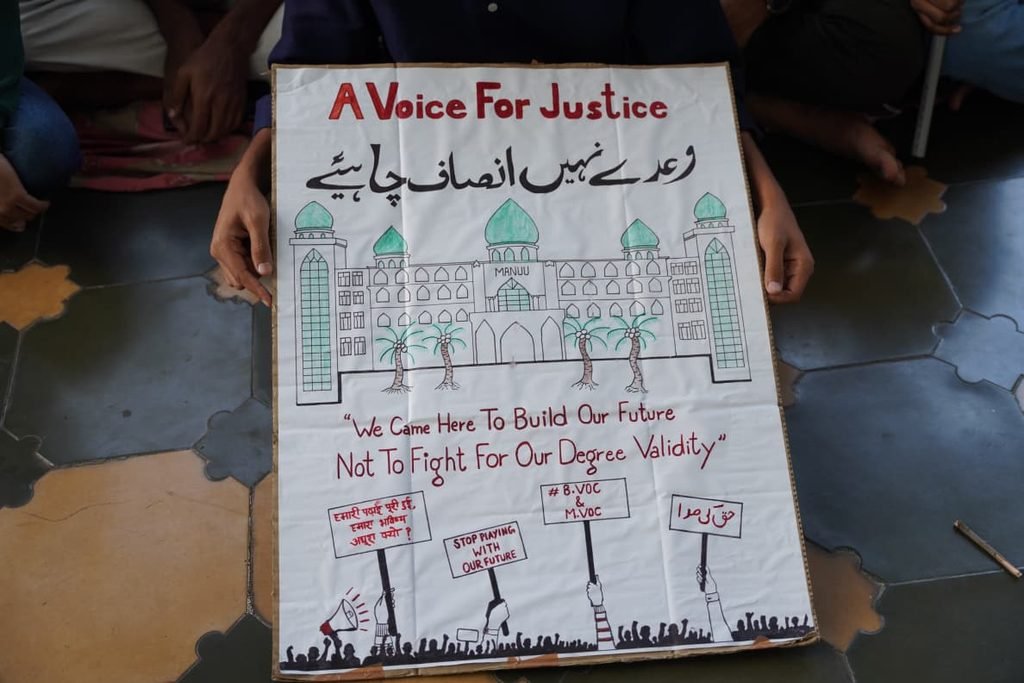
Students are demanding that their programmes be assessed against the prescribed academic and clinical standards, their registration eligibility be clarified, and the university provide a written commitment with a defined timeline. They have also called for a consistent policy covering similar healthcare programmes at institutions including Jamia Millia Islamia and Pondicherry University.
Who is accountable?
The MANUU protest raises a broader question about the responsibility of universities and regulators when professional standards change after students have already enrolled in approved programmes.
The students are not asking for professional standards to be diluted. They want their academic training assessed against the prescribed requirements, their eligibility for registration clarified, and a transition mechanism that protects those who enrolled under the previous system.
If a university-approved qualification cannot provide students with a clear route towards professional registration, the responsibility for resolving that uncertainty cannot rest on students alone.
The UGC oversees academic degree specifications, while NCAHP regulates professional standards and registration. Both operate within the central government’s institutional framework. The question, therefore, extends beyond the university campus: how should the government protect students caught between academic recognition and professional regulation?
For the young woman whose father sold land to finance her education, the question is more immediate. Her family sent her hundreds of kilometres from home in the hope that education would offer her independence and a more secure future.
Now, as the protest enters its 17th day, she is asking the institution she trusted to ensure that those years of sacrifice have not been in vain.
“We came here trusting the university,” she said. “If you started this course and admitted us, then you also have a responsibility towards our future.”