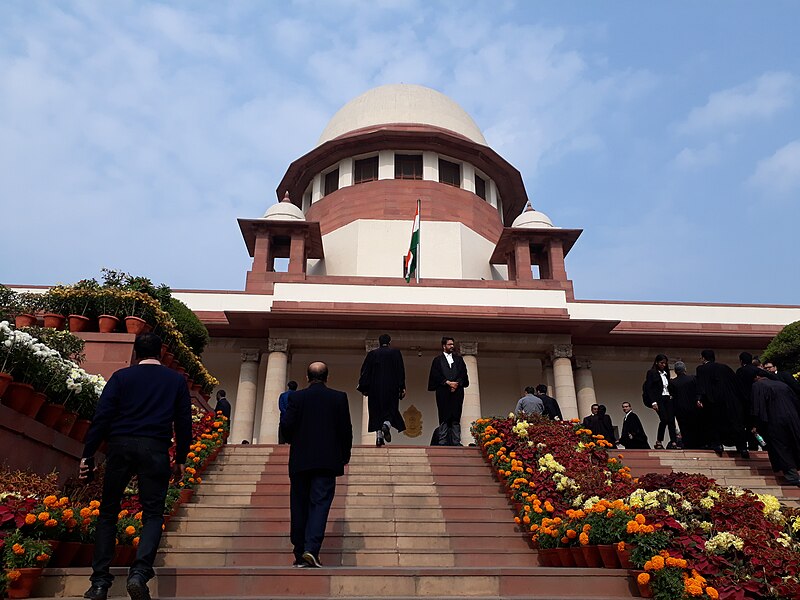
The Supreme Court on Friday, November 6, dismissed a public interest litigation seeking guidelines on the appointment of ministers who face serious criminal charges, with Justice Joymalya Bagchi cautioning that criminal cases can be used as a weapon against political opponents.
A bench of Chief Justice Surya Kant and Justices Joymalya Bagchi and V Mohana heard the plea. The PIL asked the court to prescribe constitutional safeguards and objective standards for appointing ministers at the Centre and in the states.
According to IANS and Bar and Bench, the petition proposed a framework in which the Prime Minister and Chief Ministers would carry out an objective suitability assessment before appointing a minister, record their reasons in a public “Suitability Memorandum”, and avoid giving portfolios where pending criminal proceedings could create a conflict of interest.
Advocate Nisha Tiwari, appearing for the petitioner, said the plea did not seek any new disqualification under Articles 75 and 164, which deal with the appointment of Union and state ministers. She argued that the discretion given to the Prime Minister and Chief Ministers must be exercised reasonably and in line with set parameters, and that a voter who elects a legislator does not necessarily agree to that person becoming a Cabinet minister despite a criminal record.

She also pointed out that although the Supreme Court had flagged the problem of criminalisation of politics more than a decade ago, Parliament has not done enough to deal with it.
The judges were not persuaded. Justice Bagchi said the court would be entering difficult constitutional territory if it tried to frame such guidelines, particularly because prosecutions can follow a change of government.
He remarked that “criminal law is continuously weaponised” against people in the democratic process. The bench observed that criminal cases are sometimes started against political leaders by their opponents. After hearing the arguments, the court dismissed the petition.
The effect is that the choice of ministers and the allocation of portfolios stays entirely with the Prime Minister and Chief Ministers, and no judicially framed filter based on pending criminal cases applies.
The Supreme Court has dealt with the same question before. In 2014, in Manoj Narula v. Union of India, a Constitution bench declined to add a disqualification to Article 75(1), but said it could legitimately be expected that the Prime Minister would consider not choosing a person against whom charges have been framed for heinous or serious offences, or for corruption, to be a minister.

The bench left the rest to the Prime Minister’s wisdom. In a separate opinion, Justice Madan Lokur said it was for the legislature to make a law restricting people with criminal antecedents from becoming ministers. The latest petition cited that expectation as one that has not been followed in practice.
Parliament has not passed a law on the matter, and the court has now declined, for the second time in a dozen years, to step in.