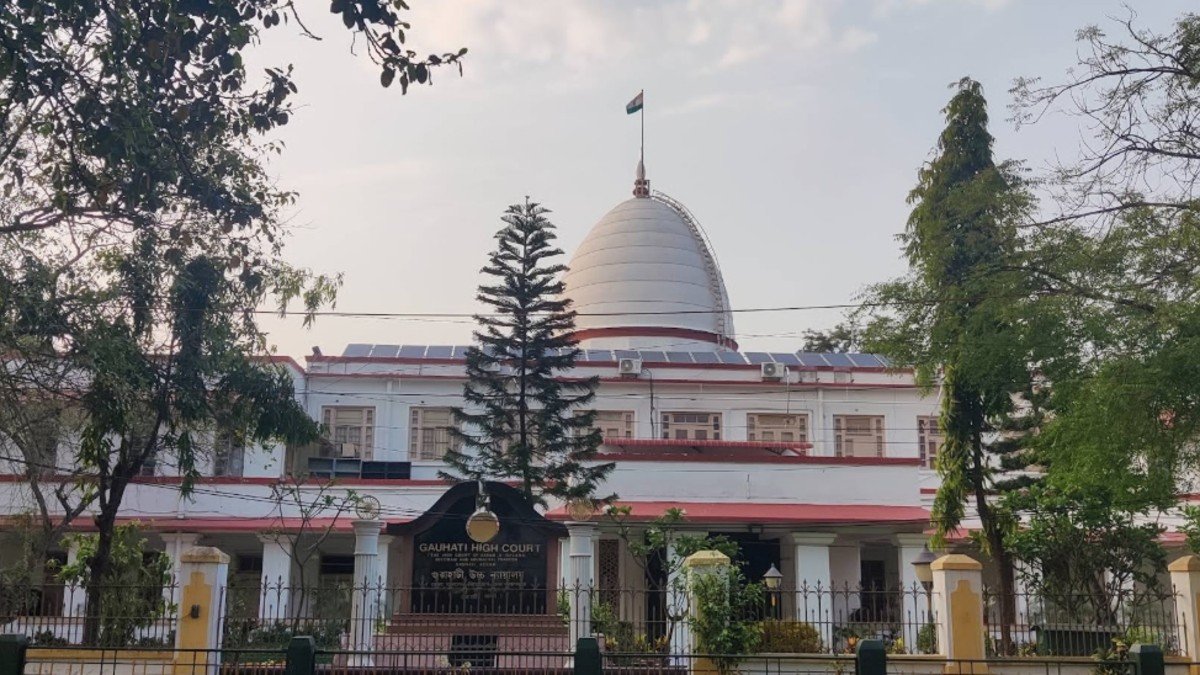
The Gauhati High Court has ruled that Permanent Account Number (PAN) cards and voter ID cards cannot, by themselves, establish Indian citizenship unless the records supporting their issuance are also proved.
The court made the observation on November 5 while dismissing a petition filed by Kulchan Begum, who had challenged a Foreigners Tribunal order declaring her a foreigner who entered India after March 25, 1971.
A division bench of Justices Kalyan Rai Surana and Susmita Phukan Khaund held that Begum had failed to establish her relationship with her claimed father and grandparents through reliable evidence. She also failed to prove that her family had continuously lived in Assam, as required under Section 6A(2) of the Citizenship Act, 1955.
Court Says PAN and Voter ID Are Not Proof of Citizenship
Begum had told the court that she was born in Assam on April 25, 1977. To support her claim, she submitted electoral rolls from 1966 and 1970 carrying the names of her claimed grandparents. She also produced her father’s PAN card and voter ID, her own voter ID, a ration card and an acknowledgement receipt for her National Register of Citizens (NRC) application.
She argued that her father was an Indian citizen whose name appeared in electoral records. She also said he had contested Lok Sabha and Assembly elections and served as a councillor of the Guwahati Municipal Corporation.
However, the Foreigners Tribunal rejected her claim, holding that she had failed to establish her relationship with her claimed father.
The High Court agreed with the tribunal and said PAN cards and Electoral Photo Identity Cards (EPICs) were issued on the basis of self-declarations, without formal verification by the Income Tax Department or the Election Commission of India.
“The PAN Card and EPIC are not a proof of citizenship. These are documents that are issued on self-application without any formal enquiry by the Income Tax Department and Election Commission of India,” the bench observed.
It added that the documents could not be accepted as proof of citizenship unless the records supporting their issuance were also established.
Court Rejects Plea for Another Opportunity to Submit Evidence
Begum argued that the tribunal had not properly considered her documents. She also said her previous lawyer had wrongly advised her that the evidence submitted was sufficient to prove her citizenship.

She asked the High Court to send the case back to the tribunal so she could present additional witnesses, including her parents and other relatives.
The bench rejected this request, noting that she had received several opportunities to submit further evidence before the tribunal but had failed to do so. It described her claim of incorrect legal advice as an “afterthought”.
The court also found that her documents did not establish the required relationship with her claimed parents. It noted that some records were not properly proved and that there were inconsistencies in the family history and ages recorded in electoral rolls.
The bench further said that her claimed father’s participation in parliamentary and Assembly elections, as well as his service as a municipal councillor, did not by themselves prove that she was his daughter.
The court dismissed her petition, upheld the Foreigners Tribunal’s order and revoked the interim bail granted to her in 2022.

Assam Foreigners Tribunals and the 1971 Cut-off
Foreigners Tribunals in Assam are quasi-judicial bodies that examine claims related to citizenship, particularly whether a person or their family can establish residence in India before March 25, 1971.
People declared foreigners by these tribunals can challenge their decisions before the High Court or the Supreme Court. The tribunals have also faced criticism from rights groups over allegations of arbitrary decisions and bias, including cases involving spelling errors, missing documents and inconsistencies in records.