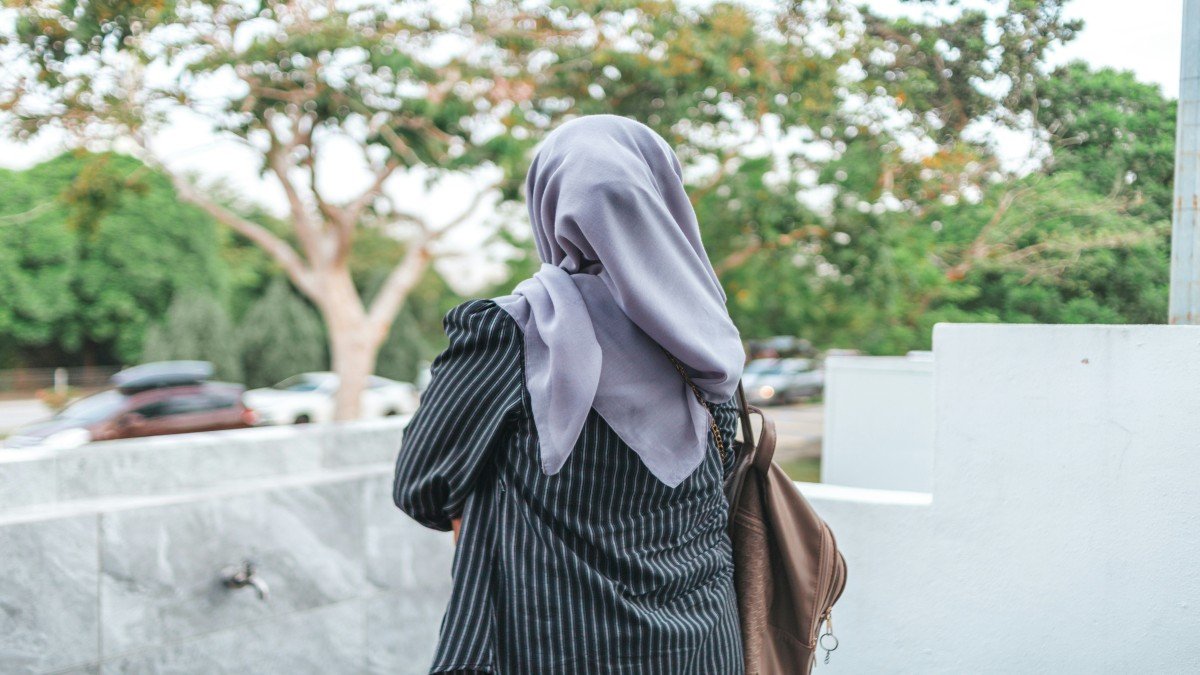
The Supreme Court has clarified that the Allahabad High Court’s ruling that wearing a hijab is not an essential religious practice in Islam should not be treated as a precedent, while issuing notice on a petition challenging the judgment.
A bench of Justices Aravind Kumar and Vipul M Pancholi passed the order on November 20 on a petition filed by the Muslim Women’s Study Circle, which challenged the High Court’s August 21, 2026 judgment. The Supreme Court also directed that the petition be tagged with pending appeals arising from the Karnataka hijab case.
The bench specifically directed that the matter be tagged with Civil Appeal No. 7095 of 2022 and that the Allahabad High Court judgment “shall not be treated as precedent”. It also sought the Uttar Pradesh government’s response to the petition, Live Law reported.
The case concerns Sukaina Rizvi, a Muslim student who approached the Allahabad High Court after Tagore Public School in Prayagraj allegedly denied her admission to Class 11 because she insisted on wearing a headscarf with her school uniform.
On August 21, a division bench of the Allahabad High Court, comprising Justices JJ Munir and Indrajeet Shukla, dismissed her plea. It held that wearing a hijab had not been established as an essential religious practice in Islam and that no material had been placed before it to show that a Muslim woman or girl would cease to be a Muslim by choosing not to wear one.
The High Court also held that students could not insist on adding clothing to a prescribed uniform if the dress code was uniform, bona fide, non-discriminatory and intended to maintain institutional discipline and identity.
What the petition argues
Challenging the ruling, the Muslim Women’s Study Circle has argued that the High Court’s judgment is arbitrary and discriminatory and violates constitutional protections under Articles 14, 15, 19(1)(a), 21 and 25.
The petition contends that restricting Muslim women from wearing the hijab infringes their freedom of conscience and religion and adversely affects their access to education. It also questions what it describes as differential treatment of religious symbols associated with other communities, including Sikh turbans.
The petitioner has argued that wearing the hijab is rooted in Quranic injunctions, including Surah Al-Noor, Verse 31 and Surah Al-Ahzab, Verse 59. It has also challenged the High Court’s application of the Essential Religious Practices doctrine, arguing that a practice cannot be declared non-essential simply because some members of a religious community do not observe it.
The plea further relies on Supreme Court judgments, including Shirur Mutt and Bijoe Emmanuel v. State of Kerala, to argue that courts must give due consideration to sincerely held religious beliefs and individual conscience.
Connection with the Karnataka hijab case
The Supreme Court has tagged the petition with appeals arising from the Karnataka hijab controversy, in which the court delivered a split verdict in October 2022.
While Justice Hemant Gupta dismissed appeals challenging the Karnataka High Court’s decision upholding restrictions on wearing hijab in educational institutions, Justice Sudhanshu Dhulia allowed the appeals and held that there should be no restriction on wearing the headscarf in schools and colleges.
The matter was subsequently referred to a larger bench and remains pending.
By linking the Allahabad case to those appeals, the Supreme Court has brought the challenge within the broader constitutional questions surrounding religious freedom, institutional dress codes and access to education.