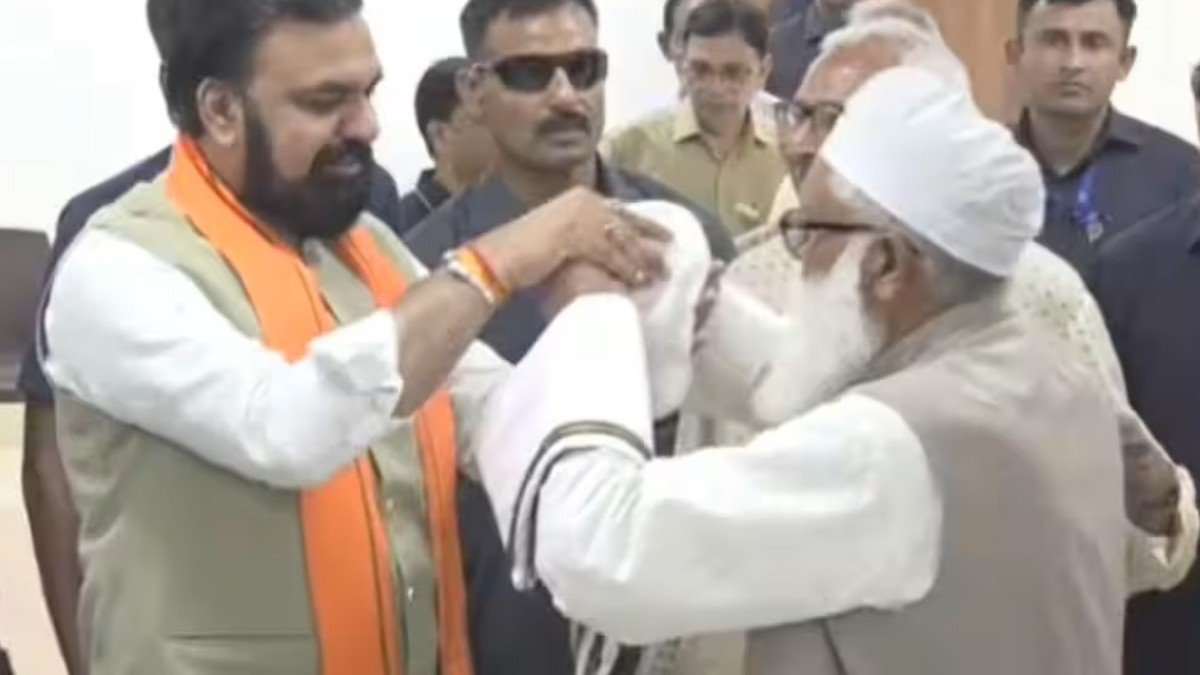
A political debate has erupted in Bihar after Chief Minister Samrat Choudhary was seen declining a Muslim cap during a public interaction at the Chief Minister’s Secretariat on Friday. The incident took place during a “janata darbar” where leaders, party workers, and members of the public met the newly appointed Chief Minister.
During the meeting, several people greeted the Chief Minister with traditional gifts such as flower garlands and shawls. A member of the minority community also attempted to place a traditional Muslim cap on his head as a mark of respect. However, the Chief Minister politely declined and instead accepted a “gamcha” (traditional scarf), which he wore during the interaction. He later handed over the cap to a security personnel present nearby.
The visuals quickly went viral on social media, triggering a political controversy in the state.
Opposition reacts, Congress raises questions
The Congress party criticised the Chief Minister’s gesture, linking it to broader questions of inclusivity. Party spokesperson Asit Nath Tiwari said that such actions reflect a political message rather than a personal choice.
He said, “Raja ko praja ke saath bhedbhav nahi karna chahiye. Bhedbhav karne wala sahi arth mein rajya ka neta nahi ho sakta,” adding that earlier leaders like Nitish Kumar used to accept both religious symbols like caps and tilak.
The opposition also accused the BJP of promoting selective symbolism and questioned its stand on secular traditions.
Political analysts call it routine protocol
Political observers, however, downplayed the controversy. Professor Pramod Kumar noted that public leaders often meet people from all communities in symbolic interactions and may accept or decline items based on personal comfort or protocol.
He said, “When someone becomes Chief Minister, people from all backgrounds meet them. It is normal for leaders to manage such symbolic gestures differently.”
BJP leaders’ past examples cited
The incident has also revived comparisons with past political events. Critics and supporters pointed out that Prime Minister Narendra Modi had once declined to wear a Muslim cap in 2011 during his tenure as Gujarat Chief Minister. However, years later, he was seen accepting traditional gifts from minority communities during public engagements in Indore.
Similarly, Nitish Kumar, who earlier often wore both caps and tilak during public events, has in recent years reportedly avoided certain symbolic gestures in select political settings, although he has also been seen wearing a cap during festive occasions.