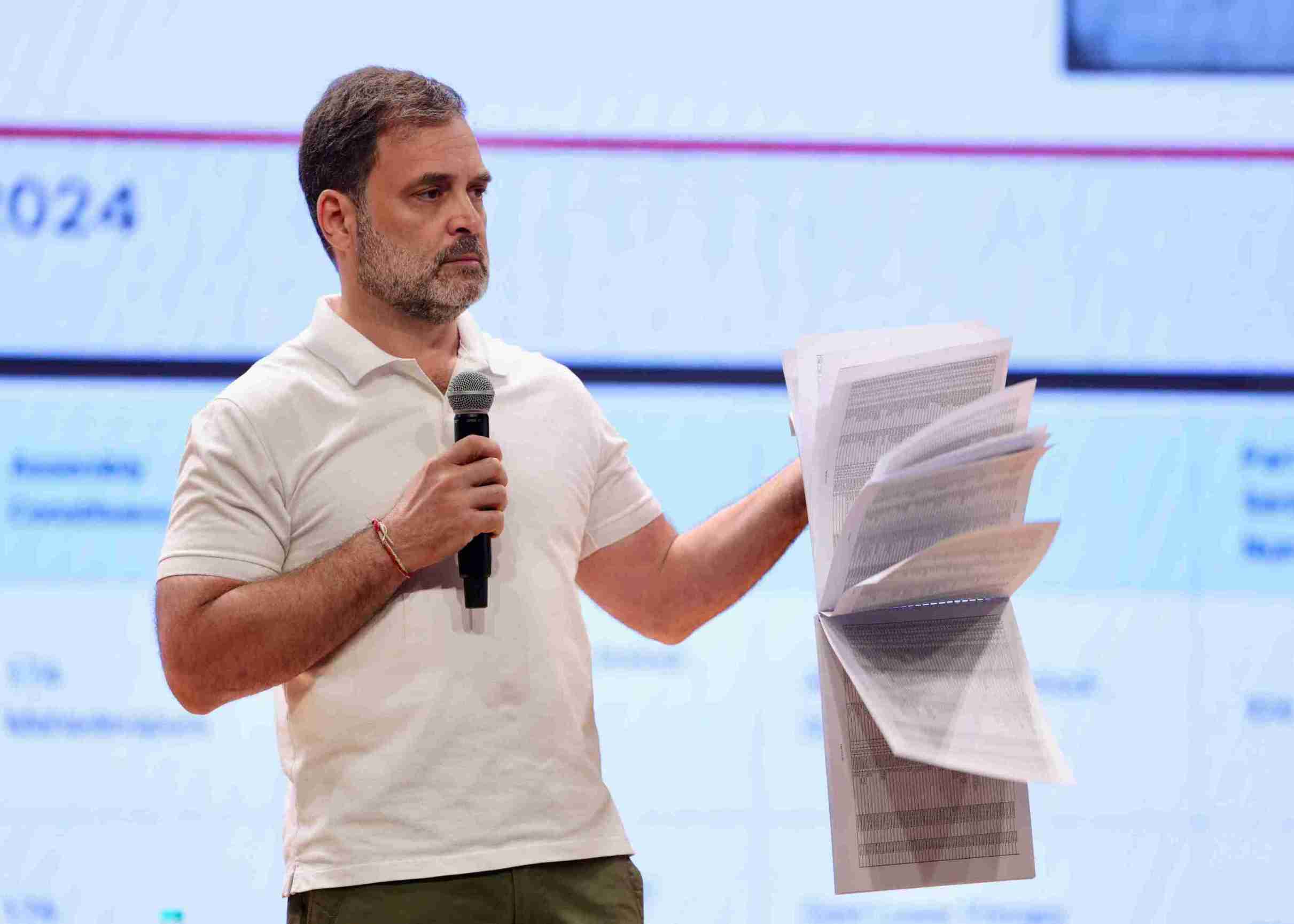
Leader of Opposition in the Lok Sabha Rahul Gandhi and other Opposition leaders have intensified their criticism of the Centre’s proposed delimitation exercise, questioning the role of Chief Election Commissioner (CEC) Gyanesh Kumar in the proposed Delimitation Commission and alleging that the government could redraw constituencies to strengthen the BJP’s electoral position.
Gandhi alleged that Union Home Minister Amit Shah may have already prepared a map of the proposed Lok Sabha constituencies, with the commission expected to implement it. He warned that the proposed expansion of the Lok Sabha could weaken the representation of communities opposed to the BJP and affect the Opposition’s electoral prospects.
“The issue is about giving a blank cheque to Modi, Shah, Gyanesh Kumar and Adani to redraw constituencies across the country, destroy democracy and continue looting the people of India,” Gandhi said.
He also referred to delimitation exercises in Assam and Jammu and Kashmir, alleging that constituency boundaries had been altered in ways that benefited the ruling party. Gandhi suggested that artificial intelligence could be used to model how 850 constituencies might be drawn to marginalise communities opposed to the BJP.
CEC’s proposed role draws Opposition criticism
Under the proposed Delimitation (Second) Bill, 2026, the Chief Election Commissioner or an Election Commissioner nominated by him would serve as an ex officio member of the Delimitation Commission.
The commission would be chaired by a person who is or has been a Supreme Court judge, appointed by the Centre. The third member would be the State Election Commissioner of the state concerned. An Election Commission secretary would serve as its ex officio secretary.
As the current CEC, Gyanesh Kumar could join the commission or nominate one of the two Election Commissioners, Sukhbir Singh Sandhu or Vivek Joshi, to represent the Election Commission.
Gandhi has questioned this arrangement, arguing that the Centre’s power to appoint the chairperson, along with the CEC’s role in selecting another member, could compromise the commission’s independence.
The proposed legislation also provides for five Lok Sabha MPs and five MLAs from each state to serve as associate members, although they would not have voting rights. Under Section 11(2), the commission’s orders would have the force of law and would ordinarily not be open to challenge in court. It would, however, be required to publish its proposals, invite objections and hold public hearings in every state before finalising them.
Opposition links delimitation to earlier disputes with Election Commission
The latest criticism comes amid the Opposition’s continuing allegations of bias against Gyanesh Kumar over the Election Commission’s Special Intensive Revision (SIR) of electoral rolls.
In March, 193 Opposition MPs, including 130 from the Lok Sabha and 63 from the Rajya Sabha, submitted notices seeking his removal. The notices alleged bias and voter disenfranchisement during the revision exercise. However, the notices were rejected by the Lok Sabha Speaker and Rajya Sabha Chairman.
The Opposition has also accused the Election Commission of irregularities in the electoral process, describing them as “vote chori”. It has now linked those allegations to the proposed delimitation exercise, using terms such as “seat chori” and “Sansad chori”.
On October 31, around 250 Opposition MPs participated in a symbolic public impeachment of Kumar at Congress president Mallikarjun Kharge’s residence, alleging that their concerns had not been addressed. The Election Commission has rejected allegations of vote theft as “incorrect and baseless”.
Government proposes 50% increase in Lok Sabha seats
The Union Cabinet has approved the Constitution (One Hundred and Thirty-Second Amendment) Bill, 2026, along with the Delimitation (Second) Bill, 2026 and the Union Territories Laws (Amendment) Second Bill, 2026.
The proposed constitutional amendment provides for a 50 per cent increase in parliamentary seats across states. The Lok Sabha’s strength would rise from its current 543 seats to 816 under the latest proposal, while earlier political statements and reports had referred to a possible expansion to 850 seats.
The government has said the increase would apply proportionately across states and would pave the way for implementing 33 per cent reservation for women in the Lok Sabha and state legislative assemblies from the 2029 elections.
A special sitting of Parliament is scheduled to begin on November 30 to consider the proposed legislation. A constitutional amendment requires a two-thirds majority in both Houses of Parliament.
The proposals have also exposed differences among Opposition parties. The DMK has announced its support for the revised legislation, with party president M.K. Stalin arguing that backing the proposal would protect Tamil Nadu from a future delimitation based on a more recent census. Congress leaders, meanwhile, are seeking support from regional parties, including the DMK and NCP (SP), to oppose the bills.
The BJP has rejected Gandhi’s allegations. Senior BJP leader Ravi Shankar Prasad accused the Congress leader of making baseless claims and described him as “anti-women”, arguing that the proposed legislation would advance women’s representation in Parliament.