A new report by the Digital Accountability and Human Rights Desk (DAHRD) has revealed what it calls India’s first industrial-scale AI disinformation operation in a state election, targeting Assam’s Muslim communities ahead of the April 9 Assembly polls.
The report documents how AI-generated content, official rhetoric, administrative measures, and new laws converged to create a highly coordinated campaign of exclusion and manipulation.
Massive Reach Across Social Media
DAHRD monitored 273 accounts across Facebook, Instagram, and X (formerly Twitter), reaching a combined audience of 407.4 million people — roughly the population of the European Union. Between November 2025 and April 2026, analysts studied 2,462 posts, identifying 432 AI-generated posts that alone reached 45.4 million views.
A single Instagram account, politooons, accounted for 88% of these AI content views. “Even at one percent engagement, a single AI post reaches four million people — over one-sixth of Assam’s registered voters,” the report states.
The AI campaign also included deepfakes: 31 targeted the main opposition candidate, Gaurav Gogoi, while six fabricated intimate videos targeted his wife, a private citizen. According to DAHRD, no previous Indian election has seen such attacks on family members.
Four-Pronged Strategy of Exclusion
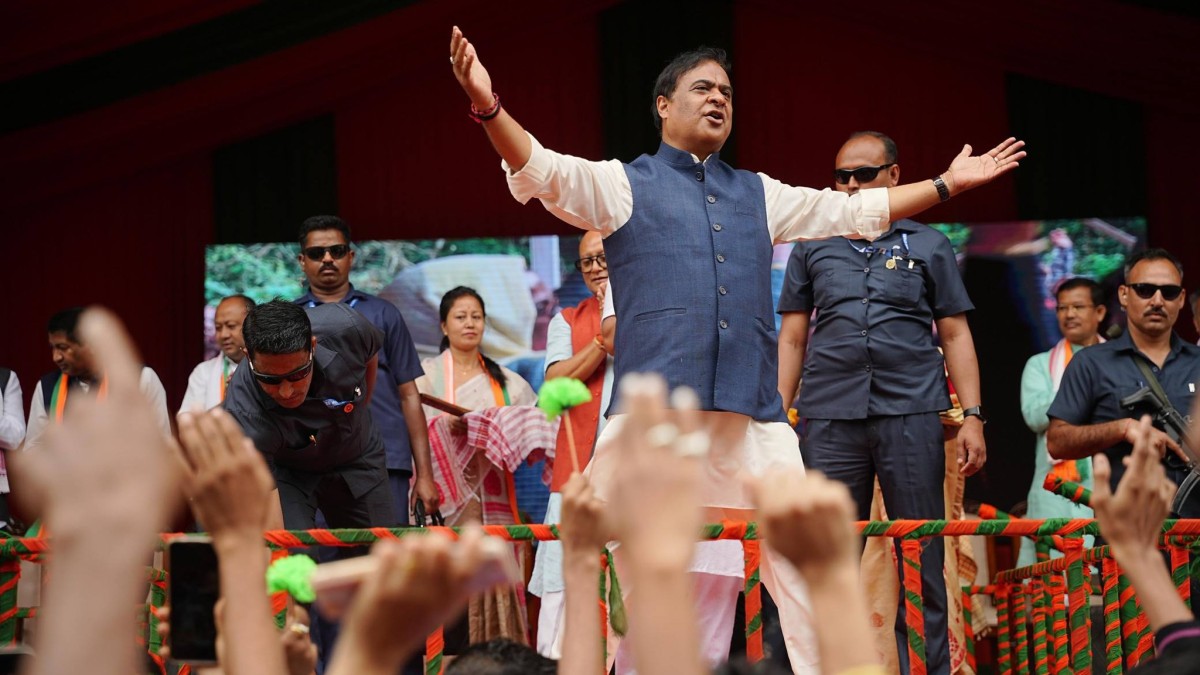
The report highlights four simultaneous operations against Assam’s Muslim communities. First, dehumanisation: AI posts and 18 verified statements by Chief Minister Himanta Biswa Sarma portrayed Muslims as an existential threat, often using the ethnic slur “Miya.”
Second, electoral exclusion: voter roll purges removed 2.43 lakh names, while a delimitation exercise reduced Muslim-majority constituencies from 35 to 20. Sarma had earlier stated, “Four to five lakh Miya votes will be deleted” during the Special Revision process.
Third, physical displacement: a 68-post social media campaign celebrated evictions as governance achievements, while a February 2026 property law restricted land purchases by Muslims, completing the economic exclusion pipeline.
Fourth, cultural erasure: the BJP campaign replaced Azan Fakir, a Sufi saint central to Assam’s shared heritage, with a Hindu figure, promoting a monocultural identity. DAHRD notes the replacement videos reached over 220,000 views.
Propaganda Turned Law
For the first time, DAHRD found AI propaganda directly influencing legislation. The “Land Jihad” narrative spread online and by government authorities, eventually becoming law through the property restriction act in February 2026.
“This is not just social media manipulation — it is a full propaganda-to-policy pipeline,” said DAHRD’s report.
Institutional Failures
The Election Commission of India failed to act on 119 documented Model Code of Conduct (MCC) violations, including 15 by the Chief Minister. Social media platforms removed zero posts, and the judiciary scheduled its hearing on hate speech 12 days after the election.
CM Sarma admitted publicly on March 12, “We had not added the word Bangladeshi — it was constitutionally and legally wrong. But we will correct it and post it again.” The DAHRD report says the language was rotated deliberately to avoid legal consequences while maintaining the same communal targeting.
Assam as a Laboratory, India as the Target
DAHRD warns that the Assam model is being applied elsewhere. West Bengal’s 2026 voter roll process has already suspended over 10 million voters using similar methods. “Assam is the laboratory. The rest of India is the intended market,” the report warns.
The findings highlight six unprecedented features: industrial-scale AI content, deepfakes targeting private individuals, a propaganda-to-policy pipeline within a single election cycle, deliberate legal evasion through vocabulary rotation, record MCC violations from official accounts, and a fourfold exclusion strategy against one community.
Recommendations for Reform
DAHRD has called for comprehensive reforms, including real-time AI monitoring, mandatory AI content labeling, deepfake safeguards, judicial review before voter deletion, and rapid platform takedowns during elections. “If this trajectory continues unchecked, free and fair elections in India will be seriously compromised ahead of 2029,” the report warns.