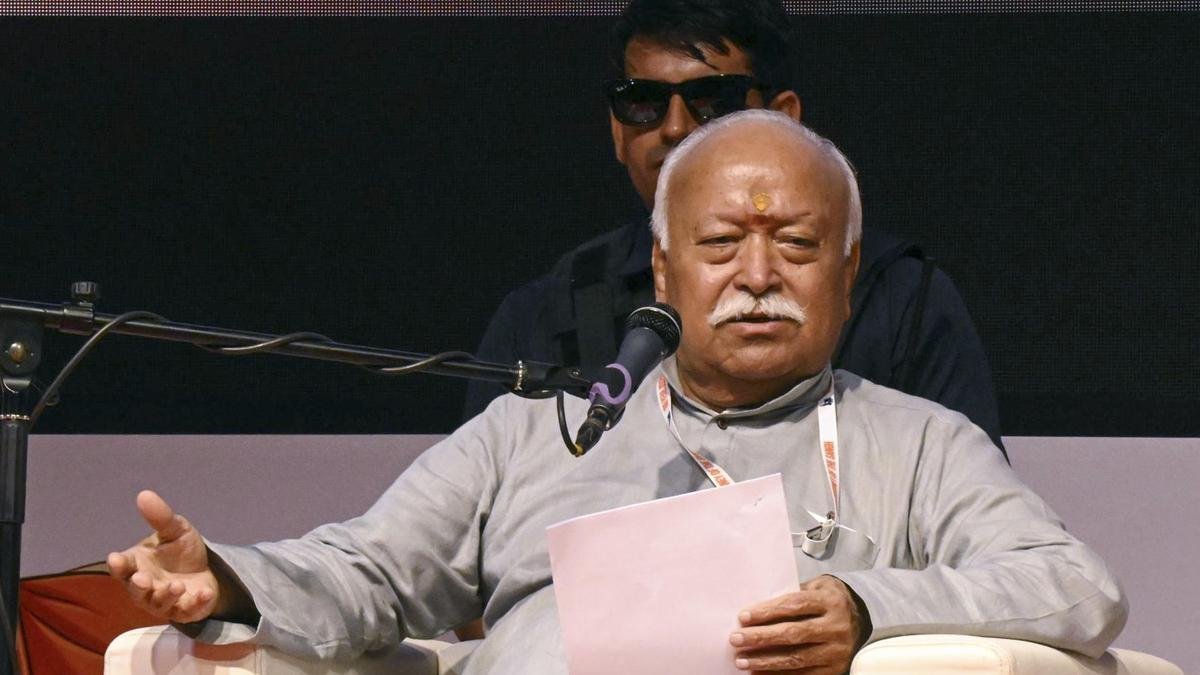
RSS chief Mohan Bhagwat on Sunday said India’s civilisational identity is rooted in the coexistence of diversity and unity, arguing that differences among people should be respected as different expressions of an underlying oneness.
Speaking at a “Celebration of Oneness” event in London, Bhagwat said diversity was natural and that people should focus on what unites them rather than what divides them.
“Hindu civilisation has always been rooted in the understanding that existence is fundamentally one, even though it appears in diverse forms. Diversity is natural; these differences are merely different expressions, or decorations, of the same underlying unity,” he said.
Bhagwat Links India’s Progress With Peace
Bhagwat highlighted what he described as India’s cultural and historical legacy, saying that India’s progress does not lead to dictatorship or war.
“When Bharat progresses, never any dictator is created. Never any war is started when Bharat progresses. Bharat creates peace, bliss, prosperity, brotherhood in all humanity as well as brotherhood with nature,” he said.
He said rulers, governments and administrative systems may change, but the nation continues to exist.
“Sometimes there were Republics. Sometimes we were ruled by others. Sometimes we were in continuous struggle for Independence, but all the time we were there, a nation,” Bhagwat said.
Explains RSS View of Hindu Rashtra
Responding to a question on Hindu Rashtra, Bhagwat said the term should not be understood simply as a nation-state.
“Rashtra is not nation. For Rashtra, first there is a purpose. What is the purpose of Hindu Rashtra? It is to give this truth to the world that diversity is natural and unity is truth. This benefits the world,” he said.
He described Hindu identity as a broader cultural and civilisational idea rather than simply a religious identity.
“Hindu is fundamentally a cultural and civilisational identity — a way of understanding life, existence and our relationship with the world,” he said.
Bhagwat also said unity did not require uniformity.
“We do not have any mechanism to make everyone uniform, because uniformity is not essential for unity. Our civilisational understanding is unity in diversity — we accept diversity,” he said.
Says Hindu Thought Accepts Different Paths
Bhagwat said Hindu thought does not require people to follow a single religious path and does not seek to convert others.
“When we say ‘Hindu’, we are not referring to a religion in the narrow sense. There are many Hindu religions and traditions, but the underlying Hindu thought accepts all paths,” he said.
He added that Hindu thought recognises different paths to the same truth and supports coexistence.
“When we say that Hindu is not a religion. But there may be Hindu religion. Hindu religion says, all other religions are also true,” Bhagwat said.
He also described Hinduism as a way of life that includes respect for nature.
“A Hindu is connected with family, community, society, and humanity. A Hindu not only worships, but also loves nature,” he said.
Calls for Focus on What Unites People
Bhagwat said conflicts could be managed better when people stopped viewing others as enemies.
“Instead of trying to restrict or conquer the other, we should recognise that ultimately, we all seek the same things. The question, then, is not how to defeat the other, but how we can attain those things together,” he said.
He also said society should focus on what unites people rather than their differences.
“Give your emphasis on what unites us instead of what divides us,” he said.
On the relationship between British Hindus and Britain, Bhagwat said loyalty should be linked to the country where a person lives and works.
“There is no conflict. If at all, such a situation arises, it is obvious that British Hindu will go with Britain,” he said, adding that “your Karmabhoomi is where your loyalty lies and your Janmabhoomi is where you received your values.”
Bhagwat Expresses Confidence in Young People
Speaking about the next generation, Bhagwat said he was increasingly confident in young people and their ability to improve society.
“I trust future generation more as they have urge to make this world a better place. Give them the goal and not the method. They will achieve the goal of universal morality and prosperity rapidly,” he said.
He said serving society required the willingness to do so and argued that young people could overcome social differences.
Bhagwat is in the United Kingdom as part of overseas programmes marking the RSS’s centenary year. His London visit is scheduled to continue until September 7.