





























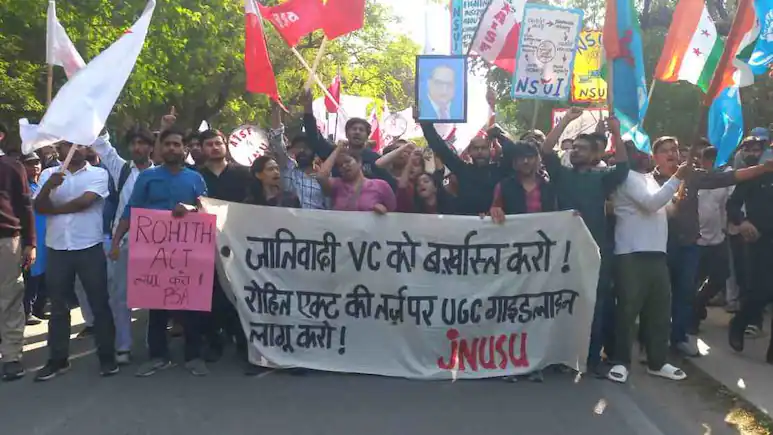
On Thursday, February 26, students from Jawaharlal Nehru University (JNU), led by the JNU Students’ Union (JNUSU) and supported by other student organisations, attempted a “long march” from the campus to the Ministry of Education in Delhi. The protest, which began around 3 pm from Sabarmati Dhaba inside the university, was met with strong resistance from Delhi Police, who lathi-charged the students near the main gate and detained many, taking them to Kapashera and Sagarpur police stations.
JNUSU office bearers told The Wire that several students, including women, were injured during the police action. Danish, JNUSU joint secretary, said, “We called for a peaceful march from JNUSU to the Ministry of Education. However, Delhi Police blocked JNU gates, putting locks on them. Around 500 to 700 policemen were deployed with heavy barricading, lathis, tear gas and water cannons. When students broke the locks and marched, the police launched a brutal lathi charge. Many students were hurt. Women students were dragged and their clothes torn. Even now, many of us are injured but have not received any first aid.”
Demands Behind the March
JNUSU president Aditi Mishra said the march was organised to demand the implementation of the University Grants Commission (UGC) Equity Regulations, enactment of the Rohith Vemula Act, and the resignation of Vice-Chancellor Shantisree Dhulipudi Pandit over alleged casteist remarks. Mishra told The Wire, “Our Vice-Chancellor said ‘Blacks and Dalits are permanently drugged with victimhood’. We believe this is unacceptable. We are also asking for the restoration of funds because continuous cuts are weakening public universities and directly affecting students.”
The march followed earlier tensions on campus. On February 22, a “Samta Rally” was held protesting the Vice-Chancellor’s comments, during which clashes broke out between student groups. Left-aligned student organisations accused the ABVP, an RSS-affiliated student body, of stone-pelting during the confrontation. Subsequently, the JNU administration registered a case against JNUSU office bearers for alleged violence during the rally.
Police Response
Delhi Police said that the students attempted to take the protest outside the university without permission. “Barricades placed outside the campus were damaged as the situation escalated. The protesters pelted banners and sticks, threw shoes, and resorted to physical assault. Some police personnel were even bitten during the scuffle,” a senior officer said. Police claimed that officers were maintaining law and order, while some students accused personnel in civil dress of also beating protesters.
READ MORE: JNU: Students Injured in Campus Violence; ABVP and Left-Wing Groups Trade Allegations
Nitish Kumar, former JNUSU president, said, “We somehow broke the locks and also broke the barricades, but after that they started detaining people. They started beating people as well. Even now, students are standing firm at the JNU gate, but the police are gradually detaining them.”
Teachers’ Association Condemns Action
The Jawaharlal Nehru University Teachers’ Association (JNUTA) condemned the police action, describing it as a “brutal use of force against students.” In a statement, JNUTA said, “Several students, including women, were injured and many were detained, with reports that women detainees were taken to undisclosed locations and allegedly mistreated. Police action appeared aimed at preventing students from exercising their democratic right to march.” The association demanded the immediate release of all detained students, action against officials involved, and removal of police personnel from campus gates.
Background and Trigger
The immediate trigger for the protest was a podcast appearance by Vice-Chancellor Pandit, in which she made comments about caste-based “victimhood” that students found offensive and casteist. On February 24, former JNUSU president Dhananjay filed a complaint before the National Commission for Scheduled Castes and Scheduled Tribes, seeking an independent investigation and the Vice-Chancellor’s removal under the Scheduled Castes and Scheduled Tribes (Prevention of Atrocities) Act, 1989.
Despite heavy police deployment, chains, and barricades at campus gates, around 700–800 students participated in the protest, asserting their demands for equity, justice, and proper funding for public universities.