Muzaffar Ahmad
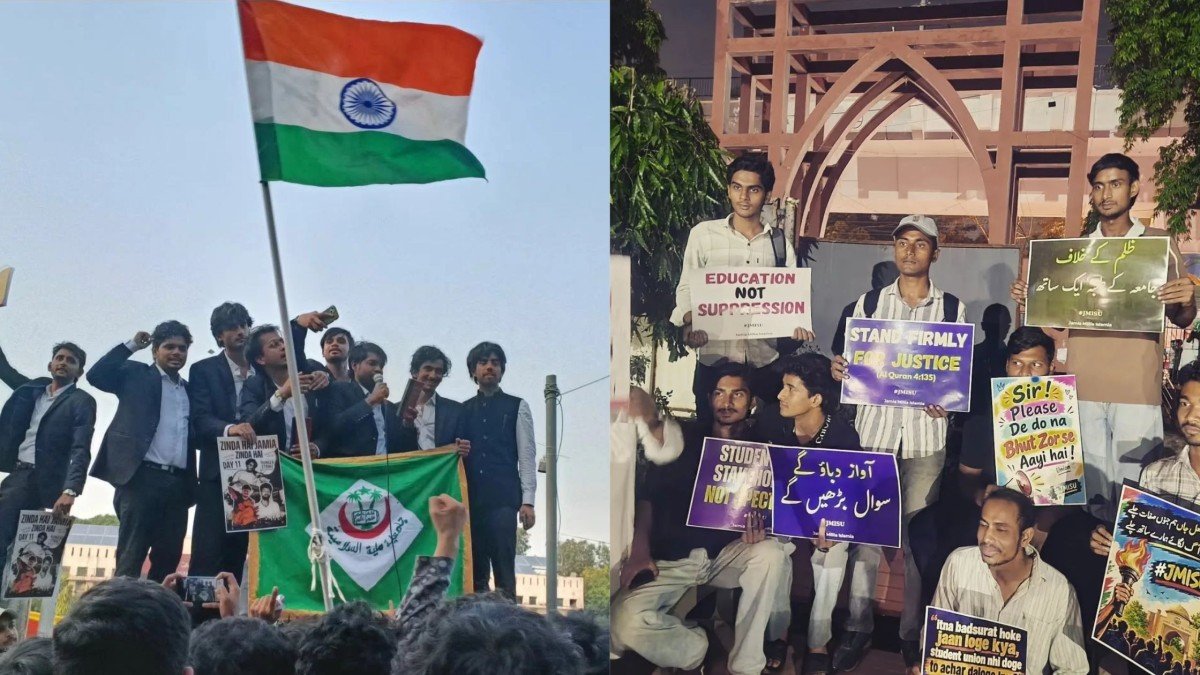
A nation can say “we” in one breath and demand proof of belonging in the next, and I keep returning to that contradiction because it becomes visible when a Muslim student protests and is asked to establish the belonging the pronoun seemed to promise. At Jamia Millia Islamia, that conflict came into view on December 15, 2019, when Delhi Police entered the university during protests against the Citizenship Amendment Act. Contemporary accounts of the Jamia raid described tear gas inside the library and baton attacks on students, while police said the operation followed violence outside the campus. What unsettles me is the speed with which students became the thing to be explained, while the language of order surrounded the force used against them.
The CAA drew this boundary into law by making specified non-Muslim migrants from Afghanistan, Bangladesh, and Pakistan eligible for a special route to citizenship, while Muslims from those same countries remained outside it. The law’s eligibility provisions The law did not itself revoke Indian Muslims’ citizenship, but the proposed nationwide National Register of Citizens made its possible effects harder to separate, because Muslims asked to document their status might not have the same fallback route to protection. Reporting on CAA-NRC concerns and anti-Muslim rhetoric records the fears and the “shoot the traitors” chant. To me, the contradiction is that a measure described as protective can coexist with a public language that makes Muslim dissent sound like betrayal.
Jamia’s current protest is distinct from the anti-CAA movement. Students began a hunger strike on October 12, 2026, demanding the restoration of elected student representation in a university whose union was dissolved in 2006, and on October 24 the administration moved classes online amid the continuing agitation, citing student safety and continuity of teaching. Current Jamia coverage confirms those events. I do not want to collapse this demand into the protest of 2019, but it raises a related question about who may shape campus life and claim political space.
A university is more than a passage to employment, because it is one of the places where young people learn to meet, disagree, organise, and imagine futures not yet granted to them. During the First Intifada, Israeli authorities closed all Palestinian universities for more than four years, from January 1988 to April 1992, interrupting classes and the ties through which students and communities could teach one another, sustain public life, and keep a shared future in view. The documented Palestinian university closures show how the disruption reached beyond the classroom.
I am not arguing that India and Israel are the same, because a police entry into an Indian university and years of military closures in occupied Palestine differ in law, duration, scale, and political setting. The comparison matters to me for a narrower reason: governments with different histories can still treat student organisation as a security problem and the campus as a place where the future must be managed.

National identity is easier to guard when land is made sacred and indivisible. An analysis of land-centred Zionism describes early traditions that placed the Land of Israel at the centre of Jewish collective identity, sometimes privileging its spiritual bond over the political community. Hindutva uses a different history, but Savarkar’s formulation made India both pitribhumi, fatherland, and punyabhumi, holy land. I do not treat these histories as interchangeable. I see a narrower parallel in how identity is fastened to territory until disagreement with policy sounds like an insult to the nation, whose “we” has a guarded threshold.
Muslim experience cannot sit at the edge of this story. The CAA drew a religious boundary around a route to citizenship, and Muslim students who opposed the law were often made to answer whether they belonged before their argument was heard. The citizen speaks about legislation while their loyalty is put on trial, and once the homeland is imagined as sacred property, dissent can be recast as trespass. I cannot accept a version of unity that asks Muslim students to leave the history of that suspicion outside the room.
The CJP complicates the easy division between a protest permitted and a protest crushed, since its demonstrations arose around the alleged NEET paper leak and demands for accountability, yet police used batons and tear gas against marchers toward Parliament in July 2026. Jamia students recalled a difference in public response, saying anti-CAA protesters were branded “anti-national” while the CJP drew support from a wider range of public figures. The Jamia-CJP comparison captures that difference. To me, the CJP asks whether solidarity can make room for Muslim students’ memory of repression without asking them to leave it at the gate.
France belongs here as a brief contrast, not another parallel case. Students there have protested teacher shortages, deteriorating schools, university funding, living costs, and admissions, while demonstrators in Paris and Dijon described being tear-gassed by police. Reporting on French student protests points to a different set of grievances, rooted in education and material security, rather than citizenship or occupation. I include France to mark that difference, not to claim that the cases share one political history.
I do not claim that these protests are alike. I am asking whether students can make claims without being turned into threats. Jamia’s current demand is for representation, anti-CAA protesters challenged a religious boundary in citizenship, Palestinian students endured years without open universities, and French students seek institutions they can afford. These struggles have different histories, yet each begins when students refuse to let others decide their future over their heads. A democracy is measured by whether people can challenge its deepest stories without first being made to feel like strangers in their own country.
Muzaffar Ahmad is a Ph.D. student in the Department of Sociology at the University of Massachusetts Amherst, where he also serves as Co-Chair of the Sociology Graduate Student Association.
The information presented in this article represents the personal viewpoints of the author and does not necessarily reflect the opinions of The Observer Post.