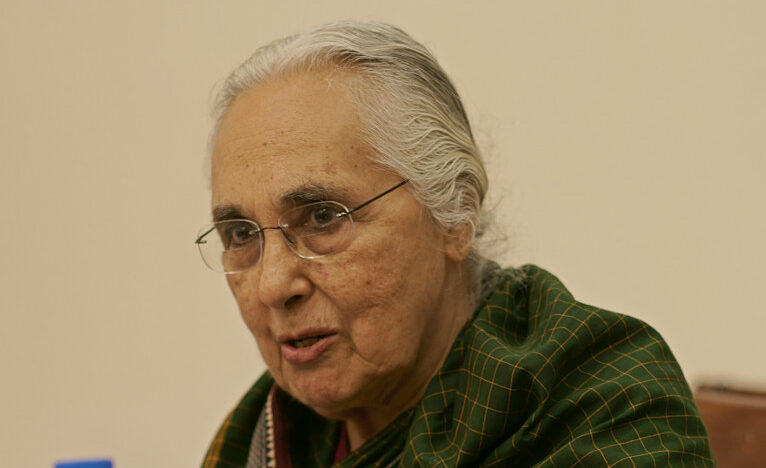
Eminent historian Romila Thapar has strongly criticized the removal of entire dynasties, including the Mughals, from school textbooks, calling such actions “nonsense”.
Speaking at the ninth edition of the Kerala Literature Festival on Saturday, January 25, 2026, Thapar stressed that history is a continuous process that reflects the evolution of people, cultures, and ways of thinking. She said breaking this continuity by omitting major periods or dynasties from textbooks makes no sense.
“The kinds of things that are happening, where, for example, chunks of history are being thrown out of the syllabus, or we are told we do not need to study them, are nonsense,” Thapar said. “History is an evolution of people and cultures, of ways of behaviour and ways of thinking. That continuity cannot be broken by saying, ‘All right, we throw this dynasty out, we throw Mughals out, we throw out that.’ It breaks history up and makes no sense.”
Her remarks come after the NCERT revised the Class 7 Social Science textbook for the 2025-26 academic year, removing chapters on the Delhi Sultanate and the Mughals. The textbook now focuses more on ancient Indian dynasties like the Mauryas, Shungas, and Satavahanas as well as cultural traditions and sacred sites across religions.
Thapar also raised concerns over the influence of “popular history” on social media, which she said often blurs the line between scholarly research and opinion. She urged people to rely on professional historians when seeking accurate explanations of past events.
“There is a difference now between the two, popular history and what professional historians write, and it is important to note that difference and understand what it entails. When quoting a historical statement, one should be aware whether it comes from professional historical writing or a statement propagated on social media,” she explained.
Thapar further highlighted the importance of feminist history and women’s autonomy. She said that while she may not have always written explicitly from a feminist perspective, she has tried to include feminist insights in her work. She stressed that behaving like a feminist, asserting independence, critical thinking, and intellectual freedom, is equally important.
“An autonomous woman, I think, is essential. Therefore, my attitude to this has been, yes, we have to write feminist history, that is a given, but if I am not writing feminist history, I am at least behaving like a feminist. I am propagating that an autonomous woman is an absolutely essential component of any society,” she said.
KLF 2026, now in its ninth edition, is hosting over 400 speakers, including Nobel laureates Abdulrazak Gurnah and Abhijit Banerjee, astronaut Sunita Williams, author Kiran Desai, essayist Pico Iyer, Jnanpith winner Pratibha Ray, sports icons Rohan Bopanna and Ben Johnson, and Wikipedia founder Jimmy Wales. The festival concludes on Sunday, January 25, 2026.