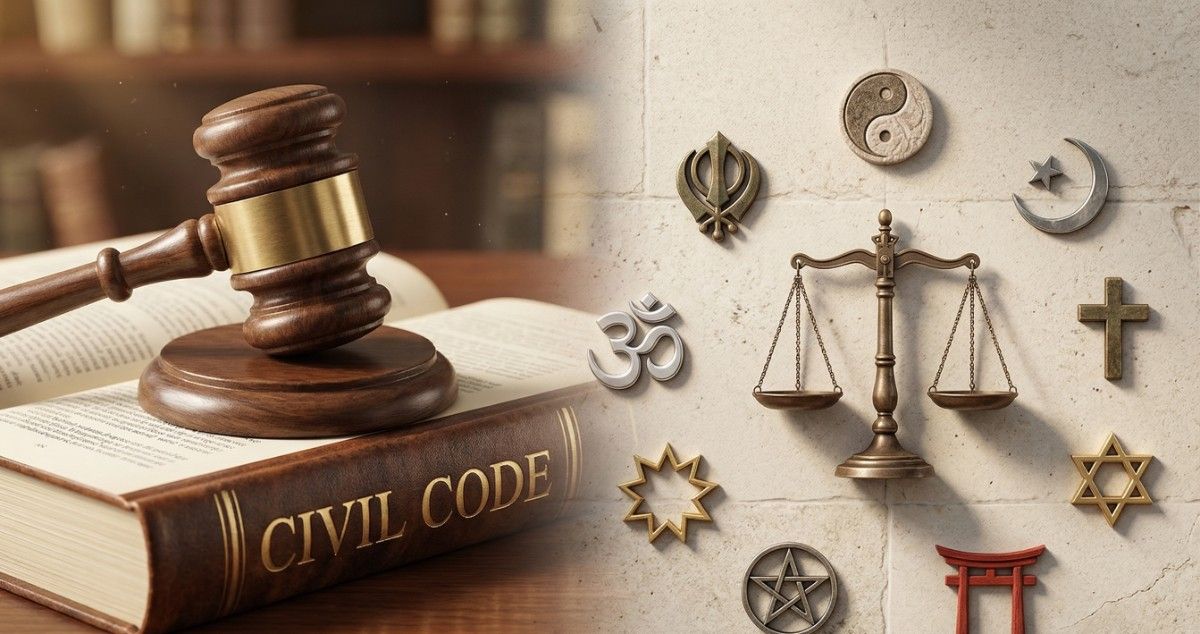
After more than seven hours of intense debate, the Gujarat Assembly on Tuesday passed the Uniform Civil Code (UCC) Bill, which aims to create a common legal framework for marriage, divorce, inheritance, and live-in relationships across all communities in the state. The legislation is being hailed by the ruling Bharatiya Janata Party (BJP) as a landmark reform, while opposition parties, especially Congress, strongly criticized it as “anti-Muslim” and rushed ahead of the 2027 assembly elections.
Uniform Civil Code Introduces Stricter Legal Framework
The bill sets out strict rules for marriages, live-in relationships, and inheritance. It prescribes up to seven years of imprisonment for marriages conducted through force, coercion, or fraud. Bigamy and polygamy are also punishable with up to seven years in jail. Registration of marriages and live-in relationships is now mandatory, with a fine of up to Rs 10,000 for marriages not registered within 60 days. Non-registration of live-in relationships could lead to three months in prison or a fine of Rs 10,000.
Chief Minister Bhupendra Patel, who introduced the bill, said, “A common legal framework is necessary for a united and undivided nation. Our ancient verses also say that truth is one, and justice must be one, even if religions are many. This legislation ensures equality for all citizens, as envisaged under Article 14 of the Constitution. Article 44 also directs the state to move towards a Uniform Civil Code, and this bill is a step in that direction.”
The CM emphasized that the legislation does not interfere with religious practices. “Absolutely no interference is being made in religious rituals. This law is solely to eliminate discrimination and ensure justice, not to erase anyone’s culture. Scheduled Tribes are completely exempted,” he said.
Legal Protections for Women and Equal Inheritance
Patel said the bill prioritizes women’s rights, security, and equality. “The key provisions of this bill include mandatory registration of marriages and live-in relationships, uniform rules for divorce, and equal inheritance rights for daughters and sons. Enforcement will be strict, and penalties for non-compliance are clearly defined,” he added.

Deputy Chief Minister Harsh Sanghavi supported the bill and justified it using examples from across India and abroad. He criticized Congress for resisting reforms in the past. “When Dr. Babasaheb Ambedkar brought laws to give women equal rights, the Congress argued the time was not ripe. We cannot tolerate the same anti-women mentality today,” Sanghavi said.
Opposition Claims Bill Targets Minority Rights
Congress leaders, however, criticized the legislation as discriminatory and rushed through without consultation. Senior MLA Shailesh Parmar said, “This bill has been brought in haste just ahead of the assembly elections. We demand it be sent to the select committee of the assembly for proper review.”
Congress MLA Amit Chavda argued that the UCC violates constitutional guarantees. “It ignores the freedom of communities to follow their personal laws and religious practices,” he said.
Imran Khedawala, another Congress legislator, voiced strong opposition on behalf of the Muslim community. “For Muslims, matters of nikah and inheritance are not just rules, they are Allah’s orders. This bill seeks to disturb our Shariyat and Quranic provisions. We will protest and also challenge this law in court,” he warned.
UCC Comes Into Effect Across Gujarat
The Gujarat UCC, 2026, will extend to all residents of the state, including those living outside its territorial limits. Scheduled Tribes and certain groups with constitutionally protected customary rights are fully exempted. With this, Gujarat becomes the second state in India, after Uttarakhand, to implement a Uniform Civil Code. Uttarakhand passed its UCC in February 2024.

The bill is expected to have a major impact on social and legal practices in the state, especially for women and inter-community marriages. The BJP believes that the law will create equality and eliminate legal loopholes that have been exploited in forced or fraudulent marriages.
Chief Minister Patel concluded, “This legislation reflects the aspirations of our citizens for equal justice. It is a step toward a society where no citizen faces discrimination based on religion or caste. Our goal is not to interfere with culture, but to ensure fairness and security for all.”