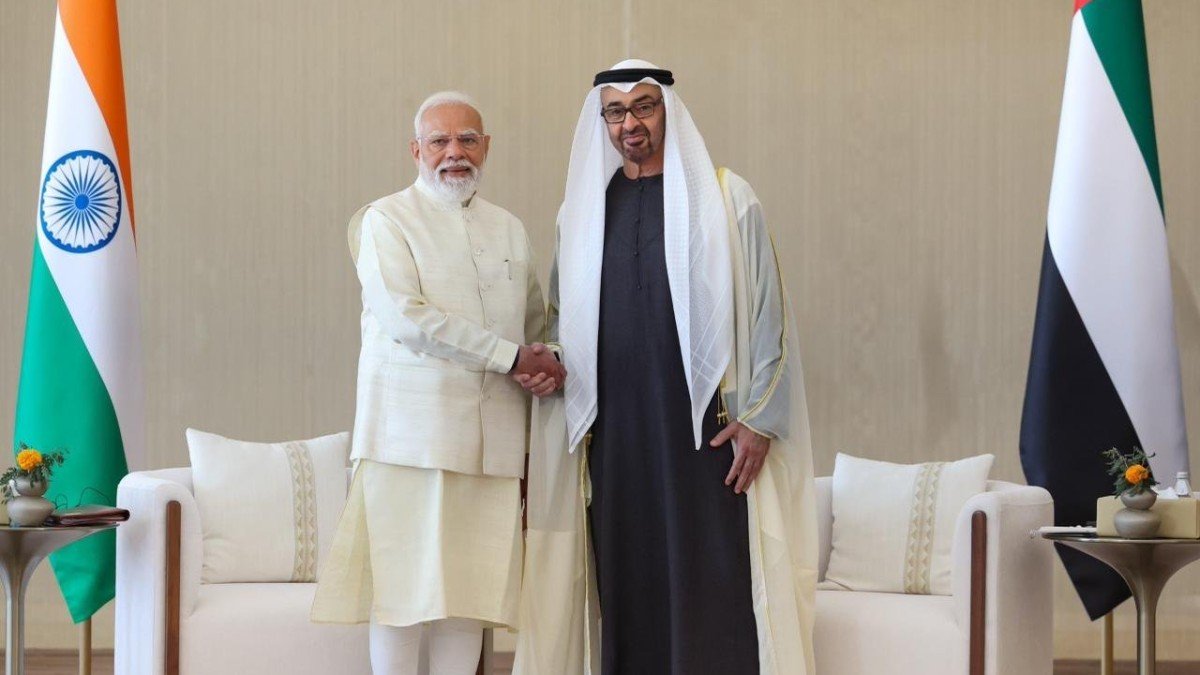
India and the United Arab Emirates (UAE) signed a framework agreement for a strategic defence partnership on Friday during Prime Minister Narendra Modi’s visit to Abu Dhabi, as both countries move to strengthen ties amid regional tensions linked to the Iran conflict.
The agreement was signed following talks between Modi and UAE President Mohamed bin Zayed Al Nahyan.
According to India’s foreign ministry, both countries agreed to deepen cooperation in defence production, advanced technology, maritime security and cybersecurity.
“The two sides have agreed on deepening defence industrial collaboration and cooperation on innovation and advanced technology, training, exercises, maritime security, cyber defence, secure communications and information exchange,” the ministry said in a statement.
أجريتُ مباحثاتٍ ممتازة مع أخي، صاحب السمو الشيخ محمد بن زايد آل نهيان؛ حيث جددتُ التأكيد على إدانتنا للهجمات التي استهدفت دولة الإمارات العربية المتحدة بأشد العبارات. كما أعربتُ عن تقديري لما يتحلى به أخي من قيادةٍ وشجاعةٍ وحكمة، وهي خصالٌ تجلّت بوضوحٍ طوال هذه الفترة. وعبرتُ… pic.twitter.com/gLYFz69Leh
— Narendra Modi (@narendramodi) May 15, 2026

The visit marks another step in the growing strategic relationship between New Delhi and Abu Dhabi, particularly at a time when instability in West Asia is affecting global energy markets.
Energy Security in Focus Amid Iran Crisis
Energy cooperation emerged as a key focus during Modi’s visit, with both sides signing agreements on strategic petroleum reserves and liquefied petroleum gas (LPG) supply.
The deal includes plans to increase crude oil storage by Abu Dhabi National Oil Company (ADNOC) in India and explores the possibility of storing crude oil in Fujairah in the UAE as part of India’s strategic petroleum reserve.
ADNOC said the agreement could expand its crude storage in India to as much as 30 million barrels.
The UAE also agreed to explore greater LPG supply and trading opportunities with Indian Oil Corporation (IOC).
“India’s scale and growth trajectory make it one of the defining energy markets of our time,” ADNOC CEO Sultan Ahmed Al Jaber said.
The agreements come as India faces rising energy concerns due to disruptions in oil supply routes caused by the Iran conflict and tensions around the Strait of Hormuz, a major global oil shipping route.
India imports nearly 90 percent of its oil, with around half passing through the Strait of Hormuz, making the country highly vulnerable to disruptions in Gulf energy supplies.
Modi Condemns Attacks on UAE
During the visit, Modi strongly condemned recent attacks targeting the UAE, after Abu Dhabi accused Iran of launching drone and missile strikes on the emirate of Fujairah.
The reported attacks caused damage to an oil refinery and injured three Indian workers.
“I renewed my emphasis on our condemnation of the attacks that targeted the United Arab Emirates in the strongest terms,” Modi said in a post on X.
The issue is particularly sensitive for India as nearly 4.3 million Indians live and work in the UAE.
$5 Billion Investment Push
Alongside defence and energy cooperation, Modi announced that the UAE would invest up to $5 billion to deepen economic ties with India.
The two countries already share strong economic relations, with the UAE ranking among India’s top trading partners.
President Sheikh Mohamed bin Zayed said discussions focused on expanding cooperation in priority sectors.

“Our talks explored measures to give new momentum to cooperation in energy, technology and other priority sectors,” he said.