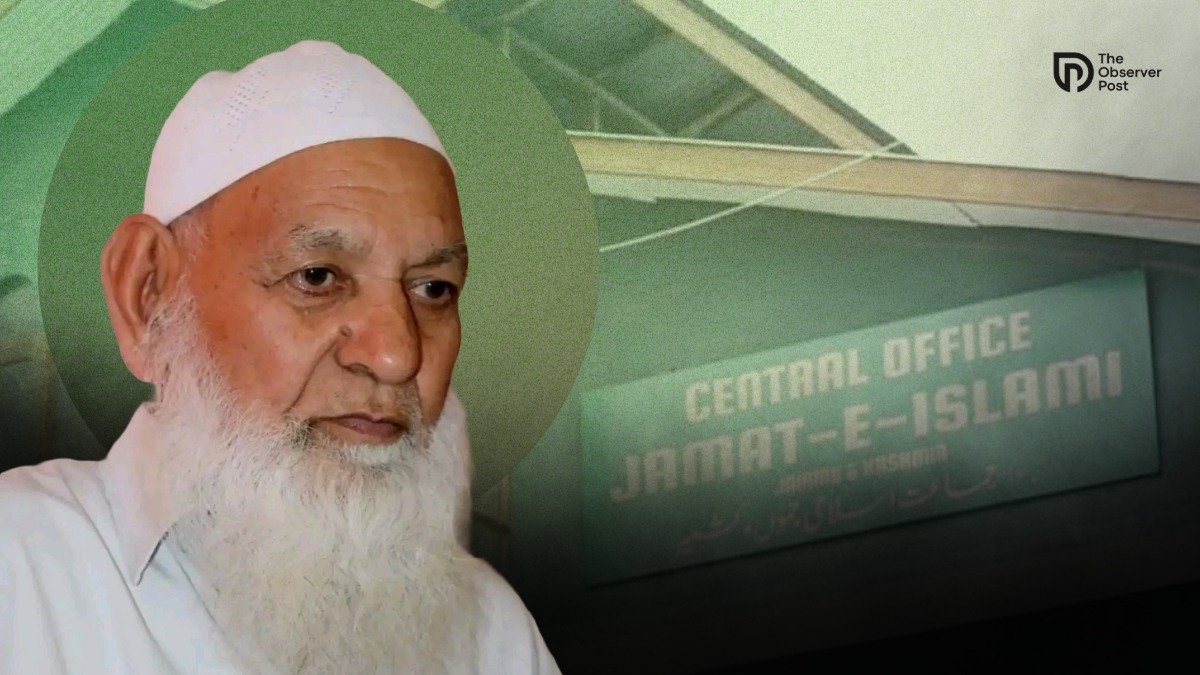
Sheikh Ghulam Hassan, a prominent Islamic scholar and former chief (Ameer) of the banned Jamaat-e-Islami Jammu and Kashmir, passed away after a prolonged illness.
According to reports, Sheikh Ghulam Hassan, also known as Sheikh Mohammad Hassan, was a resident of Tarigam village in Kulgam district and had served twice as the Ameer of Jamaat-e-Islami in Jammu and Kashmir.
His funeral prayers (Namaz-e-Janaza) will be offered at 2 pm in Tarigam village of Kulgam district on Saturday.
Condolences Pour In Across Kashmir
Several political, religious and social organisations expressed grief over his death and extended condolences to the bereaved family.
“Sorry to hear about the passing away of former Jamaat-e-Islami chief Sheikh Ghulam Hassan Sahab. May AllahTallah grant him maghfirat, elevate his درجات, and give strength and sabr to his family and loved ones to bear this immense loss,” Former Chief Minister of Jammu and Kashmir, Mehbooba Mufti said.

Many organisations and community members also remembered him as a respected religious figure whose influence extended beyond Jamaat-e-Islami circles.
A Long Association With Jamaat-e-Islami
Born on May 26, 1936, in Tarigam village of Kulgam, Sheikh Ghulam Hassan came from a financially struggling family. He reportedly lost his father at a very young age and was raised by his mother.
Despite difficult circumstances, he completed his matriculation in 1956, which was considered a major achievement at the time. He later worked as a teacher at a high school in Damhal Hanjipora while continuing his education and eventually completed his higher studies in humanities.
During the 1960s, he developed a strong interest in Islamic literature, particularly the writings of Abul A’la Maududi, founder of Jamaat-e-Islami.
According to accounts of his life, books such as Islam Ka Nazriya-e-Siyasi and Tanqeehat deeply influenced his thinking and later shaped his association with the organisation.
Served Twice as Jamaat Chief
Sheikh Ghulam Hassan served as Ameer of Jamaat-e-Islami Jammu and Kashmir twice, including from 2006 to 2012. He remained associated with the organisation for more than five decades and continued to be regarded as a respected Islamic scholar in Kashmir.