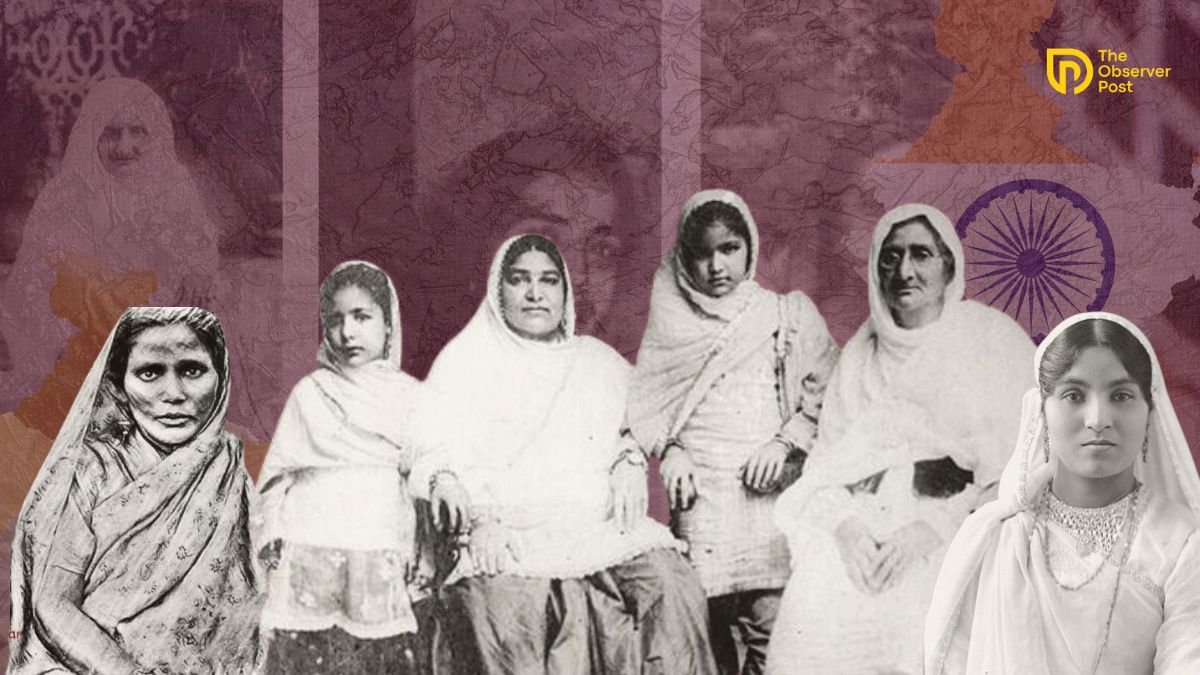
India’s freedom struggle is often remembered through the names of a handful of towering leaders. But behind the men who led protests, commanded armies and spent years in colonial prisons were women who organised communities, raised funds, addressed political gatherings, sheltered revolutionaries and, in some cases, took up arms themselves.
Muslim women were part of this history too.
Their participation stretched across nearly a century—from the uprising of 1857 to the Non-Cooperation and Khilafat movements and the final decades of the freedom struggle. Some came from royal households; others were writers, social workers, political activists, workers and ordinary women who entered the movement despite the social restrictions of their time.
Many of their stories, however, have faded from public memory.
Begum Hazrat Mahal: The queen who refused to surrender Awadh
Among the most prominent Muslim women of the 1857 uprising was Begum Hazrat Mahal, who emerged as one of the principal leaders of resistance in Awadh after the British annexed the kingdom in 1856 and exiled Nawab Wajid Ali Shah.
Rather than leaving with her husband, she remained in Lucknow with her young son, Birjis Qadr. When the uprising spread across northern India in 1857, she took charge of the resistance in Awadh and declared her son the ruler, acting as his regent.
Her role went beyond symbolic leadership. She mobilised troops, addressed the people of Awadh and worked with commanders including Maulvi Ahmadullah Shah and Mammoo Khan. For a period, rebel forces succeeded in driving the British out of significant parts of the region.
The British eventually recaptured Lucknow in 1858. Begum Hazrat Mahal refused offers of a pension and privileges in exchange for surrender and went into exile in Nepal.
She died in Kathmandu in 1879.
Her story is a reminder that the resistance of 1857 was not confined to men on battlefields. Women could also become political and military leaders when colonial rule threatened their kingdoms and communities.

Asghari Begum: A rebel leader from Thana Bhawan
In western Uttar Pradesh, Asghari Begum became associated with the armed resistance against British rule during the uprising of 1857.
Born in Thana Bhawan, she reportedly encouraged women to participate in the rebellion and trained them in the use of weapons. Historical accounts describe her as having taken an active role in the fighting in the region.
After the rebellion was suppressed, she was captured by the British.
Accounts of her death describe an exceptionally brutal punishment: she was sentenced to death and ultimately burned alive.
Whether every detail of the surviving accounts can be independently established is difficult to determine, but her story survives as part of the largely forgotten history of women who participated in the rural and local resistance of 1857.
Moondar: The Muslim woman beside Rani Lakshmibai
The story of Rani Lakshmibai of Jhansi is among the best-known accounts of women’s participation in 1857. Less remembered is that a Muslim woman, Moondar, was reportedly among those closest to her.
Moondar served as one of Lakshmibai’s companions and bodyguards. Accounts cited in historical works describe a Muslim woman riding alongside the Rani during the fighting around Gwalior.
Some British accounts even created uncertainty about the identity of the woman whose body was recovered after the battle, suggesting how closely Moondar may have remained with Lakshmibai until the end.
Her story is particularly significant because it challenges the idea that the 1857 resistance was neatly divided along religious lines.
Begum Azizan: From Kanpur to the battlefield
Another lesser-known figure of 1857 was Begum Azizan, also known as Azizan Bai.
Born in Lucknow and later associated with Kanpur, she supported Nana Sahib’s resistance against the British. Historical accounts describe her as a skilled horse rider and swordswoman who helped organise a group of women during the uprising.
The women associated with her are said to have assisted rebel forces, including by carrying messages and supplies and participating in military activities.
After the British recaptured Kanpur, Azizan was arrested. Accounts say that she refused to seek mercy or abandon her position and was subsequently executed.
Her story also illustrates the complicated social worlds from which women entered the rebellion. As a tawaif, she came from a community that occupied an important cultural position in nineteenth-century north India but was later frequently marginalised in conventional historical narratives.
Bi Amma: The mother who mobilised Muslim women
By the twentieth century, Muslim women’s participation in the freedom movement had taken a different form.
Abadi Bano Begum, popularly known as Bi Amma, became one of the most recognisable Muslim women associated with the Khilafat and broader nationalist movements.
Born in Amroha in 1852, she was widowed while raising seven children. Two of her sons, Maulana Mohammad Ali Jauhar and Maulana Shaukat Ali, went on to become prominent leaders of the Khilafat movement.
Bi Amma herself became politically active despite the social conventions of her time.
She addressed political gatherings, encouraged women to participate in the nationalist movement and helped raise funds for political causes. Her public presence was particularly significant because she represented a generation of Muslim women for whom political participation was still heavily constrained.
Mahatma Gandhi encouraged her involvement in mobilising women.
Bi Amma’s influence extended beyond her own political activity. Through her sons and her public campaigning, she became a bridge between the political movements of the time and Muslim households that had previously remained distant from organised nationalist politics.
Amjadi Begum: The organiser behind the scenes
Amjadi Begum, the wife of Maulana Mohammad Ali Jauhar and daughter-in-law of Bi Amma, continued this tradition.
She participated in the Khilafat and nationalist movements, attended political meetings and worked to mobilise women.
When her husband was imprisoned, she was involved in managing political and organisational affairs. Accounts also credit her with playing an important role in fundraising and in supporting Jamia Millia Islamia during its early years.
Her story is significant because the freedom movement depended not only on famous speeches and mass demonstrations but also on people who managed finances, communication, institutions and political networks.
Much of this work was performed away from the spotlight.
Begum Nishatunnisa Mohani: Politics And Journalism
Begum Nishatunnisa Mohani, wife of poet and revolutionary Maulana Hasrat Mohani, was another politically active Muslim woman of the period.
Hasrat Mohani is remembered for his association with the slogan Inquilab Zindabad and his uncompromising opposition to British rule. But his wife too participated in political life.
Accounts describe Nishatunnisa as attending public meetings independently, writing, participating in political campaigns and taking part in delegations.
Her public political activity was notable at a time when women appearing openly in political spaces was still unusual.
Her story also demonstrates that Muslim women’s participation in nationalism did not simply happen through their husbands. Many developed their own political voices and activities.
Saadat Bano: The woman behind the Jallianwala Bagh mobilisation
Saadat Bano, wife of prominent nationalist leader Saifuddin Kitchlew, was a writer, poet and political activist in her own right.
Kitchlew became one of the prominent figures whose arrest helped trigger the gathering at Jallianwala Bagh on April 13, 1919.
But Saadat Bano’s own political activity is often less remembered.
She addressed public meetings, wrote about women’s rights, education and nationalism, attended Congress sessions and participated in women’s organisations.

Her story complicates the familiar narrative of women as merely the wives or relatives of male political leaders. Saadat Bano was already active in public life and used writing and public speaking as tools of political mobilisation.
Bibi Amtus Salam: Fighting communal violence
Not all contributions to India’s freedom movement involved confronting the British directly.
Bibi Amtus Salam, a close associate and disciple of Mahatma Gandhi, became particularly prominent during the communal violence surrounding Partition.
She worked in riot-affected areas and participated in efforts to protect vulnerable people and rehabilitate refugees.
Her willingness to enter areas affected by communal violence reflected another form of political courage: trying to preserve the idea of a shared India at a moment when the country was being torn apart by violence and displacement.
Her work reminds us that the freedom struggle did not end neatly on August 15, 1947. For many activists, independence immediately brought another challenge—building a society capable of surviving Partition.
Begum Anis Kidwai: From personal loss to public service
Begum Anis Kidwai experienced Partition’s violence personally when her husband, Shafi Ahmed Kidwai, was killed amid communal violence.
Instead of withdrawing from public life, she joined relief and rehabilitation efforts.
Working alongside figures such as Mahatma Gandhi, Subhadra Joshi and Mridula Sarabhai, she helped establish rescue and relief efforts for women affected by Partition.
She later entered Parliament, serving in the Rajya Sabha, and documented her experiences in Azadi Ki Chhaon Mein.
Her life illustrates the transition from freedom fighter to nation-builder: women who had fought against colonialism subsequently became involved in rebuilding a country scarred by Partition.
The women whose names disappeared
Beyond these better-known figures were women whose stories are even harder to recover.
Habiba, a Muslim Gujjar woman from Muzaffarnagar, is described in historical accounts as having fought the British during the 1857 uprising before being captured and executed.
Nazneen, associated with the rebellion in Delhi, is remembered in accounts of women who took part in armed resistance.
Rahimi and Alia Begum are similarly described as organising women and participating in fighting in western Uttar Pradesh.
There were also women whose names have disappeared altogether. One account describes an unidentified elderly woman dressed in green who reportedly appeared on horseback during the 1857 rebellion, attacked British forces and disappeared before eventually being captured.
The difficulty with many of these stories is that the historical record is fragmented. Colonial records often documented rebels primarily as threats to British authority, while later mainstream histories frequently concentrated on major male leaders and a small number of celebrated women.
As a result, some women’s stories survive only through local histories, memoirs, oral traditions or scattered references in historical works.
From armed resistance to political mobilisation
The stories of these women span very different periods and forms of resistance.
Some fought with weapons. Others organised political campaigns, raised money, wrote articles, addressed public gatherings, supported educational institutions or worked among communities affected by violence.

What connects them is not a single ideology or method, but their willingness to enter public life at a time when women—particularly women from conservative or patriarchal social settings—faced significant barriers to doing so.
Their participation also challenges a simplified understanding of India’s freedom struggle.
The movement was not fought only in Delhi, Lucknow, Kanpur or the major political centres. It unfolded in villages, princely states, homes, schools, newspapers, political meetings and local communities.
And women were present in many of those spaces.
Why remembering them matters
The history of India’s independence is not incomplete because it lacks famous names. It is incomplete because countless less-famous people remain absent from the popular narrative.
Muslim women were among them.
From Begum Hazrat Mahal’s resistance in Awadh to Bi Amma’s mobilisation of women, from Asghari Begum’s reported armed resistance to Anis Kidwai’s work during Partition, their lives reveal the many ways women participated in India’s journey towards independence.
Remembering them is not about assigning the freedom struggle to one community or another. It is about recognising that India’s independence was built through the contributions of people from different regions, religions, classes and social backgrounds.
The tricolour that India raises every August 15 carries a history far larger than the names printed in textbooks. Among those names that deserve to be brought back into public memory are the Muslim women who fought, organised, sacrificed and, in many cases, disappeared into the archives after independence.